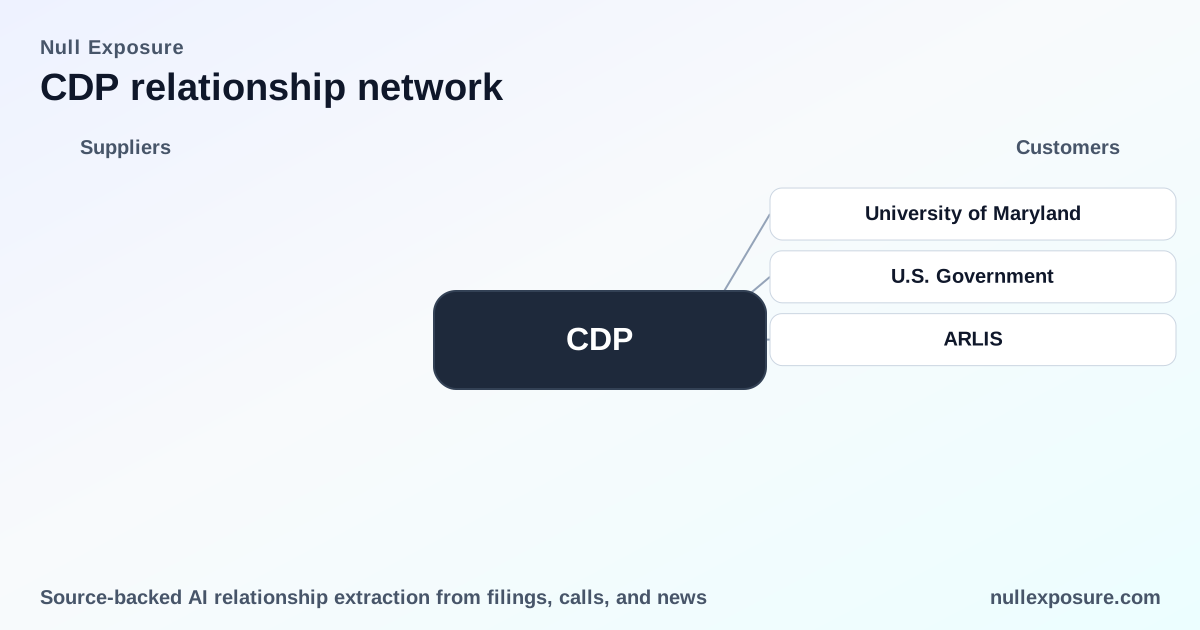
COPT Defense Properties (CDP): Customer Relationships That Underpin Defense-Adjacent Cash Flow
COPT Defense Properties operates a focused REIT model that acquires, develops and manages office and data-center shell properties strategically proximate to U.S. defense installations, and monetizes through long-term, triple-net leases and build-to-suit development contracts with the U.S. Government and its contractors. The company augments leasing revenue with in-house development and property services that convert pipeline commitments into predictable, contract-backed cash flow—an investment profile driven by concentration in government counterparties and long lease duration. For an analytical feed on customer exposure and relationship signals, visit the NullExposure homepage: https://nullexposure.com/.
Why the customer list matters for valuation and portfolio risk
COPT Defense Properties is not a broadly diversified office landlord; it is a specialist landlord whose cash flows are structurally tied to a small set of mission-critical tenants. That specialization creates both upside—durable, creditworthy cash flow with contractual protections—and downside—meaningful concentration and geopolitical/regulatory dependence.
- Contracting posture: CDP operates on long-term lease economics, typically negotiating multi-decade, triple-net leases with rent escalators and extension options, which transforms near-term development investment into long-duration recurring revenue and supports valuation multiples grounded in predictable cash yields.
- Counterparty concentration and criticality: The company’s customer base is overwhelmingly government and defense-related, with the U.S. Government identified as the single largest tenant and a material source of ARR; this concentration drives low tenant churn but raises renewal and funding-cycle risk.
- Geographic and operational scope: Properties cluster in North America—principally the Mid-Atlantic and Greater Washington, D.C./Baltimore corridor—so CDP’s market is localized and tied to U.S. defense posture.
- Business-model mix: CDP is both a seller of real estate (landlord) and a service provider (developer and property manager), converting build-to-suit commitments into leased assets and adding fee revenue streams alongside base lease income.
- Maturity and scale: The portfolio is large and active—hundreds of operating properties and millions of square feet—indicating institutional scale but also operational complexity as development pipelines are executed.
These are company-level signals drawn from regulatory and corporate disclosures; the filings themselves explicitly call out the U.S. Government as the largest tenant and quantify concentration metrics that investors must weigh when modelling downside stress.
Detailed mentions from the record: how each customer relationship was reported
Below I cover every customer-related mention in the provided results, one by one, with plain-English summaries and source cues.
University of Maryland — Q4 2025 earnings call commitment
CDP disclosed a $66 million commitment to a fully pre-leased development with ARLIS (University of Maryland’s Applied Research Laboratory for Intelligence and Security) as part of expanding ARLIS’s footprint in the park. This was stated on CDP’s Q4 2025 earnings call (transcript dated March 8, 2026). (CDP Q4 2025 earnings call, Mar 8, 2026)
ARLIS noted in a Globe and Mail press release (FY2026)
A Globe and Mail press release repeating CDP’s commentary reiterated the $66 million, fully pre-leased ARLIS build-to-suit commitment, underscoring that the ARLIS project is secured prior to construction commencement. (Globe and Mail press release, FY2026)
ARLIS duplicate press notice (same Globe account)
A second Globe and Mail capture of the company’s release again recorded the ARLIS pre-leased commitment, which corroborates company messaging across distribution channels and investor wires. (Globe and Mail press release, FY2026)
U.S. Government — concentration highlighted in a 10‑K summary
A media summary of CDP’s SEC 10‑K flagged significant tenant concentration with the U.S. Government, calling out the risk if large government tenants do not renew or if appropriation cycles change; CDP’s disclosures quantify the USG as the largest tenant by revenue. (TradingView summary of CDP 10‑K content, Mar 2026)
ARLIS and San Antonio projects — $155 million in combined commitments
In a separate corporate release, CDP disclosed it committed roughly $155 million across two fully pre‑leased build‑to‑suit projects: the ARLIS project ($66 million, 110,000 sq ft) and a San Antonio project ($88 million, 132,000 sq ft), demonstrating simultaneous deployment of capital into contracted development. (Globe and Mail press release summarizing CDP’s FY2026 commentary, Mar 2026)
University of Maryland referenced in equity research note
An equity note referenced the ARLIS expansion and other development commitments and tied those project wins to recent share-price momentum and multi-year shareholder returns, framing the development activity as value-accretive in market perception. (SimplyWall.St coverage of CDP developments and share returns, Mar 2026)
What these relationships imply for investors
- Predictable, long-dated cash flows: Pre-leased, build-to-suit deals with ARLIS and similar government-affiliated tenants convert development capital into long-term lease revenue and reduce absorption risk. That supports CDP’s valuation premium vs. generic office.
- Concentration risk is real and measurable: The filings show the USG accounted for a very large share of revenue and ARR; this is a material single-counterparty exposure that must be stress-tested in valuation scenarios where government occupancy or contracting budgets shift.
- Operational complexity but vertically integrated control: CDP’s ownership of development and property-management capabilities reduces third-party execution risk and captures construction-to-lease margins, but it also concentrates operational responsibilities internally.
- Regional and mission-driven dependency: The concentration in the Mid‑Atlantic and on defense missions tightens the company’s correlation to federal defense spending cycles and local market dynamics.
Bottom line for portfolio allocation
COPT Defense Properties is a specialist, government‑aligned REIT whose growth is driven by pre-leased, build‑to‑suit development with defense and university research lab tenants and whose income stream is anchored by long-term, triple-net leases. For yield-oriented investors, that structural durability is attractive; for risk managers, the USG concentration and geographic clustering require scenario work on renewal, budget and defense policy shocks. For a focused read on customer signals and to monitor relationship changes over time, see NullExposure’s coverage: https://nullexposure.com/.
If you want an investor-ready digest of changes to CDP’s tenant exposure and development commitments, I can prepare a short model-ready summary that translates these relationship signals into cash-flow and scenario sensitivities.