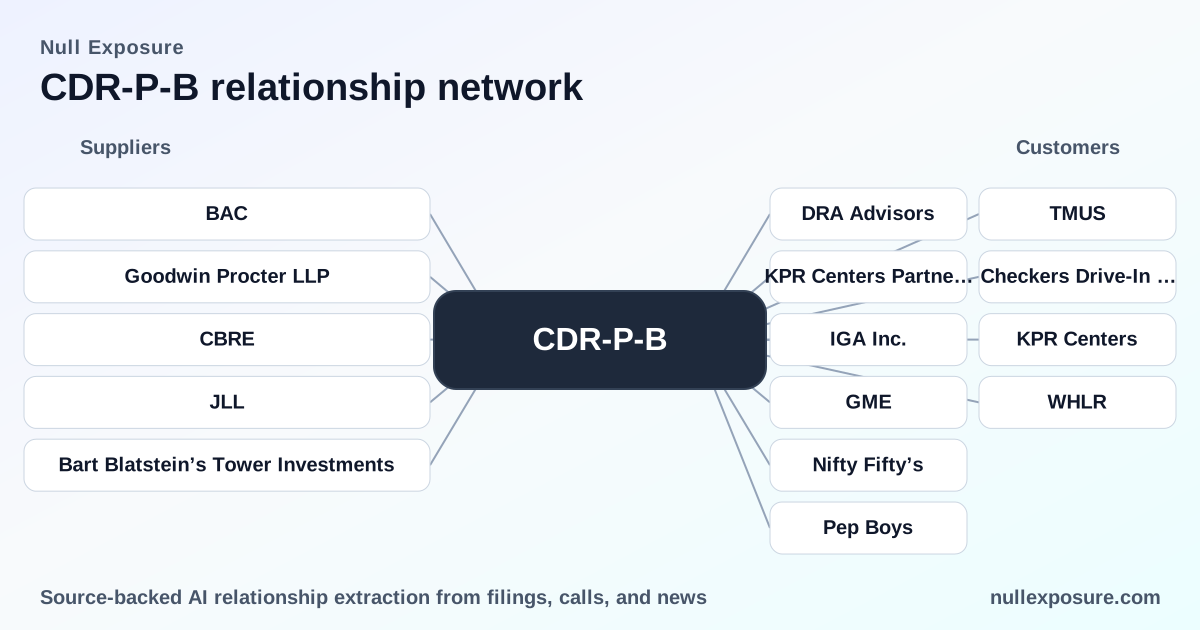
Cedar Realty Trust (CDR-P-B): counterparty map and investment implications
Cedar Realty Trust monetizes a portfolio of grocery-anchored retail properties through long-term net leases and active portfolio management, generating predictable cash flow that supports a 7.25% cumulative preferred dividend while retaining a redeemable feature that gives the issuer financing flexibility. For investors in CDR-P-B, the return profile is income-first: preferred dividends are funded by rents from supermarket-anchored centers, and portfolio transactions and strategic dispositions drive capital redeployment and balance-sheet treatment. Visit https://nullexposure.com/ for more structured counterparty intelligence on REIT exposure.
How Cedar operates in plain terms
Cedar operates as a retail-focused REIT concentrated on grocery-anchored shopping centers, leasing space to a mix of national and regional anchors and neighborhood retailers. The company’s economic model is anchored in stable, anchor-backed rents and leasing activity that drives occupancy and tenant mix, with asset sales and joint-venture dispositions used to realize value and adjust portfolio concentration. The preferred stock is supported by that same cash flow profile and benefits from the firm’s practice of actively transacting assets to manage capital structure and liquidity.
Operating constraints and business-model signals investors should note
- Contracting posture: Cedar uses long-term leases anchored by supermarkets and national service retailers, which creates a landlord posture that emphasizes lease enforcement and tenant credit quality over short-term turnover.
- Concentration risk: The firm’s focus on grocery-anchored centers concentrates cash flows around supermarket tenancy and related convenience and service retailers, increasing sensitivity to grocery sector health and store-level performance.
- Criticality of anchors: Anchor tenants drive foot traffic and subtenant economics; the stability of the preferred dividend is therefore materially linked to anchor retention and lease roll performance.
- Strategic maturity and liquidity management: Public reporting and market activity show a pattern of large portfolio dispositions and re‑positioning, signaling a management approach that uses transactions to manage leverage and timing, which affects preferred-holder recovery dynamics in stressed scenarios.
- Counterparty mix and operations: The tenant base includes national carriers, auto service, discount restaurants, and specialty retail — a mix that balances stable staples with discretionary-facing names and local lessees.
Counterparty map — every relationship in the public signal set
Below I list every relationship recorded in the collected results with a concise, plain-English summary and the source cited.
- DRA Advisors — In a JLL newsroom piece (FY2024), DRA is identified as a buyer alongside KPR for a Philadelphia power center that had been part of a 33-center grocery-anchored portfolio originally sold by Cedar. Source: JLL newsroom article on the Philadelphia power center financing (first seen 2026).
- KPR Centers Partnership — JLL’s financing coverage (FY2024) indicates KPR participated with DRA in acquiring the Philadelphia power center, a property transaction that traces back to a multi-asset portfolio originally held by Cedar. Source: JLL newsroom article on the Philadelphia power center financing (first seen 2026).
- IGA Inc. — Local coverage of Port Richmond Village (FY2019) lists an IGA-affiliated supermarket as a primary tenant, underlining the role of regional grocery operators in Cedar’s portfolio. Source: The Philadelphia Inquirer coverage of Fishtown Crossing / Port Richmond Village (2019).
- GameStop (GME) — A 2019 profile of a Cedar-owned center noted GameStop relocating within the property to accommodate redevelopment, demonstrating Cedar’s active onsite redevelopment and tenant relocation to enhance asset economics. Source: The Philadelphia Inquirer (2019).
- Nifty Fifty’s — Reporting on planned construction at a Cedar center (FY2019) included Nifty Fifty’s as a committed tenant for a new retail structure, illustrating local restaurant tenancy in mixed-use center plans. Source: The Philadelphia Inquirer (2019).
- Pep Boys — The Inquirer’s 2019 article records Pep Boys as a main tenant at Port Richmond Village, reflecting presence of auto service anchors in Cedar’s tenant mix. Source: The Philadelphia Inquirer (2019).
- T-Mobile USA Inc. (TMUS) — Local reporting (FY2019) describes T-Mobile branches relocating within a Cedar property as part of redevelopment staging, highlighting national wireless carriers as flexible, small-footprint tenants. Source: The Philadelphia Inquirer (2019).
- TMUS (duplicate mention) — The same 2019 Inquirer piece reiterates T-Mobile’s space adjustments inside the center to facilitate construction of a new retail structure, reinforcing the carrier’s role in in-line tenant reshuffles. Source: The Philadelphia Inquirer (2019).
- Checkers Drive-In Restaurants Inc. — A 2013 community report cites a Cedar leasing brochure listing Checkers for a site in a redevelopment plan, an example of quick-service restaurant interest in Cedar’s urban locations. Source: Hidden City Philadelphia (2013).
- DRA Advisors (transaction reporting) — Industry press (FY2022) records a joint-venture purchase by DRA Advisors of a 33-center grocery-anchored portfolio from Cedar for approximately $840 million, indicating a significant portfolio-level disposition. Source: TheRealDeal report on Cedar’s portfolio sale (2022).
- KPR Centers — TheRealDeal’s 2022 coverage names KPR as the joint-venture partner with DRA in the $840 million acquisition of Cedar’s grocery-anchored centers, reflecting a buyer consortium strategy for large REIT portfolio blocks. Source: TheRealDeal report on Cedar’s portfolio sale (2022).
- Wheeler Real Estate Investment Trust (WHLR) — Industry press (FY2022) reports Wheeler agreeing to an all-cash merger for Cedar’s remaining shopping-center assets, a transaction that valued those properties at roughly $291.3 million and completed a near-total portfolio exit. Source: TheRealDeal coverage of Cedar’s sale/merger of assets (2022).
- WHLR (duplicate mention) — The same transaction coverage repeated Wheeler’s acquisition valuation for Cedar’s remaining assets, reinforcing the completion of Cedar’s disposition strategy in that period. Source: TheRealDeal (2022).
What the counterparty map tells investors
- Disposition-driven liquidity: Multiple entries document large portfolio sales and JV buyers, which indicates Cedar uses asset disposals to manage capital structure and liquidity — a structural element that supports preferred dividends but also changes cash-flow permanence.
- Anchor-dependent cashflow: The tenant mix (supermarkets, national carriers, auto service, quick-service restaurants) underlines that anchor supermarket leases are the core credit support for CDR-P-B distributions.
- Operational playbook: Repositioning, tenant relocations, and redevelopment activity are recurring themes; management’s active asset management approach can enhance occupancy and lease rolls but introduces execution risk during redevelopment cycles.
- Buyer diversity reduces single-buyer concentration risk: The presence of multiple strategic buyers and JV partners in documented transactions points to market demand for grocery-anchored product, which supports exit optionality for Cedar’s assets.
Risks and monitoring checklist for income investors
- Monitor anchor lease roll dates and supermarket credit trends; anchor vacancy or major downsizes are the single largest operational risk to dividend coverage.
- Watch redeployment cadence following large dispositions; abrupt timing of asset sales can signal either opportunistic value capture or forced liquidity events that affect long-term rent roll stability.
- Track tenant mix changes toward discretionary retail—a drift away from grocery-anchored weighting increases cyclicality.
- Review counterparty concentration in transaction buyers and the credit quality of remaining tenants after disposals.
Bottom line and next steps
Cedar’s preferred (CDR-P-B) is a pure income instrument backed by grocery-anchored retail cash flow and supported by an issuer that actively manages assets through dispositions and restructurings. The principal investment thesis is income stability driven by supermarket anchors; the principal risk is anchor concentration and execution risk on redevelopment or large-scale dispositions. For more context and a detailed counterparty intelligence brief on retail REIT counterparties, see https://nullexposure.com/.
For deal-level summaries or a tailored counterparty report for institutional review, contact the team via https://nullexposure.com/ — we provide structured relationship mapping and source-backed exposure analysis.