Cedar Realty Trust (CDR-P-C): How recent dispositions reframe customer exposure and capital strategy
Cedar Realty Trust operates and monetizes as a grocery-anchored retail REIT that acquires, manages and selectively redevelops shopping centers across the eastern United States, generating cash through long-term tenant rents and periodic asset sales and redeployments. The company’s 6.50% Series C cumulative redeemable preferred shares are positioned for reliable income backed by this asset-centric cash flow model and an active capital recycling strategy that converts mature properties into liquidity while preserving core grocery-anchored exposure. For a road-tested view of counterparty linkages and transaction counterparts, see the NullExposure platform: https://nullexposure.com/.
How a single portfolio sale changes the customer map
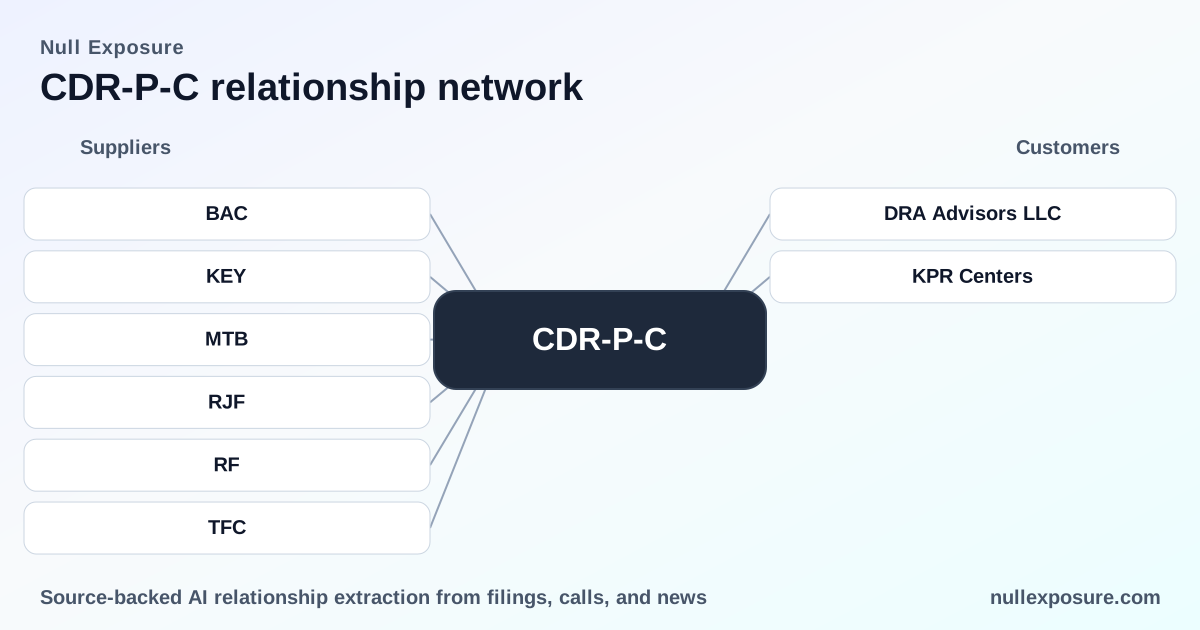
In FY2025 Cedar executed a material portfolio disposition that reconfigures its tenant counterparty exposure. The company sold a package of 33 grocery-anchored shopping centers and certain redevelopment properties to a joint venture involving a fund managed by DRA Advisors LLC and KPR Centers, a transaction disclosed in Cedar’s public filings and summarized in market reporting (filed FY2025; reported 9 March 2026). That deal transfers a large, geographically concentrated block of tenants to institutional operators, converting operating cash flows into liquidity and removing those specific tenant relationships from Cedar’s landlord ledger.
This kind of transaction demonstrates two strategic themes: active portfolio rotation to crystallize value and partnering with institutional capital to transfer redevelopment risk. For investors, the consequence is a lower immediate exposure to the specific tenant roster in the sold assets and a higher reliance on portfolio-level asset-management and redevelopment capacity going forward.
The counterparties named in the record
DRA Advisors LLC
DRA Advisors LLC is reported as a fund manager responsible for the institutional fund that participated in the joint venture acquiring Cedar’s 33 grocery-anchored centers and redevelopment properties (disclosed in Cedar’s FY2025 filings and summarized in market filings on 9 March 2026). The relationship is transactional and capital-driven: DRA’s fund is the buyer-side institutional capital vehicle that absorbs those tenant leases under the JV structure (source: Cedar Realty FY2025 SEC filings summarized on StockTitan, reported 03/09/2026).
KPR Centers
KPR Centers is identified as the co-venture partner alongside the DRA-managed fund in the acquisition of the 33 shopping centers and redevelopment properties, positioning KPR as the operating partner on properties transitioned out of Cedar’s balance sheet (disclosed in the same FY2025 filing materials summarized on 9 March 2026). The relationship is an asset-sale and operator handoff where KPR assumes day-to-day property operations under the JV arrangement (source: Cedar Realty FY2025 SEC filings summarized on StockTitan, reported 03/09/2026).
What the transaction-level disclosures signal about Cedar’s operating model
Cedar’s recent disclosures provide company-level signals about how the business contracts, concentrates risk, and matures assets:
-
Contracting posture — transactional and portfolio-focused. Cedar executes large, discrete asset sales to institutional buyers, illustrating a willingness to convert property-level cash flow into balance-sheet flexibility rather than holding all assets to term. This is consistent with a REIT that balances recurring rent collection with periodic monetization events.
-
Concentration management — sectoral but geographically selective. The portfolio remains concentrated in grocery-anchored retail, a segment that provides essential-retail resiliency, even as specific geographic clusters are rotated out through sales. This preserves sector specialization while reducing cluster concentration risk through selective dispositions.
-
Criticality of counterparties — institutional acquirers reduce single-tenant dependence. By selling a large portfolio to institutional JV partners, Cedar transfers operational and redevelopment execution risk to counterparties with scale, reducing Cedar’s single-tenant operational burdens tied to those assets.
-
Maturity and capital-cycle behavior — active capital recycling. The sale reflects a mature capital-management posture: realize value on stabilized or redevelopment-stage assets and redeploy proceeds into new opportunities or balance-sheet repair, as required.
These signals are company-level characteristics observed from the filing narrative and are not attributed to any single counterparty unless explicitly named in the disclosure.
Operational and portfolio consequences investors should track
-
Tenant roll-forward and lease expirations. After the sale, investors must monitor which tenant cash flows remain on Cedar’s books and which moved to the JV; the composition affects near-term distributable income for preferred shareholders.
-
Redevelopment exposure. Properties sold with redevelopment potential now carry performance risk under the JV operators; Cedar’s residual value exposure (if any) will depend on the explicit terms disclosed in the filings.
-
Liquidity and leverage dynamics. Asset sales of this scale materially change liquidity profiles and debt covenants; review subsequent filings for debt paydowns, covenant adjustments, or capital redeployments.
Risk and return implications for preferred-stock investors
Preferred holders of CDR-P-C invest for a stable income stream supported by Cedar’s rental base and capital strategy. The company’s execution of large portfolio transactions reduces direct operating exposure to sold assets while increasing the importance of continued asset management and non-disposed portfolio performance. This raises two central points for investors:
-
Income resiliency is tied to portfolio quality and capital allocation discipline. If proceeds from sales are used to strengthen the balance sheet or reinvest in higher-return grocery-anchored assets, the preferred dividend profile strengthens.
-
Counterparty execution and JV terms create second-order risk. Institutional buyers like DRA and operating partners like KPR Centers are credit-relevant: their operational success indirectly influences market perceptions of Cedar’s capital strategy and overall valuation.
Bottom line: repositioned exposure, preserved income focus
Cedar Realty’s FY2025 disclosures show a deliberate repositioning: convert a concentrated block of grocery-anchored assets into institutional JV ownership with DRA Advisors LLC and KPR Centers, crystallizing value and shifting redevelopment execution away from Cedar (as reported in the FY2025 SEC filings summarized 9 March 2026). For preferred-stock investors, the trade-off is clearer balance-sheet flexibility and lower direct exposure to the sold tenant roster against an increased reliance on future capital allocation outcomes.
For analysts building counterparty maps or stress-testing Cedar’s preferred equity, the immediate next steps are to review the full sale and merger documents in the company filings, monitor pro forma liquidity and leverage disclosures, and track lease-level roll-forwards for remaining grocery-anchored assets. If you want a structured view of counterparties and disposition partners, NullExposure provides that coverage: https://nullexposure.com/.
Key takeaway: Cedar is executing active capital recycling with institutional partners, preserving its grocery-anchored strategy while outsourcing redevelopment and operational intensity to JV partners — a strategic posture that reshapes customer exposure but keeps the preferred dividend story intact.