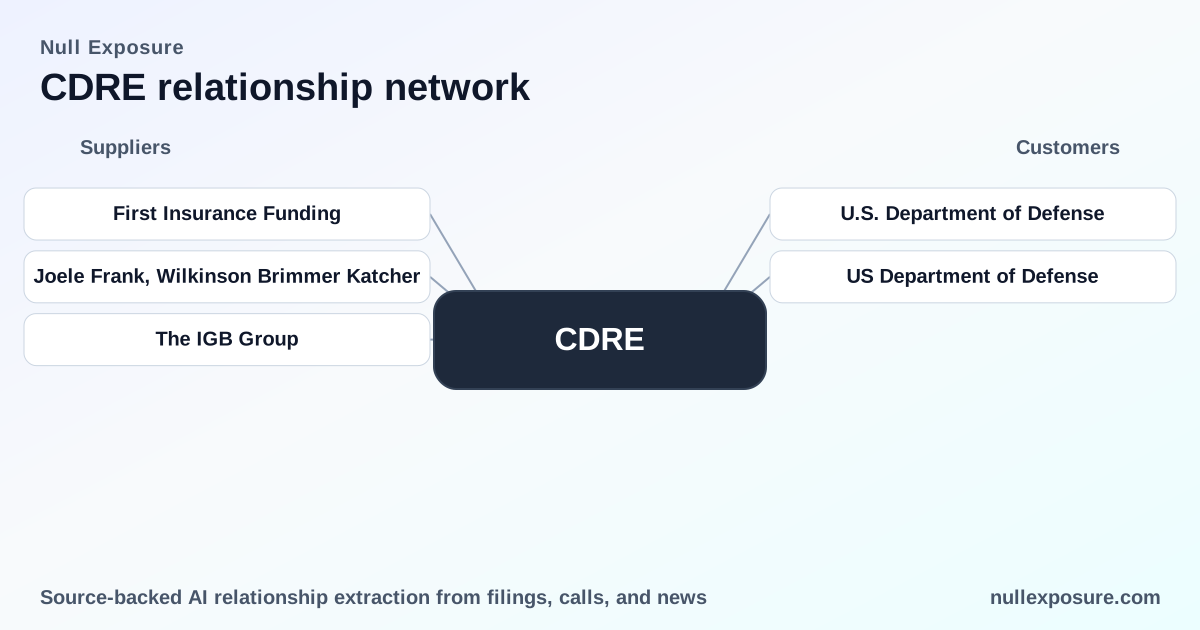
Cadre Holdings (CDRE): Defense contracts turn product breadth into recurring revenue
Cadre Holdings operates and monetizes through a dual model: manufacturing mission-critical safety and survivability products (bomb suits, blast attenuation seats, nuclear safety gear) and owned distribution that supplies first responders and defense customers. Revenue is driven by a mix of multi-year government contracts and recurring aftermarket sales, plus distribution margins on third-party gear. For investors, Cadre’s thesis is straightforward: scale specialized manufacturing into durable government relationships and amplify margins through distribution reach. Learn more at https://nullexposure.com/.
How Cadre’s customer model converts defense work into cash flow
Cadre’s operating model is built around long-term, performance-obligated contracts and an owned distribution channel that smooths cyclicality. Company disclosures describe recognizing revenue on long-term contracts using an input method tied to costs incurred, signaling contracting posture focused on multi-year commitments rather than one-off spot sales. The business mixes roles — manufacturer, distributor, reseller and seller — which gives Cadre control of product pricing and aftermarket channels while also enabling cross-selling into a customer base of law enforcement, federal agencies and international defense primes.
The customer composition is government-heavy: Cadre sells to U.S. federal agencies and a broad set of state, local and international customers, with reported federal and international revenue lines cited in filings. That profile increases revenue visibility but concentrates policy and procurement risk with public budgets and prime contractors. Geographic and operational diversification is material: Cadre runs 20 manufacturing sites across North America and Europe and reports sales into more than 100 countries, creating regional resilience but also operational complexity across EMEA and NA. The firm also reports relationships with over 23,000 first responders and many government accounts over 15 years, underscoring relationship maturity and high switching costs.
Key operating constraints and business-model signals:
- Contracting posture: Predominantly long-term contracts with revenue recognized over time based on cost input — favorable for revenue visibility and backlog conversion.
- Counterparty mix: Material exposure to government customers, which drives higher contract lifecycle and procurement compliance.
- Geographic footprint: Global manufacturing and sales with explicit EMEA and North American operations, reducing single-market dependency.
- Role and margin control: Integrated manufacturer + distributor footprint gives Cadre product margin capture and distribution margin capture.
- Relationship maturity: Many top customer relationships exceed 15 years, indicating high retention and aftermarket revenue potential.
If you want a concise map of Cadre’s customer wins and partners, see the breakdown below.
Customer wins and partners you need to price into your model
U.S. Department of Defense — BEMO (FY2025)
Cadre’s Med-Eng unit was awarded the BEMO (Blast Exposure Monitoring System) contract; the announcement was discussed on the company’s Q3 2025 earnings call. According to an InsiderMonkey earnings call transcript (published March 2026), this award underscores Cadre’s role supplying specialized EOD equipment to the DoD.
US Department of Defense — five-year $50 million contract (FY2025)
Med-Eng LLC secured a five-year contract valued at $50 million from the U.S. Department of Defense, announced November 19 and reported by market coverage later; this is a sizeable multi-year award that increases booked defense revenue. InsiderMonkey covered the November 19 announcement in its March 2026 write-up.
General Dynamics European Land Systems (GDELS) — $86 million contract suite (FY2026)
Med-Eng won contracts totaling $86 million from General Dynamics European Land Systems to provide blast attenuation seats for vehicle occupant protection, as announced in Cadre’s Q4 2025 disclosures. The Q4 2025 earnings call (InsiderMonkey, May 2026) and market wires including Finviz (May 2, 2026) reported the awards, which are meaningful given the size and defense-program integration.
General Dynamics — multi-year vehicle protection systems (FY2026)
Cadre’s Med-Eng secured two multi-year contracts to supply vehicle protection systems for General Dynamics programs, reflecting continued partnership across General Dynamics’ regional units. Sahm Capital reported the multi-year agreements on March 12, 2026, with follow-up coverage in SimplyWall (May 2026), highlighting sustained prime-contractor demand.
General Dynamics — broad, repeat customer relationship (FY2026)
Management stated that General Dynamics (including its USA, Canada and Europe businesses) is a long-standing customer across product lines, indicating deep programmatic integration. The company referenced this in its Q4 2025 earnings call transcript (InsiderMonkey, May 2026), confirming strategic customer stickiness across jurisdictions.
General Dynamics European Land Systems — press and market coverage (FY2026)
Multiple market reports reiterated the GDELS contract awards to Cadre’s subsidiary, reinforcing public visibility of the deal flow and the potential backlog contribution. Finviz and other market outlets ran stories on May 2, 2026, amplifying investor awareness of the $86 million awards.
General Dynamics — additional mentions across coverage (FY2026)
Earnings commentary and analyst write-ups reiterated Cadre’s operational relationship with General Dynamics as a cross-border partner, strengthening the narrative of Cadre as a preferred supplier for vehicle protection and survivability systems. InsiderMonkey documented this point in its Q4 2025 transcript coverage (May 2026).
Investment implications: what these relationships mean for risk and upside
- Revenue visibility and backlog growth: The mix of long-term DoD and prime-contractor contracts (e.g., General Dynamics and GDELS) adds multi-year revenue visibility and supports a higher revenue multiple than single-year distributors.
- Margin leverage from integrated model: Being both manufacturer and distributor lets Cadre capture upstream product margins and downstream distribution margins, improving EBITDA conversion when scale is realized. Cadre’s FY metrics (operating margin ~13.4%, profit margin ~7.2% on reported TTM) reflect current leverage; major defense contracts should improve gross-to-operating translation as scope and mix shift toward higher-margin product programs.
- Concentration risk: Government and prime-contractor concentration creates procurement and timing risk; procurement cycle changes or defense budget shifts can materially affect near-term revenue. Counterparty dependency is an explicit risk factor but is balanced by long-term contract structures and international diversification.
- Operational complexity and execution risk: A global footprint across 20 plants creates resilience but requires disciplined supply-chain and program management to deliver on long-duration defense programs. Execution on GDELS and DoD contracts will act as a near-term proof point for scaling margins.
- Durability: With many customer relationships exceeding 15 years and recurring aftermarket demand, Cadre’s customer base is sticky and mission-critical, which supports higher lifetime value per customer.
Bottom line
Cadre converts specialized manufacturing into durable defense revenue by pairing long-term government contracts with an owned distribution channel that multiplies lifetime value. The recent DoD and General Dynamics wins materially increase booked revenue and backlog, while the company’s multi-role model (manufacturer + distributor) supports margin expansion as programs scale. For deeper research on how these wins affect Cadre’s backlog and valuation, visit https://nullexposure.com/.
Bold takeaways for investors: Cadre’s wins with the DoD and General Dynamics materially increase multi-year visibility; government concentration raises policy risk but also locks in high-margin, mission-critical revenue; execution on these contracts will determine near-term margin upside.