Conduit Pharmaceuticals (CDT): AstraZeneca License Signals an Early Commercial Pathway
Conduit Pharmaceuticals is a clinical‑stage biotech that develops enhanced drug delivery formulations and monetizes primarily through licensing and strategic partnerships, with downstream upside tied to clinical milestones and eventual product royalties or direct commercialization. The company is pre‑revenue, with a small market capitalization and concentrated insider ownership; the AstraZeneca license disclosed in March 2026 represents the clearest customer/partner signal to date and a potential inflection point for value realization. For a concise view of Conduit’s relationship intelligence and commercial posture, visit https://nullexposure.com/.
How Conduit operates and how it gets paid
Conduit positions itself as a platform company that improves efficacy and safety for oncology and rare‑disease therapies by out‑licensing optimized formulations or entering co‑development agreements with larger pharma partners. Given its clinical‑stage status and zero reported revenue through the latest quarter (2026‑03‑31), the operating model is service‑and‑partner‑centric: Conduit converts preclinical/early clinical proof points into licensing fees, milestone payments, and contingent royalties when partners take programs into late‑stage development or to market.
Company financials reinforce that model: as of the latest quarter Conduit shows a $10.2 million market capitalization, no revenue, and negative EBITDA of $24.7 million, indicating reliance on financing and partner funding to reach clinical inflection points. Insider ownership is highly concentrated at 77.9%, while institutional ownership is effectively nil, which influences governance dynamics and capital strategy.
Operating constraints and business‑model signals investors should read together
These characteristics are company‑level signals rather than relationship‑specific constraints:
- Contracting posture: Pre‑revenue and early‑stage biotechs commonly use non‑exclusive or exclusive licenses with milestone structures; Conduit’s announced license to a major pharma fits that template and implies the company will monetize primarily through upfront and milestone payments rather than product sales in the near term.
- Concentration and counterparty dependence: A small number of partner relationships drive value creation; the AstraZeneca agreement therefore has outsized portfolio impact and increases single‑counterparty concentration risk.
- Criticality of partnerships: For Conduit, partner validation is essential to de‑risk programs and attract capital. Successful clinical starts by partners materially reduce development and financing risk for Conduit.
- Maturity and runway sensitivity: Clinical‑stage, pre‑revenue status means value is milestone‑driven and susceptible to dilution if capital markets remain constrained.
Why the AstraZeneca license matters
The March 2026 license with AstraZeneca is the first explicit partner disclosure linking Conduit’s platform to a large global pharmaceutical company. For an investor, partnering with a major commercial or development-stage company provides independent validation, potential milestone cash flows, and a clearer path to clinical execution that Conduit cannot deliver alone.
Beyond validation, the practical implications are: AstraZeneca’s involvement could accelerate clinical timelines for the licensed program, reduce Conduit’s near‑term cash burn tied to development, and create milestone/royalty economics that transform the company from a pure R&D cost center into a monetizable pipeline vehicle.
Relationship log — every recorded partner mention
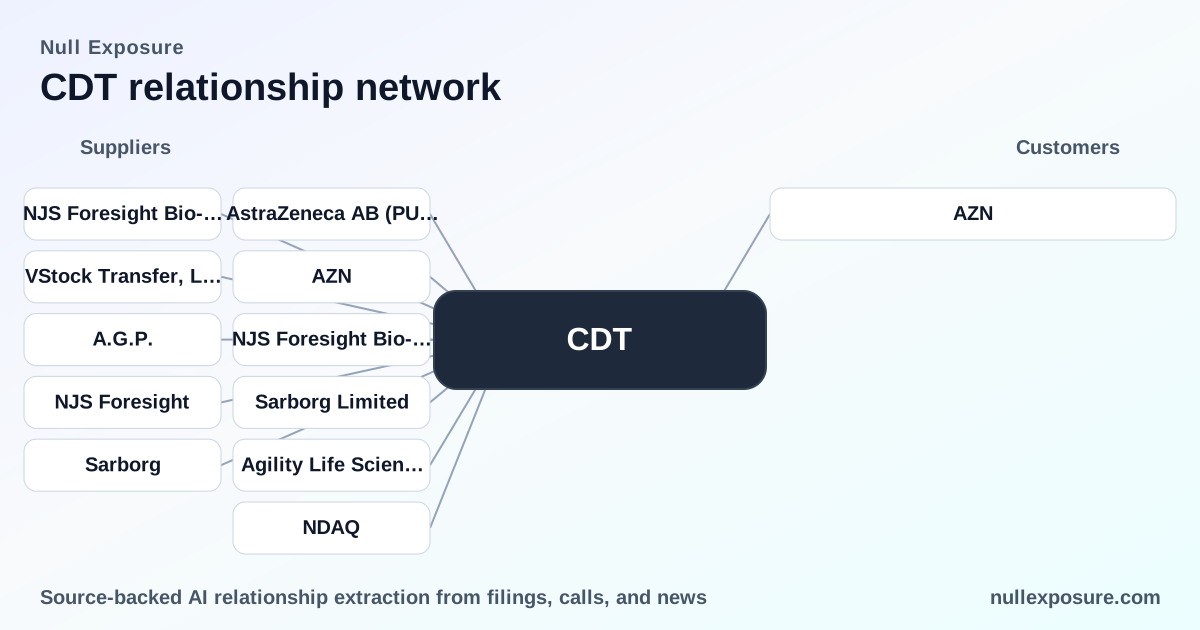
- AstraZeneca (recorded as "AstraZeneca"): Conduit announced signing a license deal with AstraZeneca and positioned that agreement as advancing its pipeline toward its first clinical trial. According to a StockTitan news report dated March 9, 2026, the company framed the license as a key step toward clinical execution. (StockTitan news, 2026‑03‑09)
- AZN (recorded as "AZN"): The same March 9, 2026 news item is logged separately under the ticker label "AZN", reiterating that Conduit executed a license agreement with AstraZeneca to move a program toward its initial clinical study. The duplicate entry reflects identical public disclosure captured under a ticker alias. (StockTitan news, 2026‑03‑09)
What to watch next — milestones, revenue cadence, and balance‑sheet events
- Clinical start and milestone receipts: The most value‑relevant event is the cadence of clinical startup milestones tied to the AstraZeneca license and any publicly disclosed payments. Confirmed upfronts and scheduled milestone amounts materially change near‑term valuation.
- Disclosure clarity: Investors should track formal Conduit filings and partner press releases for explicit financial terms; news headlines alone do not quantify economic rights or royalty percentages.
- Financing and dilution risk: With negative EBITDA and no revenue, Conduit will require either partner funding or capital markets to sustain operations until milestone receipts. Expect dilution unless the AstraZeneca agreement includes significant non‑dilutive funding.
- Governance and execution: High insider ownership (77.9%) concentrates control and accelerates decisionmaking, but it can also complicate negotiations with external investors or strategic partners. Institutional ownership is negligible, which affects liquidity and public market interest.
For a consolidated view of Conduit’s partner landscape and how it impacts counterparty risk, see additional resources at https://nullexposure.com/.
Valuation and risk framing for investors
Conduit is an archetypal early‑stage, partnership‑dependent biotech: upside is binary and milestone‑driven; downside is capital shortfall and clinical failure. The AstraZeneca deal reduces binary risk by providing an independent development path but does not eliminate execution risk for Conduit’s broader pipeline or corporate solvency. Current market metrics—tiny market cap, zero revenue, and deeply negative EBITDA—imply that the stock price already prices in substantial execution risk and financing uncertainty.
Key investment considerations:
- Positive: Validation from a major pharma partner, potential non‑dilutive funding, and a clear commercialization route if milestones are met.
- Negative: No realized revenue, high cash consumption, concentrated governance, and the need for additional capital absent sizable upfronts or milestone receipts.
Bottom line for investors
Conduit Pharmaceuticals is a small, pre‑revenue biotech that monetizes through licensing and strategic partnerships, and the March 2026 license with AstraZeneca constitutes the company’s strongest customer/partner signal to date. Investors should prioritize confirmation of economic terms, the timing of clinical milestones, and funding arrangements that bridge the company to value‑creating events. For deal tracking and partner validation intelligence relevant to assessing Conduit’s commercial trajectory, consult https://nullexposure.com/.
Key takeaway: AstraZeneca’s license materially improves Conduit’s commercial trajectory, but the company remains pre‑revenue and financing‑sensitive; the licensing economics and milestone schedule will determine whether that validation translates into sustainable value.