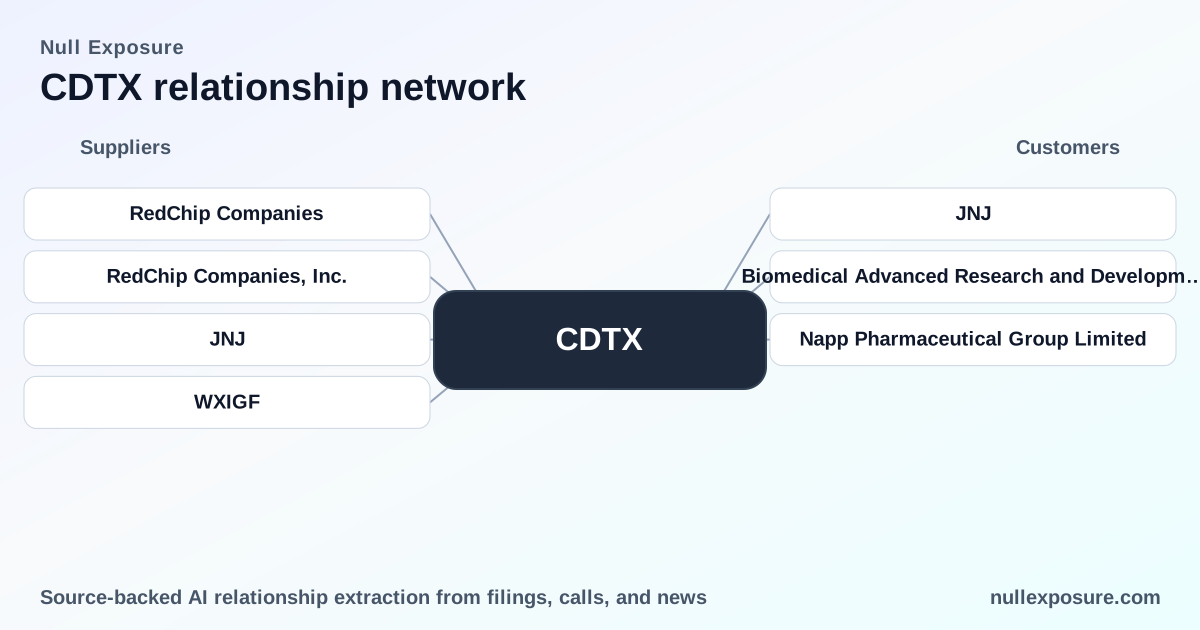
Cidara Therapeutics (CDTX) — Customer Relationships and Strategic Revenue Signals
Cidara develops drug–Fc conjugate (DFC) therapeutics and monetizes through a mix of collaboration and license revenues, milestone-triggered cash inflows, government program awards, selective asset sales, and ultimately strategic M&A outcomes. Revenue is milestone- and partnership-driven rather than volume-based product sales, and recent events — including a large government award and an acquisition agreement — materially reshape the company’s cash flow profile and strategic optionality. For a concise view of partner exposures and implications, see https://nullexposure.com/.
High-level takeaways for investors
Cidara’s commercial model is collaboration-first: the company advances clinical candidates and converts development milestones into partner payments and government awards. This yields four operational characteristics:
- Milestone-driven cash flow: material one-off payments are a core revenue stream.
- Counterparty concentration: a small number of large partners and a government sponsor dominate economic outcomes.
- Strategic optionality via asset sales and licensing: the company has both divested assets and entered technology-transfer arrangements, signaling a pragmatic commercial posture.
- Late-stage value realization: late-stage trials and regulatory designations on lead assets transform R&D progress into immediate acquisition value.
These signals frame how to evaluate CDTX exposure: value depends on clinical readouts, partner execution on milestone payments, and the final terms of the announced acquisition.
Full partner map and what each relationship contributes
Merck (MRK)
Merck agreed to acquire Cidara for about $9.2 billion — roughly $221.50 per share — giving Merck ownership of Cidara’s lead influenza-prevention antibody CD388, which holds FDA Breakthrough Therapy designation and is in large late-stage trials. The acquisition also produced a reported FY2026 charge of $3.62 per share tied to the deal. Multiple media outlets covered the transaction, including BiopharmaDive and NJB Magazine (May 2026), and a local report noted the FY2026 charge. (Sources: BiopharmaDive, NJB Magazine, WHBL — May 2026.)
Johnson & Johnson / JNJ (earnings-related)
Cidara recorded a $45 million milestone payment tied to the initiation of a study that was recognized in Q3 2025 and scheduled for payment in Q4, reflecting classic milestone economics under a large-pharma collaboration. This payment was disclosed on the company’s Q3 2025 earnings call documentation. (Source: CDTX Q3 2025 earnings call — referenced March 2026.)
J&J Innovative Medicine (Janssen) — prior collaboration and license evolution
Cidara disclosed collaboration revenue from R&D and clinical supply services provided to J&J Innovative Medicine under a prior license and collaboration agreement; that earlier arrangement was terminated when a subsequent license and technology transfer agreement became effective on April 24, 2024. The corporate update and Q3 2025 results detail the revenue recognition and contract transition. (Source: GlobeNewswire corporate update and Q3 2025 financial results — Nov 6, 2025.)
Biomedical Advanced Research and Development Authority (BARDA)
Cidara received an award valued up to $339 million from BARDA to support expanded manufacturing and clinical development of CD388, representing significant non-dilutive government funding and strategic validation of the program’s public-health importance. The BARDA award was announced in October 2025. (Source: GlobeNewswire press release — Oct 2, 2025.)
Napp Pharmaceutical Group Limited
Cidara sold its rezafungin assets and related contracts to Napp Pharmaceutical Group Limited under an asset purchase agreement executed April 24, 2024, reflecting an asset monetization pathway and portfolio pruning to concentrate resources on prioritized programs. The asset sale and related disclosure were included in the company’s corporate update. (Source: GlobeNewswire corporate update and Q3 2025 financial results — Nov 6, 2025.)
How these relationships define CDTX’s operating posture
Collectively, the partner set demonstrates a transactional, partnership-driven operating model:
- Contracting posture: Cidara pursues license and collaboration agreements that convert R&D progress into discrete milestone payments and revenue for clinical services, rather than relying on commercial product sales.
- Concentration: Economic outcomes are concentrated among a few counterparties and a major government sponsor; single-event payments (milestones, awards, asset sale, and acquisition) dominate realized value.
- Criticality: Government funding of hundreds of millions and the buyer’s strategic purchase price indicate the company’s programs are critical to public-health and acquiror pipelines.
- Maturity: Presence of FDA Breakthrough Therapy designation and late-stage enrollment places key assets in late clinical maturity, enabling near-term value realization through acquisition or regulatory progress.
These are company-level signals derived from the documented partner interactions and public program awards.
Investment implications and risk checklist
- Upside drivers: The BARDA award and milestone streams reduce near-term financing risk, while the Merck acquisition sets a definitive enterprise valuation for remaining shareholders. The J&J milestone history demonstrates the company’s ability to convert program milestones into material cash.
- Key risks: Dependency on a small set of counterparties and one or two late-stage assets creates outcome concentration; clinical or regulatory setbacks on lead programs would have outsized valuation impact.
- Cash-flow profile: Expect lumpy, event-driven cash inflows (milestones, awards, asset sale proceeds) rather than predictable product revenue. That makes timing of recognition and contractual payment mechanics crucial for short-term liquidity.
For a quick reference on partner exposures and derived signals, visit https://nullexposure.com/.
Bottom line
Cidara’s partner footprint tells a coherent strategic story: the company is structured to turn scientific progress into milestone cash and strategic exits, supported by meaningful government backing and validated by large-pharma interest culminating in an acquisition agreement. For investors and operators assessing counterparty risk and cash-flow timing, focus on the mechanics of milestone payments, the status of late-stage trials for lead assets, and contract termination/transfer terms that affect future service revenue.