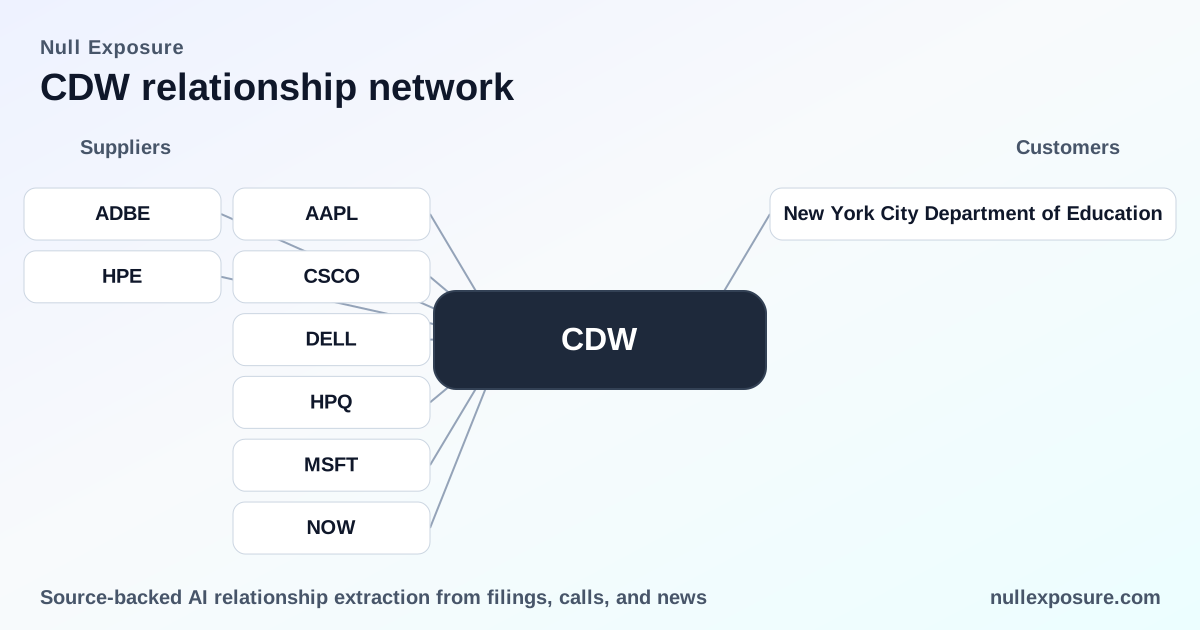
CDW’s customer footprint: what the New York City Department of Education win reveals about scale, contract mix and revenue durability
Thesis: CDW is a multi-channel IT reseller and services integrator that monetizes through a blend of hardware sales (high-volume, lower-margin), software licensing and subscription revenue (increasingly recurring), and professional/managed services (higher-margin). The company leverages scale, channel depth and public-sector credentials to win large, lifecycle deals—turning one-time device rollouts into multi-year services and software relationships that stabilize gross-to-operating margins. For investors and operators, the key question is how much of CDW’s growth is repeatable recurring revenue versus lumpy transactional hardware sales and whether public-sector scale deals improve lifetime customer economics.
If you want a concise briefing of CDW customer exposures for underwriting or competitive diligence, review the full platform at https://nullexposure.com/ for detailed customer-level records and provenance.
How CDW actually earns its money — a layered commercial model
CDW’s financials show the model in plain sight: $22.4 billion revenue TTM with roughly $4.87 billion gross profit, reflecting a business that mixes low-margin product flows with higher-margin services and software. CDW acts in several commercial roles simultaneously:
- Principal seller of hardware — CDW buys and resells devices and infrastructure equipment, recognizing hardware sales on a gross basis and driving volume-based revenue.
- Software licensor and subscription facilitator — CDW sells perpetual and term licenses and increasingly supports SaaS subscriptions via third-party partners, creating recurring revenue streams.
- Provider of professional and managed services — CDW designs, implements and manages IT solutions as the principal, recognizing services revenue on a gross basis and capturing higher margin attach rates.
- Agent/reseller for vendor-delivered services — for some vendor-delivered offerings CDW arranges delivery and records net revenue.
This blended posture gives CDW both revenue scale and margin optionality: hardware fuels top-line throughput; software subscriptions and professional services improve predictability and operating margins.
Contracting posture, concentration and commercial implications
CDW’s operating-play constraints are important signals for investors and ops teams evaluating customer relationships:
- Contracting posture: mixed principal and agent roles. CDW’s filings describe gross recognition for hardware and professional services where it is the principal, and net recognition when arranging vendor-delivered services; investors should model mixed margin stacks rather than a single blended margin.
- Revenue concentration by geography: predominantly North America. CDW reports roughly 90% of net sales from the U.S., with presence in the UK and Canada and the ability to operate in ~150 countries for multinational customers; this means macroeconomic and public-sector dynamics in the U.S. dominate performance.
- Counterparty mix: enterprise, small business and government/education. CDW separates corporate, small business, government, education and healthcare channels—over 250,000 active customers—so revenue diversification is broad across customer counts but concentrated by channel exposures.
- Contract maturity and criticality: lifecycle relationships. The company emphasizes life-cycle services and multi-year engagements (licensing, subscriptions, managed services), which increase customer stickiness when deployments expand beyond device rollouts into managed services.
- Role and segment signals: seller, reseller and service provider. CDW’s public disclosures classify it as a seller of hardware, a reseller/agent for vendor services, and a principal for professional services—each role has different margin and risk characteristics.
If you want deeper readouts on how these signals map to individual customer contracts and clauses, see https://nullexposure.com/ for customer-level documentation and provenance.
The New York City Department of Education relationship — what was announced
CDW recently reported a material education-sector deployment: a large Chromebook solutions rollout with the New York City Department of Education (NYC DOE). According to an earnings call transcript published March 9, 2026, CDW cited K–12 deep customer and partner relationships and life-cycle services capabilities as drivers of that Chromebook rollout. (InsiderMonkey transcript, March 9, 2026: https://www.insidermonkey.com/blog/cdw-corporation-nasdaqcdw-q4-2025-earnings-call-transcript-1689502/)
This win is consistent with CDW’s strategic emphasis on lifecycle deployments where device sales are followed by software, support and managed services, converting high-volume device orders into multi-year revenue streams and support contracts.
Why the NYC DOE deal matters to investors and operators
- Scale and referenceability: NYC DOE is one of the largest K–12 districts in the U.S.; securing that deployment is a strong market signal for CDW’s education channel and supports future public-sector bids.
- Revenue composition implications: a Chromebook rollout is initially hardware-heavy, but CDW’s disclosure explicitly ties the project to life-cycle services, suggesting material upsell potential into subscriptions, management and security services—areas with higher and stickier margins.
- Procurement and payment profile: government and education contracts carry procurement rigor and often predictable payment terms, improving receivable visibility but also introducing procurement-cycle risk and competitive rebid exposure.
All customer relationships in this review
- New York City Department of Education — CDW described a major Chromebook solutions rollout driven by its K–12 customer relationships and life‑cycle services capabilities during its Q4 FY2025 earnings commentary; this public education engagement underscores CDW’s strength in converting device rollouts into longer-lived services revenue (InsiderMonkey transcript, March 9, 2026: https://www.insidermonkey.com/blog/cdw-corporation-nasdaqcdw-q4-2025-earnings-call-transcript-1689502/).
Practical consequences for modeling and operational diligence
- Model recurring revenue explicitly. Given CDW’s mixed contract types—perpetual licenses, term licenses, subscriptions and managed services—financial models should split hardware, software-license, subscription and services lines rather than treating revenue as homogeneous.
- Adjust margin assumptions by role. Treat hardware sales as lower margin, services and managed offerings as higher margin, and vendor-resold services as net revenue items with thinner contribution.
- Stress test public-sector timing. Large education and government deals generate scale but follow procurement calendars; include longer sales cycles and the potential for lumpy revenue recognition tied to device delivery and services milestones.
- Monitor concentration metrics. U.S. exposure (~90% of net sales) is a dominant risk dimension; regional or public-sector shocks will disproportionately affect CDW.
Bottom line: durable platform with mixed revenue dynamics
CDW’s business converts volume device sales into recurring software and service relationships; the NYC DOE Chromebook rollout is a textbook example of that playbook—big-device deployment that anchors longer-term services. For investors, the opportunity is scalable recurring revenue growth and margin expansion through services attach; the risk is hardware-driven revenue volatility and U.S.-centric concentration. Operators assessing customer commitments should focus on contract structure (gross vs net recognition), renewal terms for services and the timeline for converting device installs into managed-service contracts.
For a deeper, customer-by-customer dossier and provenance-backed records to support underwriting or competitive intelligence, visit https://nullexposure.com/ for full coverage and sourcing.