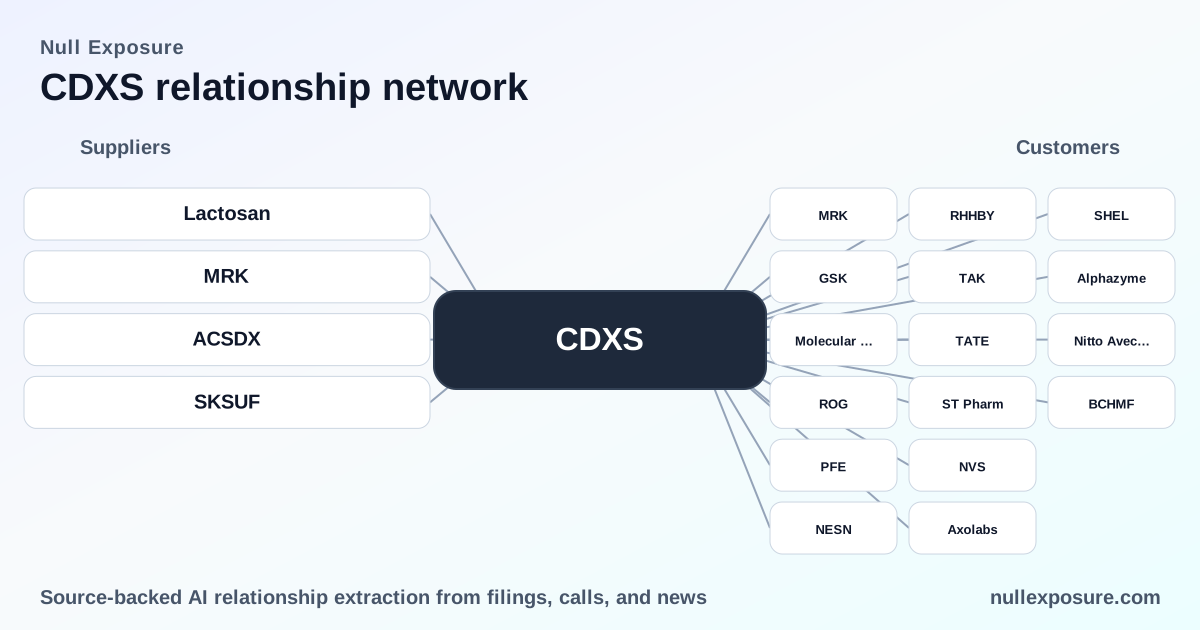
Codexis (CDXS): customer map and what it means for investors
Codexis engineers and commercializes enzymes used as biocatalysts, selling through a mix of product supply agreements, licensing deals, technology transfer fees and royalties. The company monetizes by supplying engineered enzymes for commercial drug manufacture, licensing its CodeEvolver platform and capturing one-time transfer or milestone payments alongside recurring product revenue. For investors, the critical question is concentration and durability: a handful of large pharmaceutical partners drive outsized revenue swings but also validate the platform for broad manufacturing adoption. Learn more at https://nullexposure.com/.
How Codexis runs the business — commercial posture and structural constraints
Codexis operates as a hybrid supplier-licensee in the pharmaceutical manufacturing supply chain. Contracting posture is license-forward (high-confidence evidence of licensing agreements) combined with supply and technology-transfer arrangements; this creates revenue that is a mix of recurring product sales and lumpy, high-margin transfer/licensing fees. The company’s customer base is concentrated — Codexis discloses dependence on a limited number of large pharmaceutical customers, and product revenues tied to the Pfizer supply agreement produced volatile year-to-year percentages of total revenue (0% in 2024, 12% in 2023 and 54% in 2022), a clear illustration of materiality and single-counterparty impact (company filings, 2024). Codexis serves global markets with revenue footprints across the Americas, EMEA and APAC and sells enzymes used in manufacturing for 16 approved commercial drugs as of year-end 2024, which signals commercial maturity of several technology applications (company filings, 2024). Finally, observed transaction sizes place some relationships in the $10m–$100m spend band (historic product revenue to Pfizer of $75.4 million in 2022), meaning a small number of deals can move the top line materially.
Customer roll call — who Codexis works with and why each matters
Below are every customer relationship surfaced in public materials and press coverage, with a concise plain-English summary and source reference.
Merck (MRK)
Codexis has a long-term strategic manufacturing relationship with Merck built around a chemoenzymatic route for sitagliptin; the companies extended their license and supply arrangements and Codexis completed a $37.8 million Technology Transfer Agreement with Merck that materially boosted Q4 revenue. Source: FiercePharma (deal extension coverage, originally reported FY2021) and Codexis press release reporting the $37.8M Technology Transfer Agreement (GlobeNewswire, March 11, 2026).
Pfizer (PFE)
Pfizer is a material customer that purchased proprietary Codexis enzymes for PAXLOVID production and was the buyer under the CDX-616 supply agreement; product sales to Pfizer generated $75.4 million in 2022 and Pfizer-specific licensing and credit arrangements were recognized as non-cash R&D revenue in 2023–2024 per company disclosures. Source: Codexis 2024 Form 10‑K (Pfizer Supply Agreement disclosures) and company filings describing the March 31, 2023 and December 20, 2024 license arrangements.
GSK
Codexis’ 2024 Form 10‑K explicitly lists GSK among performance enzyme customers and discloses the risk that termination by GSK or similar partners would affect results, indicating a meaningful commercial relationship. Source: Codexis 2024 Form 10‑K (FY2024 risk disclosures, filed Feb 2026).
Novartis (NVS)
Novartis is identified by Codexis as a named performance enzyme customer in corporate filings, making it part of the peer group of large pharma partners that underpin Codexis’ commercial enzyme business. Source: Codexis 2024 Form 10‑K (FY2024).
Roche (ROG / RHHBY)
Codexis engineered a double‑stranded DNA ligase that was exclusively licensed to Roche, with press coverage highlighting an exclusive licensing agreement that drove investor interest when announced. Source: Nature (coverage of the 2019 engineered ligase and licensing) and press reports (Globe and Mail, FY2024 coverage).
Takeda (TAK)
Codexis entered a strategic collaboration and license agreement with Takeda around CDX‑6311 announced in March 2020; this relationship reflects Codexis’ recurring business in pharmaceutical discovery and development collaborations. Source: Nature (article recalling the Takeda collaboration, FY2020).
Nestlé Health Sciences
Nestlé Health Sciences exercised an option and acquired an exclusive license for CDX‑6114 in 2019, triggering a milestone payment and demonstrating Codexis’ reach beyond large pharma into nutraceutical/health‑science licensing. Source: Nature (report of the 2019 license exercise and $3 million milestone).
Tate & Lyle (TATE)
Codexis signed a multi‑year supply and licensing agreement with Tate & Lyle for performance enzymes used in manufacturing the TASTEVA® M stevia sweetener, an example of Codexis’ commercialization beyond pharma. Source: Prepared Foods (press coverage of the Tate & Lyle licensing agreement, FY2019).
Aldevron, LLC
Aldevron entered into an agreement to acquire a global exclusive license for Codex® HiCap RNA Polymerase from Codexis, illustrating Codexis’ licensing activity in the oligonucleotide tools market. Source: SimplyWallSt summary (FY2026 reporting).
Molecular Assemblies, Inc.
Molecular Assemblies combined its chemistries with Codexis’ enzymes to advance commercialization efforts, representing partner co‑development in novel manufacturing routes. Source: SynBioBeta (coverage of the collaboration under the SynBio Innovation Accelerator, FY2021 context).
Axolabs
Codexis signed an evaluation agreement with Axolabs to integrate the ECO Synthesis enzymatic RNA platform into Axolabs’ manufacturing site; this is one of several CDMO partnerships Codexis highlighted as validation of transferability. Source: Codexis press release and Q4 2025 earnings commentary reported on GlobeNewswire and InsiderMonkey (FY2026 reporting).
Nitto Avecia
Nitto Avecia participated in presentations validating transferability of Codexis’ ligation processes and signed agreements underscoring CDMO interest in adopting Codexis’ manufacturing technology. Source: Codexis Q2 2025 report (GlobeNewswire, FY2025).
Bachem (BCHMF)
Bachem is one of the CDMOs that validated Codexis’ ligation process transferability and was listed among three CDMO partners that subsequently signed agreements, signaling industry adoption by commercial contract manufacturers. Source: Codexis investor materials (GlobeNewswire Q2 2025; earnings call FY2026).
ST Pharm
ST Pharm was cited by Codexis as a CDMO validating process transferability, reflecting the company’s strategy to partner with external manufacturers for scale-up. Source: Codexis Q2 2025 financial release (GlobeNewswire, FY2025).
Alphazyme
Codexis disclosed potential receipt of royalty payments under a license agreement with Alphazyme, indicating ongoing licensing revenue streams beyond direct product sales. Source: Codexis Q2 2025 financial release (GlobeNewswire, FY2025).
Shell (SHEL)
Historically, Codexis pursued biofuels work and the loss of Shell as a key customer significantly impacted revenues at that time; this serves as a reminder of client concentration risk in prior cycles. Source: Nanalyze analysis (historical context, FY2022 commentary).
Investment implications and risk calibrations
- Concentration risk is real and measurable. A single large partner has driven between 0% and 54% of revenue in recent years; investors should model volatility from contract timing and one‑off transfer fees rather than assume linear recurring growth (company filings, 2024).
- Revenue mix is hybrid: recurring product sales plus lumpy technology‑transfer/licensing receipts. That mix supports periods of high margins but creates earnings unpredictability quarter-to-quarter (GlobeNewswire Q4 2025; FiercePharma coverage of Merck deal).
- Commercial validation from major pharma and CDMOs reduces technical adoption risk but does not eliminate counterparty concentration or timing risk. The presence of multiple blue‑chip partners and CDMO agreements increases addressable market but keeps single‑deal sensitivity.
- Geographic footprint is global (Americas/EMEA/APAC), which diversifies demand sources but also requires operational scale to convert evaluations into sustained volume (company revenue breakdowns, FY2024).
For a deeper, structured read on partner exposure and contract terms that shape Codexis’ growth profile, visit https://nullexposure.com/.
Bold relationships and material agreements will continue to drive CDXS financial swings; investors should weight the company’s commercial validation against concentration and timing when building models.