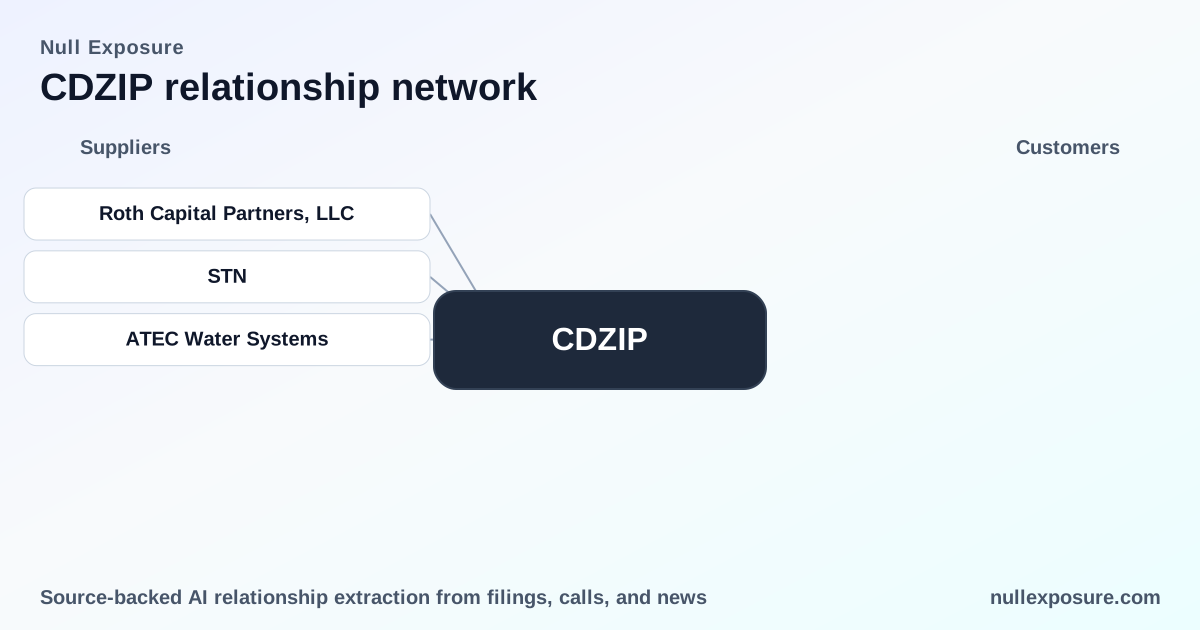
Cadiz Inc. Depositary Shares (CDZIP): Customer Relationships that Drive a Water‑infrastructure Investment Thesis
Cadiz Inc. operates a vertically-oriented water solutions business in Southern California that monetizes land, water rights, pipeline capacity and modular filtration products by selling annual water deliveries to public water systems and by commercializing filtration and agricultural leases. For investors, the core commercial thesis is straightforward: long-term, take-or-pay water contracts with public agencies create predictable volumetric revenue while filtration and farm operations provide near-term cash generation, but the company’s underlying financials reflect an ongoing development and commercialization phase with negative EBITDA and net losses. Learn more at https://nullexposure.com/.
How Cadiz actually gets paid — the operating model in plain English
Cadiz sells two principal things to customers: (1) annual water supply delivered through owned pipeline infrastructure under multi‑decade contractual commitments, and (2) equipment and services, including modular filtration tanks and related products sold to utilities and commercial water users. The company also derives rental and agricultural revenue from its land holdings. The business model is contract-heavy and capital‑intensive: revenue scale depends on pipeline capacity utilization and the conversion of signed long-term purchase agreements into cash flows. Financials show a modest revenue base of $16.3M TTM against an EBITDA loss of $24.3M, underlining that Cadiz is in a build-and-contract phase rather than a mature cash‑returning utility today.
Customer relationships on the record — who Cadiz serves
Below I cover every relationship pulled from the customer-scope results. Each entry is grounded to the cited source.
Metropolitan Water District of Southern California — March 28, 2026 note
Cadiz is actively engaging with the Metropolitan Water District of Southern California to integrate Cadiz’s water system into regional supply networks, positioning Metropolitan as a channel and counterparty for delivered annual water volumes. Source: MarketBeat instant alert, March 28, 2026 (https://www.marketbeat.com/instant-alerts/cadiz-nasdaqcdzi-stock-price-crosses-below-two-hundred-day-moving-average-heres-why-2026-03-28/).
Metropolitan Water District of Southern California — February 2, 2026 analyst coverage alert
An earlier MarketBeat note reiterates that Cadiz has engagement plans with Metropolitan and with local districts in Orange and San Bernardino counties to plug Cadiz supply into existing distribution systems, confirming active business development and customer integration efforts with public water agencies. Source: MarketBeat instant alert, February 2, 2026 (https://www.marketbeat.com/instant-alerts/cadiz-nasdaqcdzi-earns-buy-rating-from-analysts-at-maxim-group-2026-02-02/).
What Cadiz’s relationship footprint signals about risk and opportunity
Treat the following as company‑level operating model signals derived from the documented constraints and disclosures.
-
Contracting posture — long-term, take‑or‑pay orientation. Company disclosures describe membership in FGMWC and agreements that provide for delivery of purchased annual water supply over 40‑year terms (take‑or‑pay) at an initial market price estimated at approximately $850/AFY, with annual adjustments. This is a classic utility-style revenue model that underwrites project financing and asset valuations.
-
Counterparty mix — government-centric. Cadiz’s customers are principally public water systems and government agencies, which reduces commercial counterparty default volatility but raises political and regulatory dependence as a critical risk vector.
-
Geographic concentration — Southwestern U.S. focus. Assets and customers are concentrated in Southern California and the broader Southwest, making revenue sensitive to regional hydrology, drought conditions and state water policy.
-
Materiality and concentration risk. In 2024 Cadiz signed purchase agreements totaling 21,275 AFY, representing roughly 85% of the Northern Pipeline’s 25,000 AFY capacity — a high concentration of contracted volume that can be positive for revenue visibility but creates single‑asset concentration that investors must monitor.
-
Role and product mix. Cadiz functions as both seller and manufacturer: it sells water deliveries and manufactures modular filtration tanks and filter media, giving the company diversified product lines but also exposing it to manufacturing and procurement execution risk.
-
Relationship maturity — active and execution-focused. The company’s revenue today comes from filtration systems, crop sales and lease rentals, while pipeline delivery contracts are active commercial commitments that require successful operational ramp to translate into sustained cash flow.
Bottom line: the commercial setup is built for long-term contracted cash flows but remains execution‑dependent in the near term; investors should treat contractual revenue visibility as a structural positive while pricing in development and operational execution risk.
Financial and market context that matters to customer credit and cash conversion
The customer relationships must be viewed against Cadiz’s current financial position. Cadiz generated $16.3M of revenue TTM with gross profit of $5.15M, yet the company reports an EBITDA loss of $24.3M and diluted EPS of -$0.834, which confirms that work remains to convert contract capacity into positive operating leverage. Market signals show elevated volatility — beta 1.786 and trading ranges with a 52‑week high of $20.09 and low of $14.47 — and a reported SharesFloat of 55,825,000 (data shows a reporting anomaly with SharesOutstanding listed as 0). These indicators reflect investor uncertainty about timing of pipeline commercialization and revenue scaling.
Investment implications and how to monitor the relationship risk
-
Monitor contract performance and cash receipts. The 40‑year take‑or‑pay contracts underpin valuation, but real investment return requires successful conversion of signed AFY into billed and collected revenue, not just executed contracts on paper.
-
Watch public counterparty dynamics. Because customers are government agencies, contract enforcement, political approvals and inter-agency coordination are ongoing gating items; positive engagement with the Metropolitan Water District is strategically important for system integration.
-
Track concentration metrics. With agreements covering 85% of the Northern Pipeline capacity, any single large buyer decision to reduce off‑take or delay acceptance would materially affect near‑term utilization and cash flow.
-
Operational execution and manufacturing margins. Filtration sales and tank manufacturing provide nearer-term revenue; improvements in gross margins here will bridge the gap while pipeline volumes ramp.
Final takeaway and next steps for due diligence
Cadiz’s customer profile is strategically aligned to generate utility‑like contracted cash flows, anchored by long-term, take‑or‑pay arrangements with public water systems and active engagement with the Metropolitan Water District of Southern California. The commercial model is robust in principle, but realizing shareholder value depends on operational delivery, regulatory coordination and cash conversion given current negative EBITDA and net losses. For investors focused on the customer side of the story, prioritize evidence of first-year deliveries, payment milestones tied to the Northern Pipeline contracts, and continued integration with major regional distributors.
To explore deeper coverage and follow-on relationship analytics, visit https://nullexposure.com/ for proprietary relationship tracking and commercial-risk analysis.