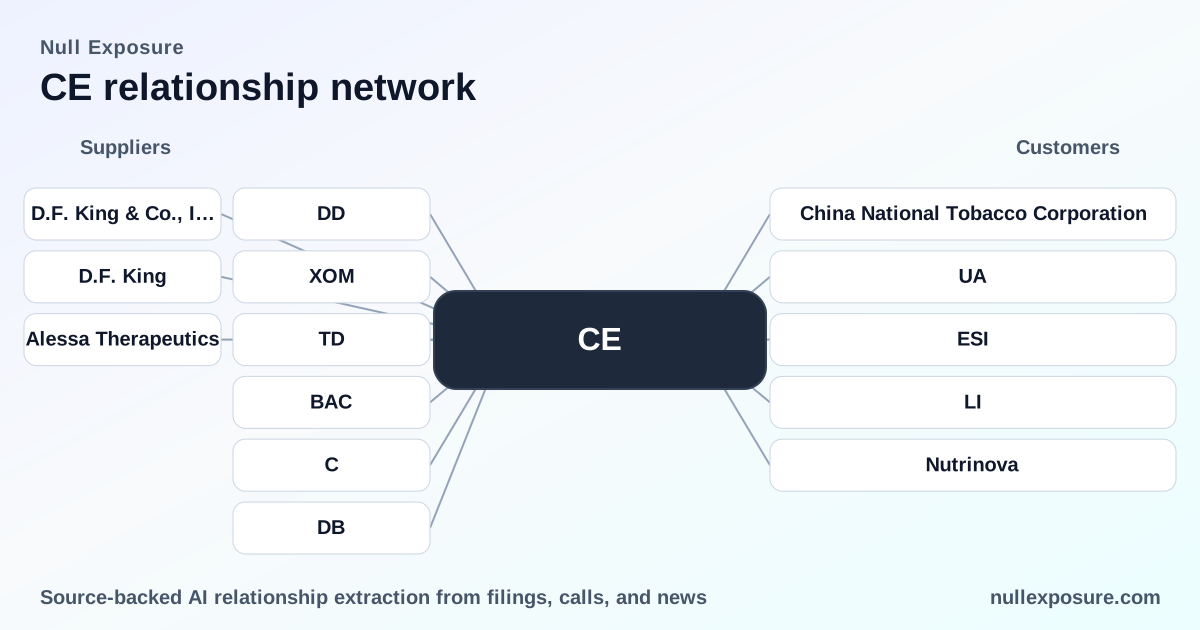
Celanese (CE): Customer relationships that map revenue durability and strategic optionality
Celanese is a global specialty materials and chemicals manufacturer that monetizes through two principal vectors: engineered polymers sold into high-value industrial and consumer applications, and acetyl intermediates supplied broadly to chemical and food ingredient customers. The company drives margins via proprietary materials, multi-year commercial arrangements, and periodic portfolio pruning — including recent divestitures — that convert businesses into cash and debt reduction. For investors evaluating customer risk, the portfolio combines large-enterprise counterparties, global geographic exposure, and a manufacturing-backed sales stance that favors long-term, contract-like relationships.
Visit NullExposure for more relationship intelligence: https://nullexposure.com/
How Celanese wins customers and why that matters to investors
Celanese operates as a manufacturer-seller with a clear bias toward stability: the engineered materials business uses multi-year and annual arrangements and distribution partners to secure volume and design wins, while the acetyl franchise supplies intermediate chemicals broadly across industries. This operating posture produces several investor-relevant signals: low counterparty churn, exposure to large enterprise clients, and global geographic concentration across North America, APAC, EMEA and Latin America. The business is capital-intensive and production-centric — Celanese reports dozens of global production facilities — so customer relationships are operationally critical and often embedded into customers’ product designs, increasing switching costs.
Key company-level signals from filings and disclosures:
- Contracting posture: multi-year and annual arrangements for engineered materials indicating long-term revenue visibility.
- Counterparty profile: predominantly large enterprise customers across diverse industries.
- Geographic breadth: meaningful presence in North America, Asia‑Pacific, EMEA and Latin America, supporting global commercialization.
- Role and maturity: predominantly a manufacturer and seller with many long-standing, mature customer relationships.
- Segment concentration: manufacturing-heavy operations with 56 global production facilities and additional affiliate sites.
These characteristics create a tilt toward predictable, commercially embedded revenue but also tie Celanese to commodity and production-cycle risk.
The customer and partner list investors should track
Below I summarize every counterparty referenced in Celanese customer relationship results and the public sources that document them.
China National Tobacco Corporation — equity partner in China acetyl/cellulose venture
Celanese discloses an equity investment in a China-based acetyl/cellulose venture where China National Tobacco Corporation holds a 70% interest and the joint vehicle is associated with a 30% interest attributed to Celanese or related parties, highlighting a strategic local partnership in China’s materials space. This is documented in Celanese’s 2024 Form 10‑K.
Source: Celanese 2024 10‑K (equity investments disclosure, FY2024).
Element Solutions, Inc. (ESI) — buyer of the Micromax business; one‑time cash inflow
Celanese completed the sale of its Micromax inks and paste business to Element Solutions in early February 2026, receiving roughly $492–500 million in cash and converting a non-core business into liquidity for deleveraging. The disposal reduces CE’s product breadth but strengthens the balance sheet.
Source: multiple March 2026 press reports including ChemEng Online and Fibre2Fashion reporting completion of the Micromax divestiture to Element Solutions.
Under Armour (UA) — co-developer of NEOLAST™ performance fiber
Celanese and Under Armour have an ongoing product-development relationship that produced NEOLAST™, a performance stretch fiber positioned as a sustainable alternative for athletic fabrics; the collaboration spans multiple years with product mentions from FY2018 through FY2025 and commercial iterations appearing in Under Armour launches. This relationship evidences Celanese’s role in co-innovation with large consumer brands.
Source: Under Armour press releases and media coverage across FY2018–FY2025; Dallas Innovates coverage of the NEOLAST collaboration (FY2024–FY2025).
Li Auto (LI) — commercial partner for low‑emission cabin materials in China
Celanese partnered with Li Auto on Hostaform POM XAP3, a polymer designed to reduce vehicle cabin emissions in new-energy vehicles, and the material is being commercialized in cabin components for Li Auto models in China. This demonstrates Celanese’s penetration into automotive OEM supply chains in APAC.
Source: Dallas Innovates reporting on the Celanese–Li Auto partnership (FY2025).
Nutrinova / Mitsui joint venture — long‑term supply arrangement for acetyls
Celanese and Mitsui formed a food ingredients joint venture (Nutrinova) and Celanese has committed to continue supplying acetyl raw materials to the JV under a long-term supply agreement, preserving a feedstock and customer channel into food and ingredients markets. This is a strategic tie to downstream, non‑commodity consumer-facing applications of acetyl chemistry.
Source: Food Business News and Dallas Morning News reporting on the Celanese–Mitsui Nutrinova JV (FY2023).
What these relationships collectively imply for revenue durability and risk
Taken together, the documented relationships reveal a company-level pattern rather than isolated, transactional ties: Celanese sells into large customers and partners with industrial and consumer OEMs and global chemical buyers through long-standing, often multi‑year commercial arrangements. The Micromax divestiture to Element Solutions is an example of active portfolio management that improves liquidity and shifts the customer mix toward core industrial buyers.
- Durability: Co‑development agreements (Under Armour) and long-term supply commitments (Nutrinova JV) indicate embedded revenue pathways with higher stickiness than spot commodity sales.
- Concentration and criticality: While the customer base is large and diverse, the manufacturing-first model creates concentration at the production level — plant outages or feedstock dislocation would have broad customer impact.
- Maturity: Multiple disclosures characterize relationships as long-standing, consistent with a mature commercial portfolio where Celanese often functions as supplier-of-record for engineered polymers and acetyls.
Major investment takeaways
- Core strength: Celanese’s business is anchored in manufacturing and engineering relationships with large enterprise customers, producing predictable, contract-like sales in engineered materials and acetyls.
- Balance‑sheet flexibility: The Micromax sale to Element Solutions provided a near-term cash infusion and shows management’s willingness to divest non-core assets to reduce leverage.
- Market exposure: Global customer footprint across NA, APAC, EMEA and LATAM supports diversification but ties revenues to global industrial cycles and regional OEM demand.
For a concise way to track counterparties and exposure across sectors, visit NullExposure’s relationship hub: https://nullexposure.com/
This review synthesizes Celanese disclosures and contemporary reporting to map the firm’s customer relationships and the structural traits that matter for revenue stability and strategic optionality.