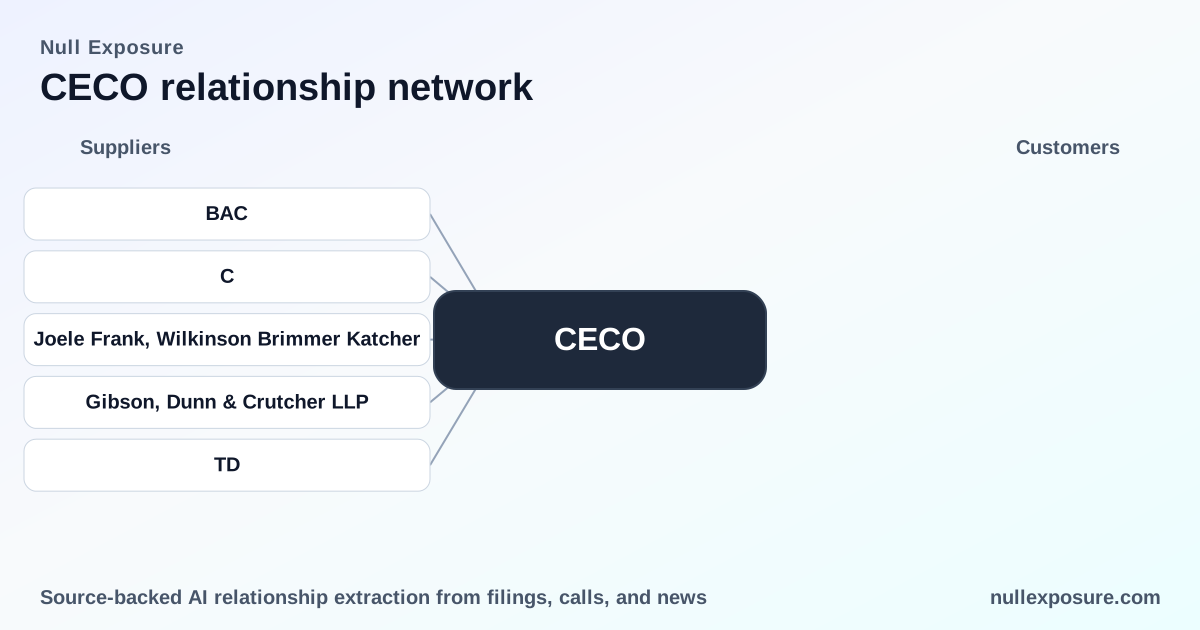
CECO Environmental: customer footprint, contract posture, and what one large client reveals
CECO Environmental sells industrial air and water treatment equipment and related services to large industrial and utility customers, monetizing through equipment sales, engineering services, and service contracts that convert installed base into recurring revenue. Revenue recognition is a blend of point-in-time equipment sales and time-based service/performance obligations; backlog and master service agreements (MSAs) are central to near-term visibility. For a focused view of CECO’s customer relationships and the implications for investors and operators, read on. If you want an investor-grade customer map and relationship signals, visit https://nullexposure.com/.
How CECO makes money and why contracts matter
CECO is a diversified industrial company serving industrial air, industrial water, and energy transition markets globally. The company generates top-line revenue from engineered equipment sales and installation, aftermarket parts and services, and longer-term maintenance/installation engagements that transfer control over time. Backlog is a core operational metric — CECO reported backlog of $540.9 million at year-end 2024, with a majority expected to convert within 12 months, which underpins short-term revenue visibility. According to company filings for 2024, CECO recognizes a significant portion of revenue over time as it performs under contracts, reflecting ongoing service and project work rather than purely transactional product sales.
Customer profile at a glance (company-level signals)
CECO’s customer set is predominantly large industrial and utility enterprises across North America, EMEA, and APAC. The company describes its typical contracting posture as short-term and single-performance-obligation focused, while still maintaining active MSAs in select cases for extended support. Key company-level signals from public filings:
- Contracting posture — short-term predominance. CECO’s filings state that the typical life of contracts is generally less than 12 months and most contracts contain a single performance obligation to deliver goods or services. This creates frequent renewal touchpoints and steady service revenue cadence.
- Customer scale — very large enterprises. CECO explicitly targets some of the world’s largest processors, refiners, power generators, and industrial manufacturers, positioning it as a supplier to enterprise-scale counterparty credit profiles.
- Geography — global footprint with concentration in North America. Net sales by region show the United States as the largest single market, complemented by sales in the Netherlands, United Kingdom, Germany, China, and other markets in APAC and EMEA.
- Concentration — immaterial single-customer risk. No single customer represented greater than 10% of consolidated net sales or accounts receivable for 2024, 2023, or 2022, reducing counterparty concentration risk for the business.
- Relationship maturity and activity. Backlog grew materially year-over-year (to $540.9M vs. $370.9M at year-end 2023), with substantially all backlog expected to be delivered within 18–24 months and a majority within 12 months, signaling an active and execution-focused book of business.
These signals come from CECO’s public filings and investor disclosures for FY2024–FY2025 and inform how the company’s revenue converts from orders to cash.
Every named customer relationship in our results
Entergy — multi-year MSA to support combined cycle upgrades
CECO disclosed on its Q1 FY2026 earnings call that Entergy engaged CECO under a three‑year master service agreement to support an extensive program of combined-cycle plant updates, representing a multi-year services engagement rather than a one-off equipment sale. A Benzinga transcript of CECO’s Q1 FY2026 earnings call reported management’s description of the Entergy program and the existence of the three-year MSA (published May 2026). This illustrates CECO’s ability to secure longer-duration enterprise MSAs alongside its typical shorter contracts.
What this means for investors and operators
CECO’s model blends transactional equipment revenues with recurring service flows and project work that is often short-dated but can include strategic multi-year MSAs for large customers. That hybrid profile has four practical implications:
- Revenue visibility derives from backlog and recurring service work. With backlog at $540.9M (end of 2024) and the majority expected to convert within 12 months, near-term revenue conversion is predictable relative to a pure spot-sales model.
- Counterparty credit and scale matter more than single-customer risk. Serving very large industrial and utility customers reduces credit volatility, and the company’s disclosure that no customer exceeds 10% of sales limits single-client exposure.
- Geographic diversification reduces region-specific demand shocks. While the U.S. remains CECO’s largest market, meaningful activity in EMEA and APAC reduces reliance on a single regional cycle.
- Contract mix creates operational cadence and execution risk. The predominance of short-term contracts creates frequent revenue recognition events and requires steady project execution; however, occasional MSAs such as the Entergy arrangement demonstrate the ability to lock in multi-year service revenue for large programs.
CECO’s valuation metrics reflect a growth/transition premium: a market capitalization in the low billions, high trailing P/E driven by modest near-term EPS, and elevated EV/EBITDA relative to some industrial peers — all signals investors should balance against execution and backlog conversion.
Key risks and operational considerations
- Execution risk on backlog. Converting a $540.9M backlog within 12–24 months requires consistent delivery across geographies and supply chains. Misses would pressure near-term revenue.
- Margin pressure in equipment-driven projects. Projects often carry thin gross margins until after scale and service penetration increase.
- Cyclic exposure to industrial capex. End markets such as power generation and refining are cyclical and influenced by regulatory and commodity cycles.
Verdict for investors
CECO is a service-plus-equipment industrial supplier with a global footprint, low single-customer concentration, and a contract mix that is mostly short-term but capable of producing multi-year revenue through MSAs. The Entergy engagement is a concrete example of CECO converting large utility programs into extended service relationships. For investors seeking exposure to environmental-industrial supply chains with a visible near-term backlog, CECO offers a predictable revenue runway balanced by execution and margin risks.
If you want a deeper, customer-level intelligence report to evaluate counterparty exposure and contract maturity across CECO’s installed base, see the coverage at https://nullexposure.com/.
Sources: CECO Environmental FY2024 public filings and investor disclosures; Benzinga transcript of CECO Q1 FY2026 earnings call (May 2026).