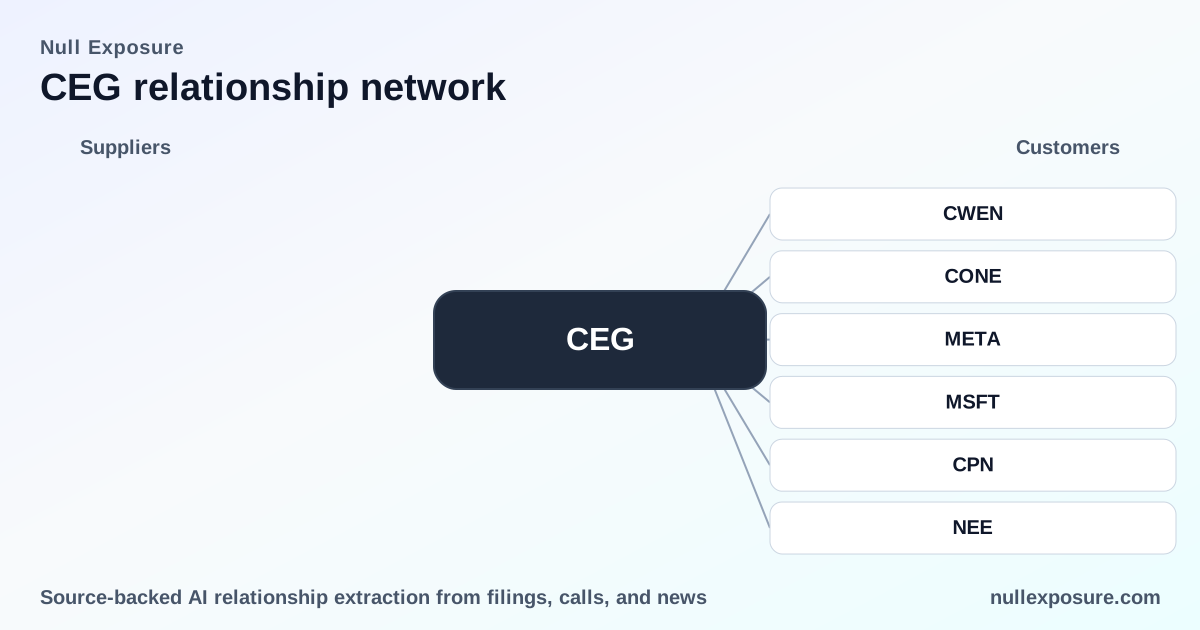
Constellation Energy (CEG): How customer deals with hyperscalers and asset buyers reshape the revenue base
Constellation Energy operates as a national energy producer and supplier that monetizes through a mix of physical generation, long-term power purchase agreements (PPAs), and retail supply to corporate and residential customers. CEG sells carbon‑free and conventional generation, offers integrated energy services, and locks in cashflow through long-term PPAs while using short‑term hedging across its portfolio; its revenue mix is therefore a combination of contracted, predictable streams and market‑exposed merchant activity. For a deeper look at how these customer relationships translate to commercial and regulatory risk, see NullExposure’s analysis at https://nullexposure.com/.
Why the customer roster matters for investors
Constellation is locking hyperscalers into multi‑decade PPAs while also servicing large data‑center operators and municipal buyers — a profile that increases both revenue visibility and regulatory/operational complexity. Long-term nuclear PPAs anchor future cashflows, while shorter-term market hedges preserve flexibility; the net effect is higher revenue predictability but concentrated counterparty exposure to large enterprise customers.
- Key commercial driver: 20‑year nuclear PPAs with major cloud providers provide durable cashflow and support capital investment in plant restarts.
- Key risk vector: Large enterprise contracts create counterparty concentration and project execution risk tied to nuclear restarts and large thermal/renewable projects.
The customer relationships you need to know
Below are the relationships flagged in public reporting and news coverage. Each entry is a concise, plain‑English takeaway with a source reference.
CyrusOne (CONE)
Constellation’s Calpine business signed a 380‑megawatt agreement to connect and serve a new CyrusOne data center near the Freestone Energy Center in Texas, supplying capacity to a hyperscale campus. Reuters coverage summarized by InsiderMonkey and contemporaneous press mentions reported the deal in February–March 2026. (Reuters / InsiderMonkey, Feb–Mar 2026)
Meta (META)
Constellation reached long‑dated agreements to keep a nuclear reactor in Illinois operating for another 20 years, effectively selling long‑term, carbon‑free energy to Meta and supporting the reactor’s economic life. Multiple news summaries reported the 20‑year arrangement and its strategic importance in March 2026. (Bitget / Tikr / Finviz, Mar 2026)
Microsoft (MSFT)
Constellation executed a 20‑year PPA with Microsoft (announced Sept 2024) to support the restart of Three Mile Island Unit 1, rebranded as the Crane Clean Energy Center, and has additional commitments to bring a Pennsylvania reactor back online to serve Microsoft’s data centers by late 2027. This is both a material offtake commitment and an operational mandate to restart legacy nuclear capacity. (Company 10‑K FY2024; press coverage Mar–May 2026)
Clearway Energy, Inc. / CWEN
Following a reorganization effective January 1, 2025, Clearway transferred employees to Clearway Energy Group LLC and relies on Constellation for operational services under a Master Services Agreement, making CEG a core operator for Clearway’s assets. This dependency was disclosed in regulatory filings summarized in March 2026. (TradingView summary of CWEN SEC filings, Mar 2026)
Calpine (CPN)
Calpine is on track to close in the fourth quarter (deal context referenced in Constellation’s earnings commentary), reflecting M&A activity where CEG provides transitional operations and integration services tied to large asset transactions. The remark came from Constellation’s 2025 Q3 earnings call. (CEG 2025 Q3 earnings call, Mar 7, 2026)
NextEra (NEE)
CEG referenced coordination with NextEra in restart and transactional activity (e.g., Duane Arnold) enabled by hyperscaler contracts, signaling collaborative project execution among large producers to meet big customers’ demand profiles. This was discussed on the company’s earnings call. (CEG 2025 Q3 earnings call, Mar 7, 2026)
LS Power
As part of resolutions related to the Calpine transaction, Constellation announced an agreement to sell PJM generation assets to LS Power, a divestiture required by regulators and the DOJ; the company confirmed the sale in its corporate news release in March/April 2026. (Constellation corporate press release, Mar 18 / Apr 2026)
How these relationships translate into constraints and operating signals
The underlying reporting and company disclosures reveal several company‑level operating characteristics that investors should treat as structural:
- Contracting posture: mix of short‑term hedging and multi‑decade PPAs. Constellation actively hedges price risk in the “prompt three years,” while simultaneously signing multi‑decade nuclear PPAs that lock in offtake and support large restart capital programs. This dual posture balances cashflow certainty against merchant flexibility (company disclosures on hedging and contract types).
- Counterparty concentration but diversified tiers. The customer base spans ~1.5 million customers, including residential volumes and three‑quarters of Fortune 100 buyers; however, the hyperscaler and enterprise contracts represent economically significant, concentrated counterparties that drive investment decisions and asset restarts.
- Geographic scale and regulatory complexity. Operations span the contiguous U.S., Canada, and the U.K., which increases exposure to multiple market designs and regulatory regimes and requires asset‑level divestitures (e.g., PJM sales to LS Power) to satisfy antitrust/regulatory conditions.
- Role and criticality. Constellation acts as both seller and service provider — not only providing energy but operating assets for third parties under MSAs — which raises operational risk tied to execution on restarts and transitions.
- Maturity and relationship stage mixture. The company is executing long‑dated nuclear PPAs while also marketing Hourly Carbon‑Free Energy products to growing prospect pipelines; renewal metrics for C&I customers are high, indicating sticky relationships for core supply products.
Investment implications: upside and watch‑list risks
- Upside: Long‑dated PPAs with Microsoft and Meta materially reduce cashflow volatility for capital‑intensive nuclear restarts and create attractive annuity‑like revenue that supports valuation multiple expansion. Constellation’s scale (Revenue TTM ~$25.5bn, EBITDA ~$5.6bn) gives it the balance sheet capacity to execute these projects.
- Risks: Execution risk on nuclear restarts, regulatory conditions around large M&A (necessitating asset sales like the LS Power deal), and counterparty concentration to hyperscalers are the primary downside vectors. Short‑term hedging concentration in the first three years also leaves near‑term exposure to commodity price moves.
Bottom line: predictable cashflows with execution hurdles
Constellation’s customer relationships are strategically skewed toward securing long‑dated, carbon‑free offtake from hyperscalers while monetizing through asset operations and selective divestitures. That commercial setup increases revenue visibility but places a premium on project execution, regulatory navigation, and counterparty credit management. For institutional readers tracking CEG’s customer concentration and contract profile, these relationships are the clearest drivers of valuation momentum and the principal sources of execution risk.
Learn more about how these customer relationships intersect with M&A, regulatory outcomes, and credit implications at https://nullexposure.com/.