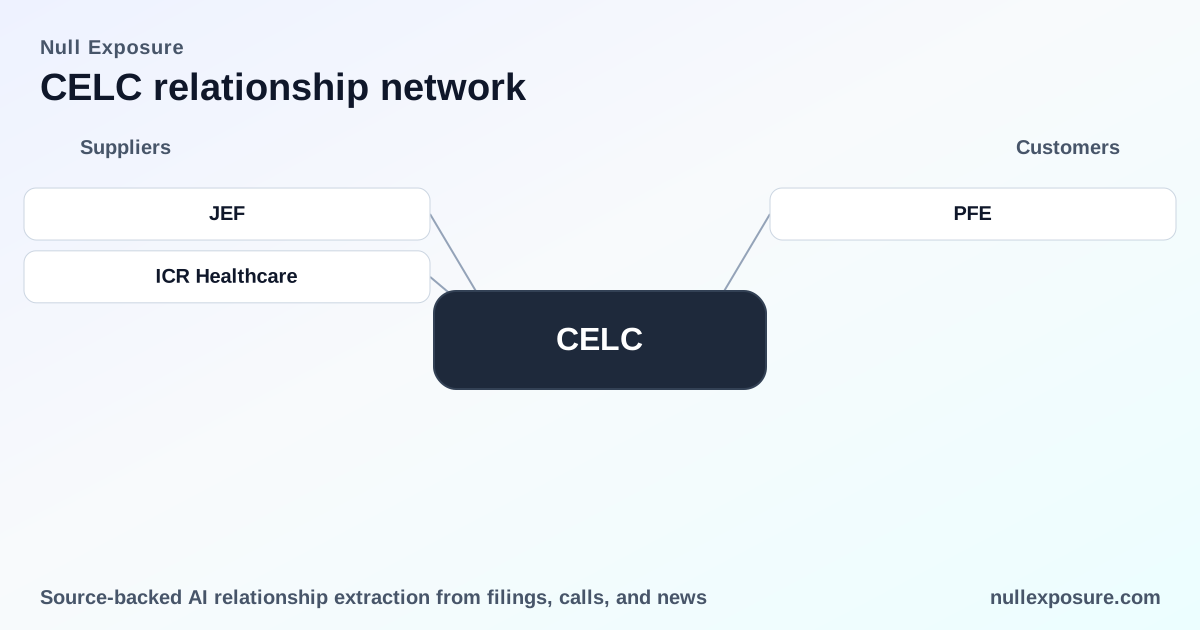
Celcuity (CELC): Partnership-driven clinical-stage story with concentrated commercialization optionality
Celcuity operates as a clinical-stage biotechnology firm that discovers cancer subtypes and pairs those diagnostics with therapeutic programs; the company monetizes primarily through co-development and licensing partnerships that convert scientific validation into upfront payments, R&D funding, milestone receipts and downstream royalties when drugs reach commercialization. With no reported revenue in the trailing twelve months and a market capitalization of roughly $7.01 billion, Celcuity’s valuation is driven by the clinical progress of its partnered assets and the strength of its partner commitments. For a focused view of customer relationships and partner risk, see more on Null Exposure: https://nullexposure.com/
How Celcuity really operates: a partnership-first commercialization architecture
Celcuity’s operational model centers on identifying tumor subtypes and matching those with therapeutic programs that require biomarker-driven development. The company has no recorded revenue TTM and reports negative operating metrics (EBITDA -$172.0M; diluted EPS -4.38), which is consistent with an R&D-intensive, clinical-stage biotech. Monetization is achieved when partners—typically larger pharma companies—sign development and commercialization agreements that provide non-dilutive funding and milestone-based cash inflows.
Key company-level signals for institutional investors:
- Contracting posture: Partnership-centric; Celcuity outsources large-scale development and commercialization to partners rather than building a broad internal commercial engine.
- Concentration: The partnership strategy creates concentrated counterparty exposure when any single partner is tied to a lead asset.
- Criticality: The company’s value is highly dependent on the clinical and commercial prospects of its partnered programs.
- Maturity: Clinical-stage with no product revenue reported; financials reflect an R&D phase organization (RevenueTTM: 0; negative returns on assets/equity).
These operational characteristics create a classic biotech risk/reward profile: asymmetric upside if partnered assets succeed, concentrated partner risk if a partner disengages.
What the relationship data shows (every reported relationship)
PFE — strategic co-development partner (FY2026)
Celcuity’s strategic partnership with Pfizer for the development and commercialization of Gedatolisib is highlighted as a core value driver, signaling an arrangement that links Celcuity’s biomarker platform to a major commercial engine. A DirectorsTalk Interviews article dated March 9, 2026 describes this partnership as central to Celcuity’s long-term growth thesis. (DirectorsTalk Interviews, 2026-03-09: https://www.directorstalkinterviews.com/celcuity-inc-celc-stock-analysis-biotechnology-innovator-s-9-29-upside-captures-investor-attention/4121240890)
Pfizer Inc. — same strategic tie captured again (FY2026)
Public commentary reiterates the Pfizer relationship with identical character: Pfizer is the partner tasked with advancing Gedatolisib into later-stage development and commercialization, which positions Celcuity to collect milestone and royalty economics on a successfully developed product. This point is reported in the same March 9, 2026 DirectorsTalk Interviews piece. (DirectorsTalk Interviews, 2026-03-09: https://www.directorstalkinterviews.com/celcuity-inc-celc-stock-analysis-biotechnology-innovator-s-9-29-upside-captures-investor-attention/4121240890)
Note: Both relationship entries in the source set reference Pfizer and the Gedatolisib collaboration; the public coverage underscores Pfizer as Celcuity’s principal commercial partner in the dataset provided.
Why the Pfizer tie matters for valuation and downside
The Pfizer collaboration transforms Celcuity from a pure discovery platform into a partner-enabled development company with realistic pathways to revenue. For investors, this delivers two concrete effects:
- Upside linkage: Clinical success for Gedatolisib combined with validated companion diagnostics creates material upside through milestone payments and royalties; that upside is reflected in a high market capitalization relative to current cash flows.
- Concentration risk: Relying on a single major partner for lead commercial options concentrates counterparty and program risk; a shift in partner priorities or clinical setbacks will have an outsized effect on Celcuity’s valuation.
Celcuity’s trading profile (52‑week high $151.02; low $9.51; 50/200 day averages indicate meaningful volatility) reflects the binary nature of partnership milestones and trial readouts.
Risk profile and contracting posture — what to watch beyond headlines
Because the constraints dataset provided contains no explicit red-team constraints, the following are company-level signals drawn from Celcuity’s operating model rather than specific constraint excerpts:
- Counterparty concentration is a primary risk signal: a small number of strategic partners can accelerate commercialization, but they also concentrate execution risk and negotiation leverage away from Celcuity.
- Commercial dependency on partner-led development reduces the need for Celcuity to build a large commercial infrastructure but increases dependency on partners’ R&D and portfolio priorities.
- Regulatory and clinical binary risk remains the dominant value driver—program-level outcomes will swing valuation substantially.
- Maturity signal: The absence of operating revenue and negative operating margins classify Celcuity squarely as a clinical-stage recipient of partner funding rather than a diversified commercial revenue generator.
What investors and operators should monitor next
- Clinical milestones and regulatory filings tied to Gedatolisib and any other partnered assets—these events directly unlock milestone payouts and re-rate valuation.
- Counterparty communications from Pfizer (press releases, investor updates, regulatory submissions) for indications of program prioritization or changes to timelines.
- Any new partner agreements or expansions that diversify Celcuity’s exposure away from a single anchor partner.
- Capital structure moves (equity raises, convertible instruments) that would dilute upside or signal funding needs given ongoing negative EBITDA.
For institutional users building partner-risk models, Celcuity should be treated as a high-conviction, partnership-levered investment where clinical and partner execution matter more than near-term cash generation. For a deeper client-grade view of partner relationships and exposure mapping, visit Null Exposure: https://nullexposure.com/
Bottom line
Celcuity’s business is a partnership-first clinical play: commercial optionality is realized through agreements with large pharma, of which Pfizer is the prominently cited partner in the available data. The company’s valuation reflects the market’s expectation that those partnerships will convert into late-stage success and commercial returns; conversely, the same structure concentrates downside if partner programs derail. Investors should prioritize monitoring partner communications, clinical milestones and any diversification of Celcuity’s commercial relationships.