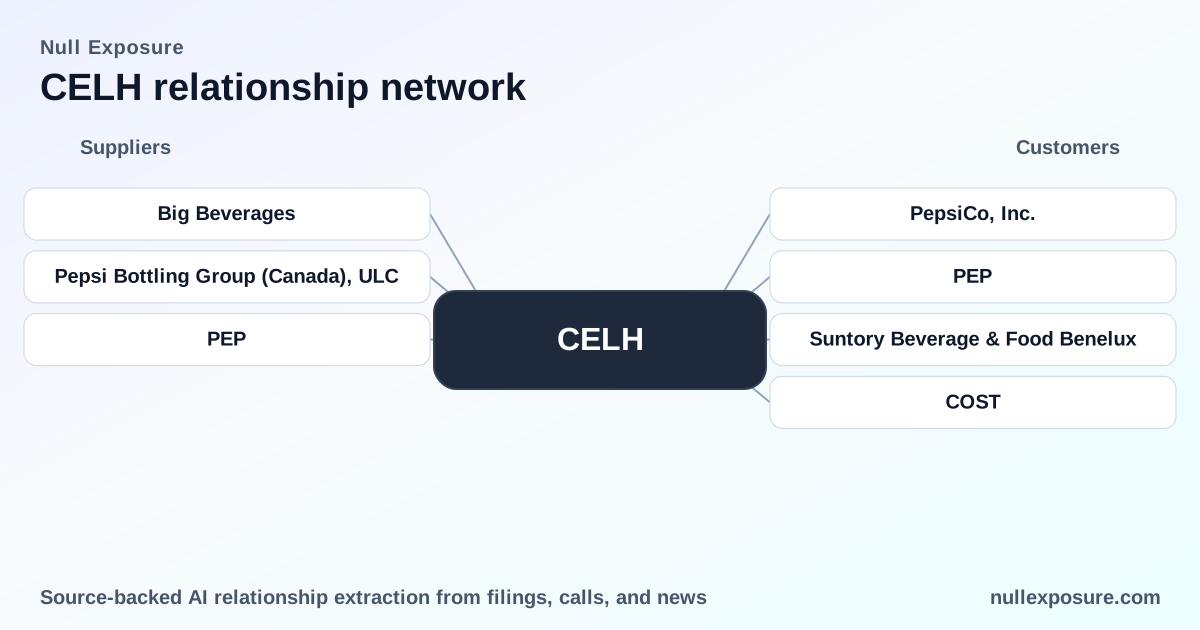
Celsius Holdings (CELH) — Customer Map and Commercial Risks for Investors
Celsius Holdings monetizes a branded portfolio of functional fitness beverages by scaling distribution and shelf presence through national partners and selective fitness-channel tie‑ins; revenue is recognized at delivery into distributor systems while profitability benefits from portfolio expansion and cost leverage. The company’s commercial thesis today is distribution-first: deep partnership with PepsiCo for U.S. national DSD distribution, targeted European rollouts with Suntory affiliates, and diversified retail placements including warehouse clubs and boutique fitness channels. For a practitioner deep‑dive into counterparties and concentration risks, see more at https://nullexposure.com/.
Why the customer map matters now
Celsius’s top-line growth and short-term working capital profile are driven by a small number of large wholesale relationships. PepsiCo accounts for a majority of revenue and receivables, creating both scale benefits and counterparty concentration risk. At the same time, international distribution pacts with Suntory affiliates and placement at Costco plus boutique partnerships provide geographic and channel diversification that supports the medium-term earnings trajectory.
How Celsius contracts and where commercial leverage sits
Celsius has a long-term distribution agreement with PepsiCo that makes Pepsi the primary U.S. distributor and gives PepsiCo category-leading responsibilities for Celsius brands in the U.S. (contract wording cited in the company’s filings). That structure creates a contracting posture where Celsius outsources execution—warehousing, delivery, and much of retail sell‑in—to a single national partner, thereby reducing operating leverage on route‑to‑market but increasing dependence on partner execution and credit.
- Concentration: Pepsi accounted for 54.7% of 2024 revenue and represented 62.2% of receivables at year-end 2024, signifying high customer concentration and balance‑sheet exposure (10‑K disclosure).
- Criticality: The distribution role is explicit—Pepsi is the primary U.S. distributor—making the relationship operationally critical (10‑K).
- Maturity: The primary distribution relationship is long‑term (agreement date August 1, 2022), implying stability of go‑to‑market but also extended exposure to partner execution risk.
- Company-level commercial programs: Promotional and reseller programs are executed in ordinary course through separate distributor/retailer agreements, indicating standard trade promotion mechanics across channels (company disclosures).
Counterparty-by-counterparty rundown (what investors need to know)
PepsiCo / Pepsi / PEP — the dominant partner
PepsiCo is Celsius’s primary U.S. distribution partner and accounted for a majority of revenue in 2024; the relationship is governed by a long‑term distribution agreement that makes Pepsi the principal route to market in North America. According to the company’s 2024 Form 10‑K, Pepsi became the primary distribution supplier under agreements signed August 1, 2022, and management reiterated the integration work and normalization of Pepsi inventory flows on the 2025 Q4 earnings call. (Sources: 2024 Form 10‑K; Q4 2025 earnings call transcript; investor conference commentary, March 2026.)
PepsiCo — integration and category captaincy in 2026 commentary
Management and sell‑side analysts emphasize an expanded role for Celsius inside the PepsiCo system—category captaincy and portfolio scale for brands like Alani Nu and Rockstar are central to the 2026 growth case. JPMorgan and other analysts cited the partnership as a driver of 2026 upside while management flagged progress in moving acquired brands into Pepsi’s distribution platform. (Sources: Analyst notes and news coverage in March 2026; Q4 2025 call.)
Costco / COST — a meaningful retail account, but not dominant
Costco accounted for roughly 10% of Celsius’s 2025 sales according to analyst commentary cited in coverage and the company’s 10‑K flagged Costco as a concentrated customer in prior filings. Management and sell‑side research stress that while Costco is important for trial and volume, it is not the single driver of sales and private‑label risk at warehouse clubs has historically been limited in energy drinks. (Sources: 2024 Form 10‑K; TD Cowen commentary and coverage, March–May 2026.)
Suntory Beverage & Food Benelux — targeted European entry
Celsius announced a distribution partnership with Suntory Beverage & Food Benelux to introduce Celsius products in Belgium and Luxembourg, supporting the company’s incremental European expansion and brand influence in that region. This move positions Celsius to convert regional distribution capacity into test markets for broader EU rollouts. (Source: press coverage summarizing the partnership, March 2026.)
Suntory Beverage and Food Spain — Spain launch confirmed
Suntory’s Spanish affiliate is the confirmed partner for a Spain launch in March 2026, reflecting a country‑by‑country roll‑out strategy in Europe rather than a single pan‑EU distribution agreement. This indicates Celsius is using local Suntory channels to accelerate market entry with established beverage infrastructure. (Source: sector coverage and market briefings, March 2026.)
Suntory (STBFY) — broader international relationship
Celsius cites national distribution with Pepsi for the U.S. alongside international expansion with Suntory, and public investor conferences note recent launches in the UK and Ireland under Suntory’s footprint—highlighting an emerging international distribution matrix that runs through local Suntory affiliates. (Source: investor conference disclosure, May 2026.)
solidcore — boutique fitness channel activation
Celsius is active in boutique fitness and lifestyle marketing: in April 2026, solidcore launched a member program featuring Celsius with member discounts and in‑studio purchase incentives, illustrating Celsius’s consumer engagement strategy and channel diversification in fitness environments. (Source: industry coverage on fitness partnerships, April–May 2026.)
Key investment implications — what drives upside and risk
- Upside drivers: Rapid distribution expansion through PepsiCo (category captaincy), successful integration of Alani Nu and Rockstar into Pepsi’s system, and incremental international rollouts via Suntory affiliates. These are the primary levers for revenue acceleration and margin improvement. (See analyst notes and management commentary, March 2026.)
- Principal risk: Customer concentration and receivable exposure to PepsiCo—54.7% revenue share in 2024 and over 60% of receivables—presents single‑counterparty credit and timing risk on cash collection and reported revenue recognition (10‑K). Trade promotions, overshipment timing, or inventory normalization at Pepsi materially influence quarter‑to‑quarter results.
- Mitigating signals: Expansion into Costco, fitness channels, and incremental European distribution with Suntory affiliates diversifies channels and geographies, reducing single‑point dependency over time if execution continues on plan. (Sources: filings and market coverage, early‑2026.)
Bottom line for investors
Celsius is a distribution‑led branded beverage growth story with an outsized exposure to PepsiCo in the U.S. and selective international roll‑outs via Suntory affiliates. That exposure delivers scale and faster shelf expansion, but it is also the core counterparty concentration risk that investors must monitor through receivable trends, inventory discussions in earnings calls, and retail scan data for sell‑through. For ongoing monitoring of counterparties, contracts, and concentration signals, visit https://nullexposure.com/.
For a structured, source‑linked view of Celsius’s customer relationships and concentration signals, explore the full interactive profile at https://nullexposure.com/.