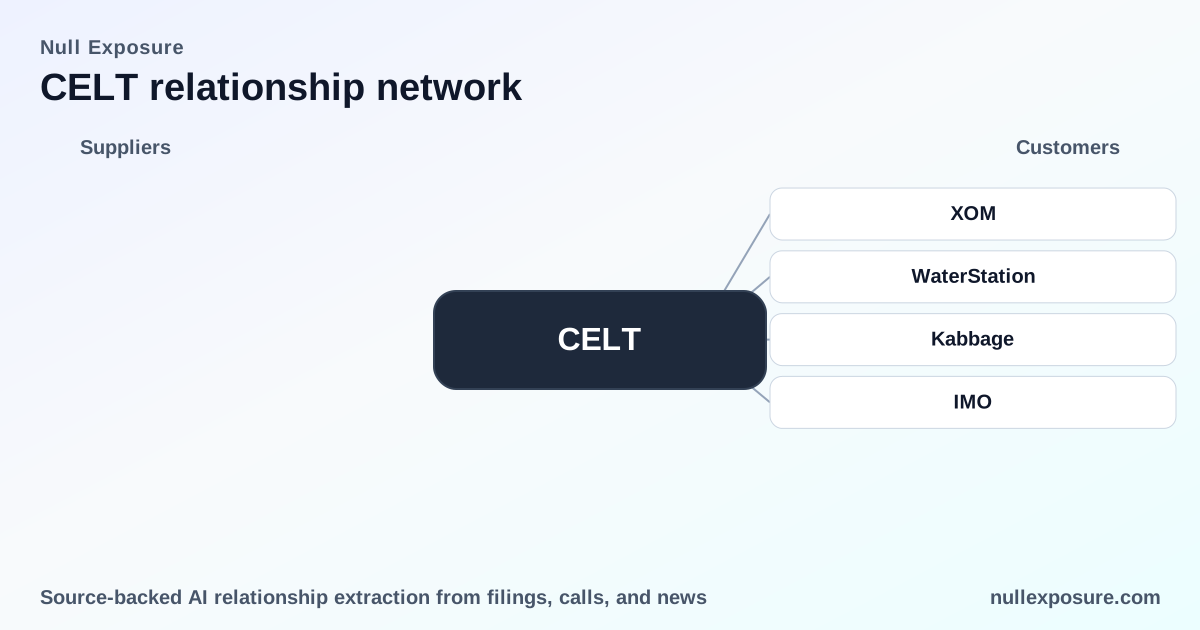
CELT customer relationships: a focused counterparty read for investors
Celtic’s public relationship map in the dataset crops up in two separate corporate contexts: Celtic Exploration Ltd., an upstream Montney-focused oil & gas operator that surfaces in M&A reporting, and Celtic Bank, a chartered lender that functions as a capital issuer to fintech-originated loans. Investors should treat CELT exposure as bifurcated between an energy asset whose strategic value attracts strategic acquirers and a banking partner embedded in fintech lending channels. For a quicker drill-down into underlying source material, see https://nullexposure.com/.
Why these relationships matter for valuation and credit work
Celtic’s counterparties reveal two distinct risk vectors for investors. The oil-and-gas side drives strategic value and potential takeover premiums; the banking side generates recurring fee and interest-margin economics but also concentrated operational risk through third-party fintech originators. That duality shapes both upside (M&A valuation, deposit/loan economics) and downside (counterparty fraud, servicing concentration).
How to read the dataset: two corporate contexts under one ticker
The raw results include evidence linking CELT to a major strategic buyer in energy and separately to multiple fintech and SBA-lending episodes. This is a dataset-level signal that CELT’s public footprint is split between an exploration asset attractive to global majors and a financial-services role as a loan issuer/partner. Treat downstream credit analysis and market comparables accordingly rather than assuming a single-business profile.
For deeper mapping of counterparties and documents, visit https://nullexposure.com/ for the full crawl and source links.
Relationship scorecard — what the coverage actually records
Below I list every relationship entry found in the results and give a concise one- to two-sentence plain-English takeaway with the original source cited.
Exxon Mobil Corp.
Globe and Mail coverage reports that Exxon Mobil Corp. is acquiring Celtic Exploration Ltd. for $2.6 billion, positioning Celtic’s Montney acreage as a strategic add to Exxon’s Canadian footprint. Source: The Globe and Mail (Mar 2026) — https://www.theglobeandmail.com/globe-investor/exxon-makes-a-land-grab-with-26-billion-deal-for-celtic/article4617626/.
XOM (duplicate mention)
The dataset repeats Exxon under ticker XOM with the same acquisition claim, underscoring that multiple mentions tie CELT’s valuation narrative to a strategic takeover by a global supermajor. Source: The Globe and Mail (Mar 2026) — https://www.theglobeandmail.com/globe-investor/exxon-makes-a-land-grab-with-26-billion-deal-for-celtic/article4617626/.
WaterStation (SBA 7(a) lending episode)
Industry reporting links Celtic to a pool of lenders that extended SBA 7(a) loans connected to WaterStation, a failed water-purification business alleged to have operated as a Ponzi-like scheme, which created potential credit and reputational exposure for participating lenders. Source: Fintech Business Weekly / Substack (2026) — https://fintechbusinessweekly.substack.com/p/stunning-sba7a-fraud-may-be-largest.
Kabbage (fintech originator relationship)
A regulatory/industry blog notes that Kabbage discloses in fine print that business loans it issues are funded by Celtic Bank, indicating Celtic Bank’s role as the chartered issuer behind large fintech-originated loan volumes. Source: Duke Law - The FinReg Blog (Jan 2020) — https://sites.duke.edu/thefinregblog/2020/01/23/the-rise-of-rent-a-charter-examining-new-risks-behind-bank-fintech-partnerships/.
IMO (Imperial Oil Ltd. referenced)
The Globe and Mail article also ties Celtic’s Montney reserves to Imperial Oil Ltd. (IMO) via Exxon’s existing Canadian assets, noting Celtic acreage could supply Imperial/Exxon export terminal plans — a signal of supply integration value to incumbent producers. Source: The Globe and Mail (Mar 2026) — https://www.theglobeandmail.com/globe-investor/exxon-makes-a-land-grab-with-26-billion-deal-for-celtic/article4617626/.
Imperial Oil Ltd. (duplicate mention)
A duplicate entry reiterates Imperial Oil’s strategic relevance in the acquisition narrative, reinforcing that one channel of value capture for Celtic Exploration is integration into existing regional production and export infrastructure. Source: The Globe and Mail (Mar 2026) — https://www.theglobeandmail.com/globe-investor/exxon-makes-a-land-grab-with-26-billion-deal-for-celtic/article4617626/.
Operating model and business-model characteristics investors should extract
- Contracting posture: On the banking side, Celtic Bank functions primarily as a chartered lender and issuer of loans behind fintech originators; contractual risk is heavy on underwriting and indemnities with partner platforms. On the exploration side, Celtic is a typical upstream E&P asset seller with contracts that monetize subsurface acreage via commodity markets or strategic divestiture.
- Concentration: The evidence points to counterparty concentration risk in two forms — dependence on large strategic acquirers for the exploration valuation uplift and reliance on a handful of fintech partners for loan volume in the banking business.
- Criticality: For fintech partners like Kabbage, Celtic is critical as the legal lender-of-record and capital provider; for legacy energy buyers, Celtic’s acreage is critical if it materially augments regional supply or export capacity.
- Maturity and exit profile: The exploration asset shows classic exit liquidity via strategic M&A (the Exxon report underscores a clear market exit route). The banking role is mature as a charter-holder but operationally sensitive due to third-party origination and regulatory and reputational friction, especially where borrower fraud or program abuse occurs.
Risk and opportunity read
- Opportunity: The Exxon-Imperial linkage demonstrates clear strategic acquisition value and a rapid de-risking path for exploration investors via sale processes. An M&A outcome drives valuation uplift distinct from operational cashflow.
- Risk: The WaterStation incident and public disclosure of Kabbage funding arrangements highlight operational and reputational risk on the banking side: fintech-originated loan programs can transmit credit losses and regulatory scrutiny back to the chartered lender.
- Net implication: Investors should segment value between a potentially binary M&A outcome for the acreage and a recurring, but operationally complex, banking franchise that requires careful counterparty monitoring.
Practical next steps for analysts and operators
- For valuation work, treat the exploration asset’s comparable set and potential strategic acquirers as the primary driver of takeout price. For credit due diligence on the bank role, prioritize loan-level controls, indemnity constructs with fintech partners, and past credit-loss incidents such as WaterStation.
- Maintain live counterparty tracking for each fintech partner and for major industry buyers in the basin; these relationships are the operational levers that will move realized value.
For more structured counterparty mapping and source-linked evidence, see the full repository at https://nullexposure.com/.
Conclusion: CELT’s public customer map bifurcates into a high-value strategic energy narrative and a high-touch banking partnership narrative; investors must apply different analytical lenses to each to separate acquisitive upside from operational credit risk.