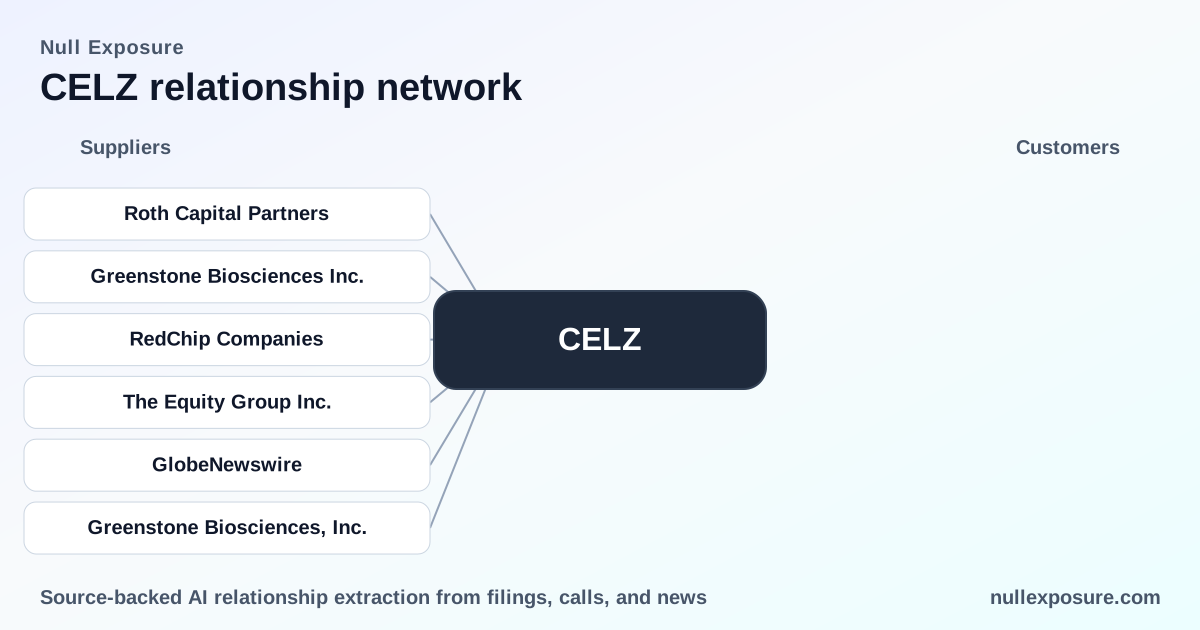
Creative Medical Technology Holdings (CELZ): customer map and commercial posture
Creative Medical Technology Holdings operates as a niche developer and seller of autologous stem-cell medical kits and related procedures. The company monetizes primarily through the sale of disposable CaverStem® and FemCelz® kits to physicians and through patient-paid procedures, with revenue recognized at delivery for kit sales and direct patient payments for clinical services. For investors, the business reads as an early-stage, hardware-centric commercial model with very limited current revenue but visible go-to-market activity through physician partnerships and training relationships.
Explore broader counterparty intelligence at https://nullexposure.com/.
Executive snapshot: what matters for investors
- Business model: sale of disposable medical kits plus revenue from patient-paid procedures; core products are hardware-oriented therapeutic kits.
- Commercial posture: spot, transactional sales recognized on delivery rather than multi-year contracts.
- Scale today: nominal—CaverStem® kit sales reported at $11k in 2024. According to the company’s results for the years ended December 31, 2024 and 2023, kit revenues totaled $11,000 and $9,000 respectively.
- Go-to-market: physician training and localized partnerships to onboard healthcare providers, not insurance reimbursement for procedures.
- Investment implication: high operational leverage to adoption; revenue upside requires meaningful physician adoption and a path to reimbursable care or materially higher out-of-pocket volume.
How the customer base is actually structured
CELZ’s commercial activity centers on physician customers who purchase disposable kits and on patients who pay directly for procedures. The company conducts most commercial operations through its CMT arm, which markets and sells the CaverStem® and FemCelz® kits utilized by treating physicians. According to the company’s disclosures for the years ended December 31, 2024 and 2023, revenues from CaverStem® kits remain immaterial relative to market-cap and operating losses.
Regenerative Medicine Health — a training and deployment partner
Regenerative Medicine Health is described in a press item as a partner location in Las Cruces, NM that has treated over 100 patients and functions as a trainer to onboard other healthcare providers to use CELZ’s CaverStem technology. According to a BioSpace report (May 2026), the clinic “partners with Creative Medical Technology Holdings, Inc. to serve as a trainer to onboard other HCPs interested in establishing their own practices.” Source: BioSpace, May 2026 — https://www.biospace.com/100-patients-treated-for-erectile-dysfunction-utilizing-company-s-patented-caverstem-stem-cell-procedure-with-significant-success-rate-and-no-adverse-effects-reported.
Constraints and what they reveal about the operating model
The company-level signals in public excerpts illustrate a distinct commercial profile for CELZ.
- Spot, transactional contracting. Revenue recognition language confirms that kit sales are transactional and recorded on delivery, indicating no substantial recurring contract book to smooth revenue volatility. The company’s revenue recognition statement directly links sales recognition to delivery to the customer.
- Counterparty type: individual payers. CELZ explicitly states that CaverStem® and FemCelz® procedures are paid for by patients and are not eligible for reimbursement from public or private insurers, so cash-pay economics dominate the commercialization path.
- Materiality: immaterial to date. Kit sales are immaterial to consolidated performance — $11k in 2024 and $9k in 2023 — leaving the product line economically insignificant relative to operating losses and market capitalization. These figures come from the company’s financial disclosures for the years ended December 31, 2024 and 2023.
- Role duality: seller and marketer. The company acts as the seller of disposable kits while conducting marketing and commercial operations through CMT to seed physician adoption; the public text also frames CMT as the primary commercial vehicle.
- Segment focus: core product, hardware-centric. The disclosures classify CaverStem® and FemCelz® as core product hardware (disposable kits), so revenue growth depends on unit sales volume and per-unit margins rather than software-like scaling.
- Spend profile: sub-$100k today. Current kit revenue levels place CELZ firmly in the sub-$100k spend band for this revenue stream, underscoring the infancy of commercial traction.
Collectively, these constraints form a coherent company-level signal: a hardware-first, transactional sales model selling into individual (cash-paying) patients through physician channels, with negligible current revenue and dependence on localized training partnerships to scale.
For a focused counterparty map and deeper relationship signals, visit https://nullexposure.com/.
Investor implications — upside and risks
- Upside: the model delivers leverage if physician adoption scales and procedures grow as a cash-pay elective category; training partnerships like Regenerative Medicine Health are critical distribution multipliers. If adoption increases, kit sales can scale predictably because the product is disposable hardware.
- Limiting factors: lack of reimbursement, very low existing revenue, and a sales model that relies on onboarding physicians individually impose high customer-acquisition costs and prolonged timelines to meaningful revenue. Regulatory, reputational, and clinical-evidence risks remain central.
- Balance sheet and capital needs: the operating loss profile and lack of recurring revenue signal ongoing capital requirements to fund commercialization and clinical validation. Investors should treat current revenues as validation of concept rather than a sustainable income stream.
- Concentration & criticality: current counterparty concentration is low in dollar terms but high in dependency: a handful of training sites and physician champions determine near-term commercial momentum.
Bottom line: positioning CELZ in a portfolio
CELZ is a speculative, early-commercial-stage biotech/hardware play where commercial traction is measured at the clinic level. The company monetizes through disposable kit sales and patient-paid procedures, and its present economics are immaterial to company financials. Investor focus should be on the rate of physician adoption, expansion of training partnerships, improved unit economics, and any pathway to reimbursement. The Regenerative Medicine Health relationship functions as an actionable example of CELZ’s go-to-market strategy: localized training partnerships that create physician supply and patient throughput. Source: BioSpace (May 2026) and company filings for years ended December 31, 2024 and 2023.
For more counterparty insights and to map similar relationships, visit https://nullexposure.com/.