Central Garden & Pet (CENT): Customer Concentration Defines the Commercial Risk Profile
Central Garden & Pet is a manufacturer and distributor of branded, private‑label and third‑party pet and garden products that monetizes primarily through wholesale and retail resale channels. The company generates revenue by selling finished goods to large national retailers and specialty chains, with significant portions of net sales flowing through a handful of large customers; fiscal 2025 revenue was roughly $3.09 billion and the top five customers accounted for approximately 54% of net sales. Learn more at https://nullexposure.com/.
How Central sells: short contracts, big customers, U.S. focus
Central operates with a clear commercial posture that influences both margin stability and downside risk.
- Short-term commercial terms dominate: The company states that most customer arrangements and related incentives have durations of one year or less, signaling frequent price and promotional negotiation cycles and limited long‑term contractual protections.
- High counterparty concentration: Roughly 54% of net sales come from the top five customers, a structural feature that concentrates revenue and bargaining power.
- U.S.-centric distribution: Central manufactures and distributes primarily in the United States, making the business sensitive to U.S. retail trends and consumer spending in lawn & garden and pet categories.
- Reseller channel model and material dependency: Central sells to wholesalers, distributors and retailers rather than directly to the end consumer, and the company explicitly warns that the loss or adverse change with top customers could have a material impact on financial results.
These characteristics create a commercial model that trades the stability of national retail distribution against cyclical negotiation risk, promotional pressure, and customer leverage.
Customer relationships that drive the business (complete list)
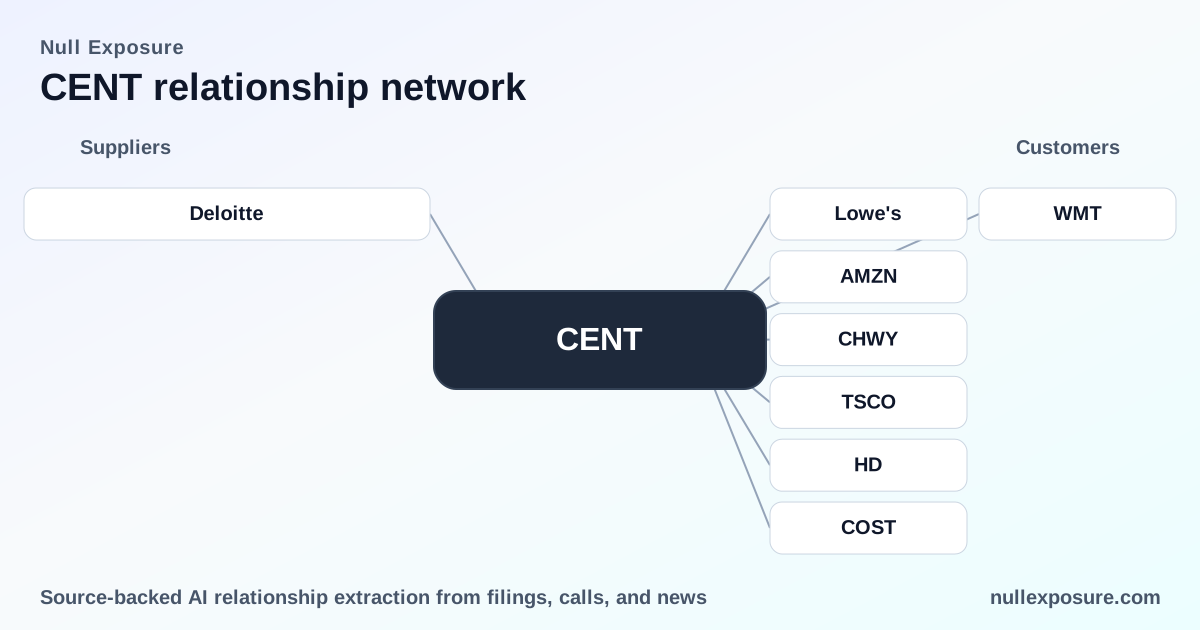
Below are the customer relationships referenced in company filings and public reporting that materially shape Central’s top-line exposures.
Walmart
Walmart was the company’s largest customer in fiscal 2025 and represented approximately 17% of total net sales in fiscal 2025 (and 16% in 2024 and 2023). According to Central’s FY2025 Form 10‑K, this single relationship is the largest single point of revenue concentration. (Central FY2025 10‑K, filed 2025‑09‑27)
Home Depot
Home Depot ranked as Central’s second largest customer and accounted for approximately 16% of total net sales in fiscal 2025, a stable share across the prior two years. This concentration underscores Central’s exposure to big‑box category cycles. (Central FY2025 10‑K, filed 2025‑09‑27)
Costco
Costco is listed among the company's significant customers that, together with other large retailers, comprise the company’s top five; Costco contributes materially to the 54% top‑five sales concentration highlighted in the FY2025 Form 10‑K. (Central FY2025 10‑K, filed 2025‑09‑27)
Lowe’s
Lowe’s is explicitly named among the significant customers and is part of the cohort that, combined with Walmart, Home Depot, Costco and Amazon, represented approximately 54% of net sales in fiscal 2025 and 2024. (Central FY2025 10‑K, filed 2025‑09‑27)
Amazon
Amazon is identified both in the FY2025 Form 10‑K as a significant customer contributing to the top‑five concentration and in subsequent trade reporting as a distribution channel for Central’s Farnam brand products. The dual role highlights Central’s dependence on national e‑commerce as a complement to brick‑and‑mortar retail. (Central FY2025 10‑K, filed 2025‑09‑27; StockTitan news report, Mar 9, 2026)
Tractor Supply Co. (TSCO)
Tractor Supply Co. is named in market coverage about Farnam products and is listed by Central as one of the retail outlets stocking Farnam pet care brands; this relationship is referenced in a March 2026 report on brand distribution. (StockTitan news report, Mar 9, 2026)
Chewy
Chewy is noted in trade reporting as a national e‑commerce partner for Farnam products, representing the company’s exposure to specialty pet e‑tail channels in addition to mass retailers and farm/agribusiness channels. (StockTitan news report, Mar 9, 2026)
What the relationship mix means for investors
Central’s customer list reads like a who’s‑who of U.S. retail: Walmart, Home Depot, Costco, Lowe’s, Amazon, Tractor Supply Co., and Chewy. That list creates a double‑edged commercial dynamic:
- Scale and shelf presence: Access to national chains and major e‑tailers provides broad market reach and predictable volume opportunities when merchandising is favorable.
- Negotiation and promo pressure: Short‑term sales terms combined with high concentration give large buyers meaningful leverage to demand promotions, pricing concessions, or favorable payment terms on a recurring basis.
- Material counterparty risk: The company explicitly warns that losing or materially changing terms with any top customer could have a material adverse effect on results, underlining the asymmetry of risk from a few large counterparties. (Central FY2025 10‑K, filed 2025‑09‑27)
Financial context reinforces the commercial picture: TTM revenue ~ $3.09B, EBITDA of about $346M, a trailing P/E of ~15 and an EV/EBITDA of ~8.1, indicating the market prices Central with modest leverage to cash‑flow multiples relative to peers. These numbers imply investors reward the company for scale but price in the customer concentration risk.
Learn more at https://nullexposure.com/.
Key investment implications and what to monitor
- Watch renewal cycles and promotional terms with the top five customers—short contract durations mean quarterly or annual negotiations can materially swing margins.
- Monitor Farnam brand traction across e‑commerce partners (Amazon, Chewy) and specialty retailers (Tractor Supply Co.); success there can diversify channel mix and reduce reliance on a handful of mass‑merchants.
- Track inventory and working capital metrics tied to large retail programs: big customers can influence seasonal purchase timing and return allowances.
- Geographic sensitivity: U.S. retail demand and lawn & pet seasonal cycles will dominate topline variability given the company’s U.S. distribution focus.
Bottom line
Central’s business model delivers scale through national retail and e‑commerce distribution, but its revenue profile is concentrated and driven through short‑term reseller contracts. That combination produces credible upside from national placement while embedding a persistent counterparty risk that investors must monitor across renewal cycles and promotional calendars. The FY2025 Form 10‑K and March 2026 trade reporting together give a complete picture of the customer relationships that currently determine Central’s commercial fortunes.