Central Garden & Pet (CENTA): Customer Footprint and Concentration — Investor Brief
Central Garden & Pet manufactures and distributes branded and private‑label lawn, garden and pet supplies to large national retailers and e‑commerce platforms, monetizing through wholesale product sales, private‑label contracts and retailer services (shelf placement, merchandising, tailored launch programs). Revenue is driven by a concentrated roster of major retail partners and high-touch retail services that support product velocity, while margins reflect manufactured goods, private‑label scale and distribution efficiency. For ongoing monitoring of customer disclosures and concentration signals, see https://nullexposure.com/.
High concentration — five retailers account for the majority of risk and opportunity
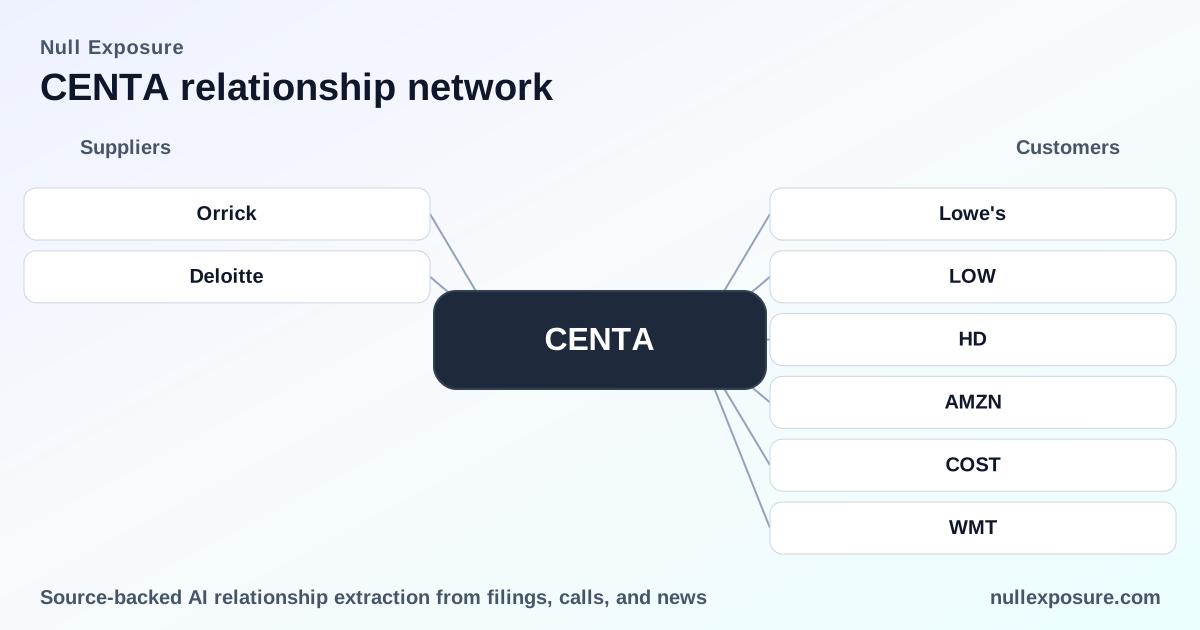
Central’s FY2025 disclosures make concentration a defining characteristic of its revenue base: Walmart is the largest single customer (~17% of net sales in FY2025), Home Depot is the second largest (~16%), and together with Costco, Lowe’s and Amazon these five retailers accounted for approximately 54% of net sales in fiscal 2025 and 2024. This concentration creates both scale advantages (large, repeat orders; merchandising access) and single‑counterparty downside (pricing pressure, program changes). Source: Central Garden & Pet FY2025 Form 10‑K (fiscal year ended Sep 27, 2025).
Lowe’s — recognized strategic vendor, significant buyer group member
Central has an established partnership with Lowe’s and was publicly acknowledged by management as Lowe’s Lawn & Garden Vendor Partner of the Year, a signal of execution and category strength within that retail channel. Lowe’s is also part of the five‑customer cohort that together accounted for ~54% of net sales in FY2025. Source: Central Garden & Pet FY2025 10‑K (filed for fiscal 2025) and an earnings‑call transcript published March 2026 by The Globe and Mail.
Home Depot — stable, large single account (≈16% of sales)
Home Depot is identified by the company as its second‑largest customer, representing roughly 16% of total net sales in each of fiscal 2025, 2024 and 2023, indicating a stable multi‑year revenue relationship that materially affects topline performance. Source: Central Garden & Pet FY2025 Form 10‑K (fiscal 2025).
Walmart — the largest retail customer (~17% of sales)
Walmart is the single largest retail customer, accounting for approximately 17% of net sales in FY2025 and 16% in prior fiscal years; this positions Walmart as both a revenue anchor and a concentration risk should terms change. Source: Central Garden & Pet FY2025 Form 10‑K (fiscal 2025).
Amazon — strategic online channel participant
Amazon is called out among significant customers in the FY2025 filing and is included in the five‑retailer group that together made up ~54% of net sales, reflecting the company’s exposure to e‑commerce distribution and digital shelf dynamics. Source: Central Garden & Pet FY2025 Form 10‑K (fiscal 2025).
Costco — large format wholesale partner in the five‑customer cohort
Costco is likewise listed among significant customers forming the concentrated five‑retailer base responsible for just over half of sales, giving Central exposure to bulk/warehouse retail channels and membership‑driven inventory cycles. Source: Central Garden & Pet FY2025 Form 10‑K (fiscal 2025).
How Central’s operating model shapes customer risk and optionality
The company’s regulatory disclosures and corporate narrative describe several company‑level constraints and operating characteristics that materially influence its customer relationships:
- Short‑term contracting posture: Key sales terms and customer incentives are established frequently and are generally one year or shorter, which gives Central commercial flexibility but increases revenue volatility and annual renegotiation risk. Evidence: FY2025 10‑K language on sales terms and incentive duration.
- U.S. geographic concentration: Central’s sales and distribution support nearly 10,000 retailer locations and over 5,600 veterinary offices, and the company reports minimal sales outside the United States, concentrating macro and retail‑channel exposure on North America. Evidence: FY2025 10‑K disclosures on U.S. network and limited international sales.
- Material customer dependence: The firm explicitly acknowledges dependence on a small number of customers for a significant portion of revenue, and states that the loss or adverse change in any of the top relationships could have a material adverse effect on results. Evidence: FY2025 10‑K cautionary language.
- Mature seller relationships with high touch services: Central describes long‑standing relationships with national and regional retailers and provides shelf placement, replenishment, packaging and merchandising — a business model that embeds Central in retailers’ operations and supports product visibility and velocity. Evidence: FY2025 10‑K descriptions of customer programs.
- Core product focus: The company’s relationships center on core branded and private‑label pet and garden products, suggesting limited reliance on experimental or non‑core categories for materially altering the customer mix. Evidence: FY2025 10‑K product and segment statements.
Together these constraints create a profile of a U.S.‑centric, retailer‑facing manufacturer/distributor whose flexible short‑term commercial terms and embedded merchandising services deliver channel access but whose concentration and contract cadence amplify counterparty and execution risk.
For a closer look at how centralized customer monitoring can inform investment decisions, visit https://nullexposure.com/.
Investment implications — what investors should price in now
- Concentration is the dominant risk factor. With five retailers driving ~54% of revenue and two customers contributing ~33% alone (Walmart + Home Depot), management execution and retailer terms will drive near‑term top‑line volatility. This is a valuation lever more sensitive to downside than to rapid upside absent new large accounts.
- Short‑term contracts increase earnings leverage. Annual renegotiations create opportunity for margin expansion if Central sustains product momentum, but also raise the probability of sudden unfavorable price or program changes.
- U.S. market focus simplifies logistics but limits geographic diversification. Investors get clarity on macro exposure (largely U.S. retail cycles) but should not expect geographic hedges from non‑U.S. growth to absorb a domestic retail slowdown.
- High‑touch retail services are a durable moat. Shelf placement, private‑label capabilities and merchandising scale are value‑adding services that support renewal and deepen retailer dependence on Central’s execution capabilities.
Bottom line: Central Garden & Pet is a scaled, margin‑sensitive distributor whose earnings outlook is tightly coupled to a handful of large U.S. retailers. Investors should underwrite both the durability of those retailer partnerships and the annual negotiation cycle when modeling revenue and downside scenarios.
Conclusion
For investors and operators evaluating CENTA’s customer relationships, the investment case turns on balancing the operational advantage of entrenched retail services against material counterparty concentration and short contract durations. Central’s FY2025 disclosures and management commentary confirm a mature U.S. retailer‑centric model that delivers steady scale but requires active monitoring of retail program outcomes and renegotiation cycles. For ongoing intelligence and cross‑company relationship tracking, see https://nullexposure.com/.