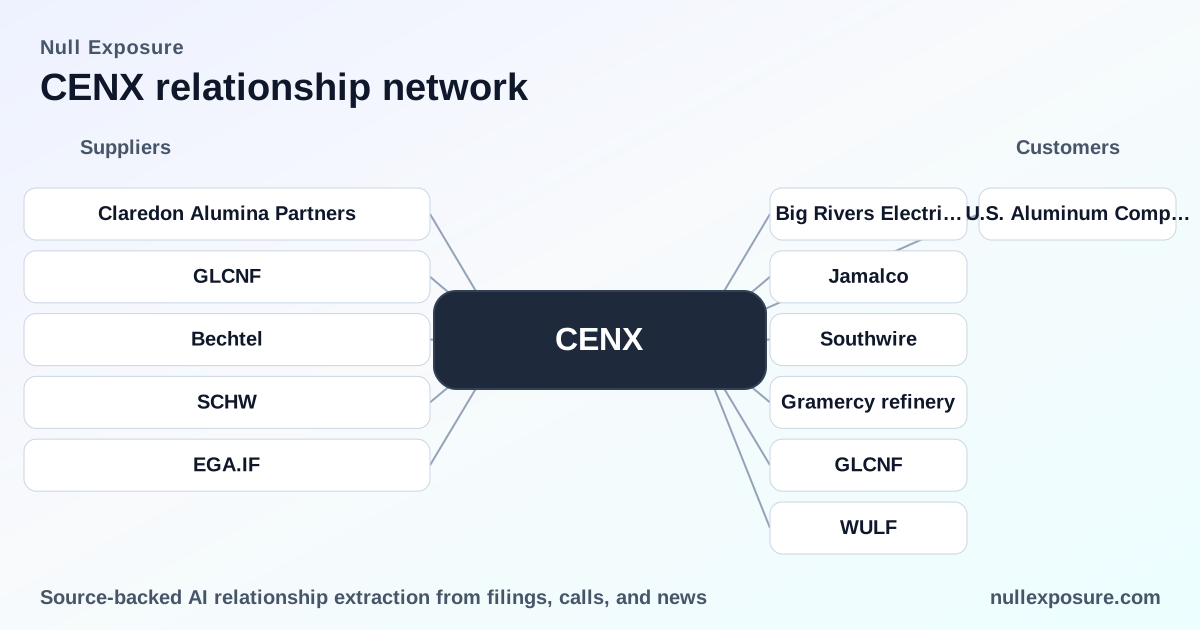
Century Aluminum (CENX): Customer Relationships that Drive Revenue and Risk
Century Aluminum produces and sells primary aluminum and value‑added aluminum products from U.S. and Icelandic smelters, monetizing through commodity‑priced contracts tied to LME benchmarks plus regional and product premiums. The company’s economics are driven by concentrated, short‑term customer commitments for commodity product flows, a dominant off‑take with Glencore that underpins near‑term cash generation, and opportunistic asset sales that reshape the balance sheet. Explore underlying relationship signals at https://nullexposure.com/.
Why customers matter for Century’s valuation
Century operates in a commodity market where revenue volatility, customer concentration and short contract tenor drive both upside and downside. The firm sells primary metal mostly on LME‑linked terms and supplements margin with value‑added premiums; therefore, who buys Century’s metal, under what contract terms, and for how long is central to cash‑flow visibility and refinancing capacity.
- Concentration: Glencore accounted for roughly 59.1% of consolidated net sales in FY2024, creating single‑counterparty exposure but also predictable offtake under existing agreements.
- Contracting posture: Management reports a customer base concentrated among a small number of buyers under short‑term contracts for 2025, implying limited long‑dated revenue locks and ongoing repricing exposure.
- Geography: Sales are meaningfully split between North America and Iceland, reflecting regional asset footprints and premium dynamics.
For a closer read on these signals and more, visit https://nullexposure.com/.
Operating model constraints and what they mean for investors
Century’s disclosures and management comments reveal several company‑level constraints that shape credit and equity risk:
- Short‑term contract mix: Management flagged a concentrated customer base under short‑term contracts for 2025, which implies revenue is regularly re‑priced against spot LME moves and regional premiums—raising earnings cyclicality.
- Geographic revenue split: Disclosure lines showing United States and Iceland sales volumes indicate North America and EMEA exposures, with Iceland representing a material regional business line.
- Critical single‑counterparty dependence: The FY2024 10‑K quantifies Glencore as a critical buyer, accounting for ~59.1% of sales; this is both a revenue stabilizer and concentration risk.
- Materiality of top customers: Century warns that losing one of its >10% customers could have a material adverse effect on operations.
- Relationship role and stage with Glencore: Filings state Glencore is the buyer of U.S. smelter production and agreements are in place to sell a substantial portion of 2025 production to Glencore, confirming an active commercial relationship.
- Segment focus: Century sells core primary aluminum products, with limited ability to pass upstream cost increases through contract structures.
These constraints frame valuation sensitivity: concentration supports near‑term revenue certainty but escalates counterparty and repricing risk when LME cycles turn.
Relationship roll call — what every customer mention tells investors
Below are each of the customer relationships disclosed in the source corpus with concise, document‑level summaries and citation cues.
-
Gramercy refinery — Century is the largest customer of the Gramercy alumina refinery in Louisiana, and supplements supply via third‑party alumina contracts, indicating a secured feedstock channel for U.S. smelters. Source: 2025 Q4 earnings call (March 2026).
-
Big Rivers Electric Corporation — Century discloses a contingent obligation tied to the unwind of a contractual arrangement involving CAKY, Big Rivers and a third party, referencing historical power contracting and associated cost‑based arrangements. Source: FY2024 10‑K (filed December 31, 2024).
-
Jamalco — The company notes that Jamalco secured alternative port arrangements during conveyor repairs to maintain alumina shipments, illustrating regional supply chain adjustments affecting alumina logistics. Source: FY2024 10‑K (filed December 31, 2024).
-
Southwire — Century reported net sales to Southwire exceeded 10% of net sales in 2024, identifying Southwire as a material customer whose business is material to results. Source: FY2024 10‑K (filed December 31, 2024).
-
GLCNF (Glencore) — For FY2024 Century derived approximately 59.1% of consolidated net sales from Glencore, and has agreements to sell a substantial portion of 2025 production to Glencore at LME‑plus‑premium pricing, making Glencore the company’s primary offtaker. Source: FY2024 10‑K (filed December 31, 2024).
-
Glencore plc — Glencore purchases Century’s U.S. smelter output at LME price plus Midwest premium and market product premiums, establishing the commercial mechanics that drive a large share of Century’s revenue. Source: FY2024 10‑K (filed December 31, 2024).
-
WULF (ticker reference for TeraWulf) — Multiple market notices document analyst upgrades and commentary following Century’s sale of the Hawesville facility to TeraWulf, signaling investor reaction to a balance‑sheet improving transaction. Source: Finviz news summary and related coverage (Feb–Mar 2026).
-
TeraWulf (earnings call mention) — Management confirmed the sale and redevelopment of the Hawesville site into a digital infrastructure campus run by TeraWulf, a strategic asset monetization that generated $200 million in cash proceeds. Source: 2025 Q4 earnings call (March 2026).
-
U.S. Aluminum Company — News reports state U.S. Aluminum signed an agreement with EGA and Century Aluminum to explore an aluminum fabrication plant near the planned Inola, Oklahoma smelter, indicating potential downstream collaboration and local ecosystem development. Source: StockTitan news item (March 2026).
-
TeraWulf (InsiderMonkey/news reprising) — Market write‑ups repeat that B. Riley raised Century’s price target after the Hawesville sale to TeraWulf, reflecting consensus narrative that asset sales materially de‑risk the balance sheet. Source: InsiderMonkey (Feb–Mar 2026).
-
TeraWulf (Intellectia coverage) — Trade press again links the Hawesville sale to positive analyst action, reinforcing the investor perception of reduced capital intensity and improved liquidity following the transaction. Source: Intellectia (March 2026).
-
TeraWulf (TS2 Tech reporting) — Detailed reporting flagged that Century’s Hawesville unit sale included a $200 million cash payment plus a 6.8% non‑dilutive minority stake in the buyer’s development arm, with redemption mechanics one year after data center commissioning, highlighting deal economics and contingent upside. Source: TS2 Tech (March 2026).
-
TeraWulf (ad‑hoc news) — European markets coverage summarized the $200 million Hawesville sale as balance‑sheet bolstering, underscoring the transaction’s strategic and financial import. Source: ad‑hoc‑news.de (March 2026).
-
Glencore (10‑K duplicate entry) — FY2024 filings reiterate that Glencore accounted for a majority of consolidated sales in 2024 and remains a primary purchaser, underlining the single‑buyer profile in the latest annual filing. Source: FY2024 10‑K (filed December 31, 2024).
-
WULF (InsiderMonkey duplicate) — Additional coverage mirrors prior notes that analysts view the Hawesville sale favorably, providing repeated market confirmation of the transaction’s positive impact. Source: InsiderMonkey (Feb–Mar 2026).
(Several news items in the results reflect the same TeraWulf/Hawesville transaction across different publishers; each is reflected above to preserve the full result set and the market narrative.)
Investment implications and risk checklist
- Positive: The Hawesville sale to TeraWulf materially strengthened liquidity and reduced asset intensity; a dominant buyer relationship with Glencore secures near‑term sales for a majority of production.
- Negative: High customer concentration and short‑term contract tenor create earnings sensitivity to LME moves and counterparty negotiation; loss of a >10% customer would be materially adverse.
- Monitor: Contract renewals with top customers, Glencore offtake terms for 2026+, and any further asset monetizations or downstream partnerships (e.g., Inola ecosystem).
For a deeper signal map and continuous monitoring of counterparty exposures, see https://nullexposure.com/.
Bold takeaways: Glencore is the principal customer and single largest risk mitigant and concentration point; short contract lengths maintain price exposure; asset sales like Hawesville change the balance‑sheet calculus but do not eliminate commodity cyclicality.