Central Puerto (CEPU): Customer Relationships Driving a Renewables Tilt
Central Puerto operates Argentina’s largest privately held power generation platform and monetizes through electricity sales to distributors, industrial offtakers and wholesale markets, plus capacity and ancillary payments and growing renewable PPAs. Revenue comes from a mixed portfolio of thermal, hydro and renewables sold under a combination of long-term offtake arrangements and spot market exposure, while new commercial deals with corporates and data-center projects provide an incremental route to margin expansion. For a mapped view of CEPU’s customer ecosystem, visit https://nullexposure.com/.
Why customer relationships matter for CEPU’s valuation
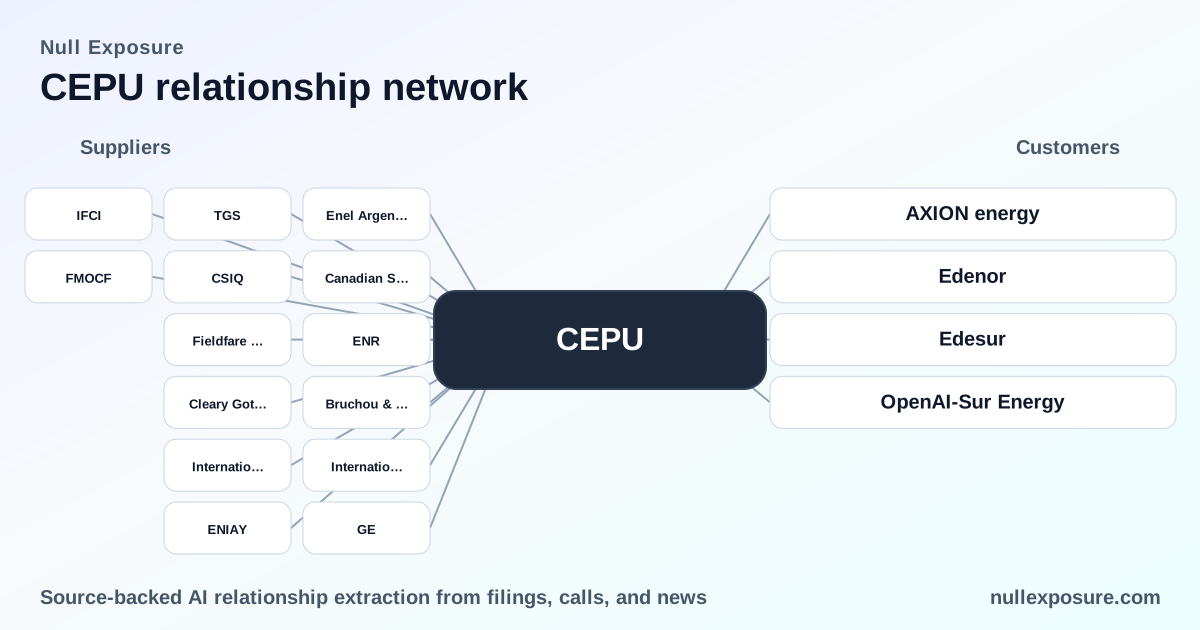
CEPU’s customer mix is the single most direct driver of near-term cash flow stability and long-run growth optionality. Long-term contracts with distribution utilities (Edesur, Edenor) anchor base load and capacity revenues, reducing volatility; commercial and industrial deals (Axion) and enterprise offtakers like OpenAI open higher-margin renewable supply channels. Contracting posture is hybrid: the company retains spot exposure while locking portions of output under multi-year supply agreements and memoranda of understanding for large new projects. This combination supports a higher multiple than an all-merchant generator while preserving upside from merchant cycles.
No explicit customer-related constraints were captured in the available relationship data; treat the absence of captured constraints as a company-level signal that public reporting emphasizes commercial agreements and MoUs rather than binding, widely publicized restrictive clauses.
Relationship roll call — who CEPU is selling to (and why it matters)
AXION energy
Central Puerto signed a strategic agreement to supply renewable energy to Axion’s refinery in Campana, Buenos Aires, positioning CEPU as the renewable supplier for a large industrial consumer and diversifying its offtaker base beyond utilities. According to MarketScreener and local press coverage on March 9, 2026, the deal targets renewable supply and I-REC certification for Axion’s operations in Campana. (MarketScreener, March 9, 2026; NoticiasAmbientales, March 9, 2026)
OpenAI
CEPU executed a memorandum of understanding that positions the company to supply renewable power to an OpenAI-backed Argentine data center, signaling entry into global-scale enterprise offtake relationships and potential long-duration demand. Bloomberg reported the MoU headline and CEPU’s engagement on October 14, 2025, and follow-up coverage in May 2026 framed the memorandum as a first step toward a formal offtake arrangement. (Bloomberg, Oct 14, 2025; Investing.com coverage, May 2, 2026)
OpenAI–Sur Energy (project-level dialogue)
CEPU’s management described discussions tied to a specific project and backup hydro capacity—Piedra del Águila—to support potential supply to the OpenAI project, indicating CEPU plans to pair renewable generation with firming resources for large customers. Management commentary in the Q4 2025 earnings transcript references project-level talks and the value of hydro backup for enterprise offtakers. (Earnings call transcript coverage, Q4 2025)
Edesur
Central Puerto identified Edesur as the offtaker for 55 megawatts at the Central Costanera complex, establishing a conventional distribution-client relationship that underwrites predictable load and capacity revenues in the Buenos Aires metro area. This disclosure came in CEPU’s Q3 2025 earnings call transcript coverage. (Earnings call transcript coverage, Q3 2025)
Edenor
CEPU noted an institutional supply arrangement with Edenor for a 150-megawatt battery-backed installation at the Central Puerto complex, reflecting a utility-scale solution to grid flexibility needs and a direct route to ancillary and capacity revenue streams. The arrangement appears in the company’s Q3 2025 earnings call discussion as reported in earnings transcript coverage. (Earnings call transcript coverage, Q3 2025)
What these relationships reveal about CEPU’s operating model
- Contracting posture: CEPU operates a hybrid model — a base of utility offtakes and capacity arrangements for stability, plus targeted commercial/enterprise deals and MoUs to capture higher-margin renewable demand. These relationships indicate deliberate commercialization toward firmed renewable supply for large customers.
- Concentration and counterparty mix: The presence of major distributors (Edesur, Edenor) anchors cash flow while industrial and enterprise customers (Axion, OpenAI) add diversification and potential for long-term, high-quality contracts. This mix reduces single-counterparty concentration risk relative to a pure-merchant generator.
- Criticality: Electricity supply is mission-critical for offtakers; CEPU’s ability to pair renewables with hydro and battery firming increases its negotiating leverage and the commercial value of contracts.
- Maturity and growth vector: CEPU is an incumbent generator adapting its product set toward firmed renewables and customer-specific solutions, signaling a shift from commodity sales to engineered offtake packages that command premium pricing.
Key takeaway: CEPU is executing a deliberate pivot to capture enterprise and industrial renewable demand without abandoning regulated and capacity-backed revenue — a profile that supports steady cash flow with scalable upside.
Implications for revenue, risk and valuation
These customer relationships translate into multiple, investable implications:
- Revenue quality improves as long-term utility contracts secure baseline EBITDA while renewables and firmed supply to corporates lift margin per MWh.
- Merchant exposure is moderated because paired hydro and battery capacity allow CEPU to offer firm offtake commitments rather than purely intermittent supply.
- Regulatory and country risk remain dominant given CEPU’s Argentina-centric operations; commercial contract wins moderate commodity risk but do not eliminate macro or policy exposure that affects grid tariffs and FX-sensitive cash flows.
- Valuation upside derives from contract conversion: MoUs and discussions with OpenAI and other large customers are value catalysts upon conversion to binding PPAs.
Investor action points
- Track conversion of the OpenAI MoU into a signed PPA and the structure (term length, pricing, firming obligations); conversion materially increases revenue visibility and justifies multiple expansion.
- Monitor the Axion contract implementation and the schedule for I-REC certification, which impacts renewable attribute monetization and exportable green credentials.
- Watch for utility contract renewals and battery/hydro firming deployment that lock in ancillary revenues.
For a structured customer-risk heatmap and follow-up signal tracking on these relationships, visit https://nullexposure.com/.
Bottom line
Central Puerto’s customer activity over the past year demonstrates a pragmatic commercial strategy: retain utility anchors for predictability while targeting high-value, long-duration renewable offtakes with industrial and global enterprise customers. That dual approach enhances revenue quality, creates new high-margin channels, and positions CEPU to extract premium pricing for firmed green power — outcomes that investors should weigh against Argentina-specific regulatory and macro risks when appraising CEPU’s risk-adjusted valuation.