Cerus Corporation (CERS): Customer Footprint and Commercial Constraints Investors Should Price In
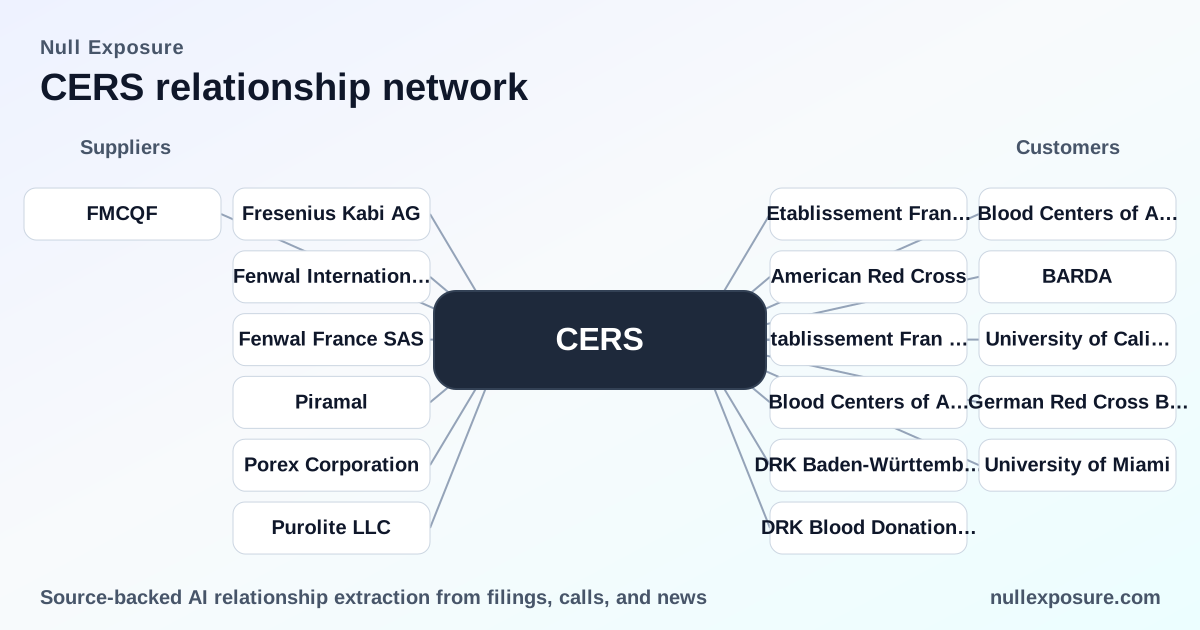
Cerus operates and monetizes a narrow, mission-critical medical-product franchise: develop, sell and service the INTERCEPT Blood System and related consumables to blood centers, hospitals, and select government agencies, while supplementing revenue with multi-year government development contracts. Revenue flows from system sales, recurring disposable kits and consumables, and contracted government funding for programmatic development and clinical studies. For a concise, investor-focused view of Cerus’ customer relationships and how they translate to commercial risk and opportunity, see https://nullexposure.com/.
Why customers matter to valuation: concentrated, recurring, and institutionally anchored
Cerus’ commercial model is concentrated and recurring. A small number of large blood banks and national health organizations drive a disproportionate share of product revenue; consumable kit sales yield high-margin, repeatable annuity-like revenue once systems are installed. That combination produces long lead sales but durable backend economics when adoption is achieved—and high revenue volatility if a large customer shifts strategy or a national deployer changes policy.
Key operating constraints that shape revenue visibility
- Long-term contracting posture: Cerus holds multiple long-duration development and supply relationships with government agencies, including BARDA, the U.S. DoD and the FDA, which deliver program funding over multi-year horizons and reduce near-term cash exposure. For investors, these contracts create cash runway and product development optionality while also concentrating program risk in a few counterparties.
- Government counterparty exposure: The company’s counterparties include major government agencies and public blood authorities, reflecting a mix of programmatic funding and policy-driven procurement rather than purely commercial purchasing.
- Geographic concentration and expansion profile: Cerus has established regulatory approvals and customers across North America, EMEA and selective global markets, positioning the company for staged international adoption but making revenue sensitive to national healthcare decisions.
- Sales model mix: Cerus sells both direct and through distributors, and relies on advocacy from long-term blood center customers to drive institutional adoption—a business model that favors deep customer relationships over fast, broad distribution.
- Spend-band signals: Public program contracts with BARDA indicate >$100m total program exposure in aggregate over option periods, while DoD and FDA agreements sit in the $10m–$100m range, delivering material but uneven external funding.
These constraints should be treated as company-level structural signals unless a contract excerpt explicitly names the counterparty.
For more investor intelligence on partner-level exposure and how it translates to revenue scenarios, visit https://nullexposure.com/ (homepage).
Customer-by-customer: what each relationship contributes to risk and upside
Etablissement Francais Du Sang (EFS) — 10‑K (FY2024)
Cerus identifies the French national blood service, EFS, as a central decision-maker for national platelet deployment, and warns that national deployment sustainability is critical to revenue in France. According to the FY2024 Form 10‑K, national adoption by EFS is a gating factor for broad product adoption in France (FY2024 10‑K).
American Red Cross — 10‑K (FY2024)
The American Red Cross is described as one of Cerus’ key customers and the largest single portion of the U.S. blood collection market, accounting for 35% of product revenue in the reported years. Cerus discloses American Red Cross represented 35% of product revenue in FY2024 (FY2024 10‑K).
tablissement Fran ais du Sang — 10‑K (FY2024)
The filing lists “tablissement Fran ais du Sang” as a significant customer representing 11% of product revenue, reinforcing the materiality of the French national blood authority to Cerus’ top-line. This is disclosed in the FY2024 Form 10‑K (FY2024 10‑K).
Blood Centers of America — Earnings call (Q4 2025)
Management referenced expectations tied to a group purchasing agreement with Blood Centers of America (BCA) as a commercial growth lever. The company discussed BCA during its Q4 2025 earnings call (Q4 2025 earnings call).
DRK Baden‑Württemberg‑Hessen — Earnings call (Q4 2025)
Cerus announced that DRK Baden‑Württemberg‑Hessen, the largest blood center in Germany, has begun enrollment in the INITIATE study evaluating routine use of pathogen-inactivated platelets. Management highlighted this enrollment on the Q4 2025 earnings call (Q4 2025 earnings call).
DRK Blood Donation Service Baden‑Württemberg – Hessen — News (Jan 22, 2026)
A press release covered DRK‑Baden‑Württemberg‑Hessen starting the INITIATE post‑market study of INTERCEPT-treated platelets, signaling clinical validation and potential adoption pathway in Germany. The press release was published Jan 22, 2026 (press release, Jan 22, 2026).
Blood Centers of America (BCA) — News (Dec 10, 2025)
Cerus issued a Dec 10, 2025 press release announcing a group purchasing agreement with BCA, which represents a cooperative that covers a significant portion of the U.S. blood supply and is expected to expand market access. The Dec 10, 2025 announcement confirmed the BCA agreement (press release, Dec 10, 2025).
Blood Centers of America — Markets/FinancialContent reporting
Market outlets summarized the BCA purchasing agreement and positioned it as a meaningful commercial catalyst for Cerus’ U.S. growth, noting BCA’s role as the largest blood supply cooperative in the U.S. (FinancialContent/market press coverage, Dec 2025).
Blood Centers of America — StockTitan coverage
StockTitan also reported the group purchasing agreement with BCA on Dec 10, 2025, echoing Cerus’ release and reinforcing media coverage of the commercial milestone (StockTitan, Dec 10, 2025).
Blood Centers of America — InsiderMonkey (Q1 2026 commentary)
Management reiterated in Q1 2026 commentary that the BCA group purchasing agreement is a key enabler of growth, noting BCA members represent roughly half of U.S. blood supply. This was discussed in Q1 2026 earnings call coverage (InsiderMonkey, Q1 2026).
American Red Cross — InsiderMonkey (Q1 2026 commentary)
In Q1 2026 remarks, Cerus thanked partners including the American Red Cross for continued trust in INTERCEPT, underlining the ongoing commercial importance of that relationship (InsiderMonkey, Q1 2026).
Swiss Red Cross — InsiderMonkey (Q1 2026 commentary)
Management highlighted the Swiss Red Cross among its largest and longest-term blood center customers, underscoring international advocacy for the technology (InsiderMonkey, Q1 2026).
Canadian Blood Services — InsiderMonkey (Q1 2026 commentary)
Cerus cited Canadian Blood Services as a long-term customer and advocate, indicating sustained international penetration and institutional support (InsiderMonkey, Q1 2026).
OneBlood — InsiderMonkey (Q1 2026 commentary)
The company listed OneBlood as a key long-term customer, signaling presence among major U.S. regional blood networks (InsiderMonkey, Q1 2026).
Blood Centers of America — StockTitan (Q4 release summary)
StockTitan’s Q4 summary reiterated the Dec 10, 2025 BCA agreement as a contributor to Cerus’ commercial outlook (StockTitan, Q4 2025 release).
BARDA — InsiderMonkey (Q3 2025 commentary)
Cerus’ revenue growth was attributed in part to enrollment in the Phase III RedeS trial and activities covered under the company’s BARDA agreements, confirming BARDA-funded clinical investment in the red blood cell program (InsiderMonkey, Q3 2025).
Blood Centers of America — InsiderMonkey (Q4 2025 investor commentary)
Management described the BCA agreement as a key contributing factor to the company’s commercial opportunity during Q4 2025 commentary (InsiderMonkey, Q4 2025).
German Red Cross Blood Service, Baden‑Württemberg, Hesse — InsiderMonkey (Q3 2025 commentary)
Cerus was selected by this German Red Cross blood service to support the INITIATE study, indicating multi‑site German clinical evaluation of pathogen‑reduced platelets (InsiderMonkey, Q3 2025).
University of California, San Diego (UCSD) — InsiderMonkey (Q3 2025 commentary)
Cerus cited UCSD’s Quality Council approval of IFC for hospital‑wide use driven by significant cost savings, supporting hospital-level adoption economics (InsiderMonkey, Q3 2025).
DRK Baden‑Württemberg‑Hessen — InsiderMonkey (Q4 2025 commentary)
The company reaffirmed DRK‑Baden‑Württemberg‑Hessen’s enrollment in INITIATE as part of its post‑market Phase IV evaluation, reinforcing German market activity (InsiderMonkey, Q4 2025).
EFS — InsiderMonkey (Q1 2026 commentary)
Management described a recently signed multiyear contract with the French EFS as enhancing visibility into Cerus’ forward outlook (InsiderMonkey, Q1 2026).
University of Miami — InsiderMonkey (Q3 2025 commentary)
University of Miami clinicians reported operational benefits from IFC’s 5‑day post‑thaw shelf life, enabling faster access and reduced wastage relative to conventional cryoprecipitate (InsiderMonkey, Q3 2025).
DRK Blood Donation Service Baden‑Württemberg – Hessen — StockTitan (Jan 22, 2026)
StockTitan covered the Jan 22, 2026 announcement that DRK‑Baden‑Württemberg‑Hessen launched the INITIATE study, aligning with other press coverage of German clinical programs (StockTitan, Jan 22, 2026).
DRK Blood Donation Service Baden‑Württemberg – Hessen — StockTitan (TD Cowen participation notice)
Additional StockTitan coverage referenced the same DRK INITIATE study when announcing Cerus’ investor event participation, reinforcing the commercial narrative in Germany (StockTitan, Jan 2026).
Investment implications — framing upside and downside
- Upside drivers: group purchasing agreements (BCA), national contracts (EFS), and BARDA/DoD program funding materially improve visibility into revenue ramps and reduce commercialization risk where adoption is endorsed by national authorities. BCA and EFS are high‑impact adoption levers.
- Downside risks: customer concentration (single customers accounting for double‑digit revenue shares) and policy-driven national decisions create step‑function tail risk to revenue. Program funding is significant but lumpy.
Investors should value Cerus’ recoverable annuity economics from consumables under installed systems while pricing in execution risk tied to national procurement cycles and the cadence of government option exercises.
For selective, partner-level analysis and scenario modeling tools, see https://nullexposure.com/.