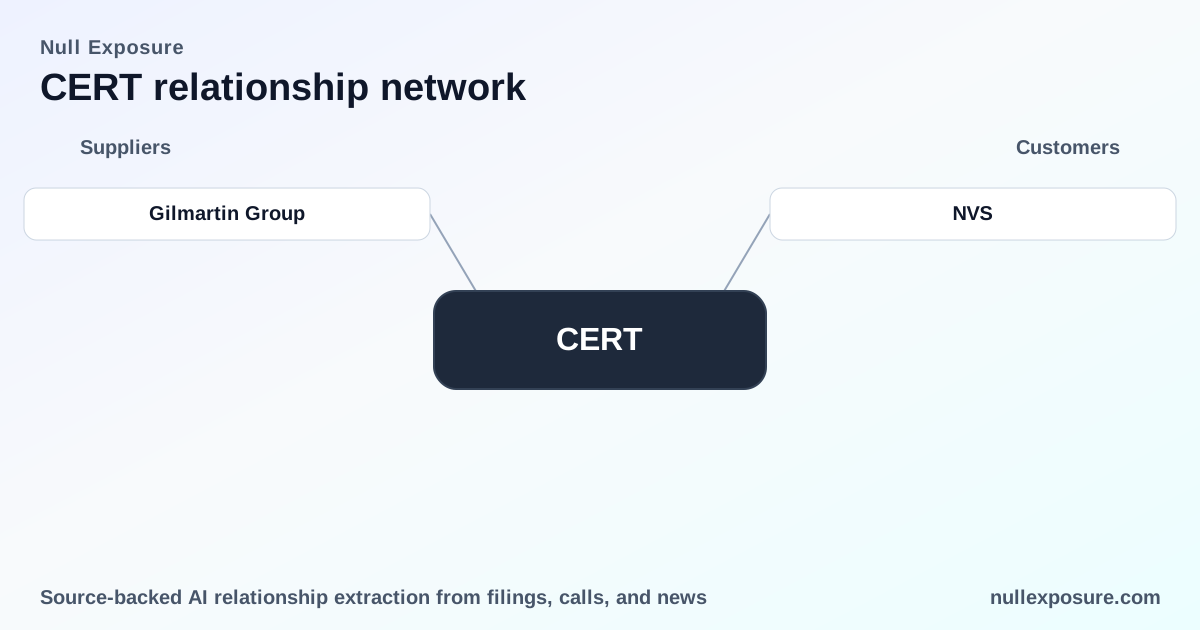
Certara (CERT) Customer Relationships: Strategic Partners, Revenue Signals, and Risk Implications
Certara operates at the intersection of biosimulation software and technology-enabled drug development services, monetizing through a blend of software licensing, cloud subscriptions, annual maintenance, and project-based consulting that supports regulatory filings and market access. With roughly $419 million in trailing revenue and a market capitalization near $949 million, Certara’s business is driven by recurring license and subscription economics combined with high-value services that are often linked directly to regulatory success and clinical decision-making.
For investors who want a quick counterparty read, see our platform for structured relationship signals: https://nullexposure.com/
Why customer relationships are the core signal in a software-plus-services biopharma vendor
Certara’s revenue model is not a pure SaaS play; it is a hybrid. Software contracts are sold as either perpetual or term licenses with upfront recognition, or as cloud subscriptions recognized ratably over one-to-three-year terms, and those commercial terms shape cash flow predictability, customer stickiness, and valuation multiples. The company also delivers technology-enabled services—scientist-led consulting and regulated writing—that are higher margin when scaled but inherently more project-driven.
Several operating characteristics stand out as investor-relevant signals:
- Contracting posture: The mix of upfront license fees and ratable subscription/maintenance revenue creates a split between predictable recurring revenue and lumpy services cash flows. The legal and accounting language indicates one-year maintenance cycles are standard, with many subscriptions lasting one to three years.
- Concentration and customer type: Certara sells globally and counts government agencies (including the FDA and other regulatory bodies) among users; that elevates strategic criticality but does not imply single-customer concentration.
- Role diversity: Certara acts both as licensor of scientific software (Simcyp and other platforms) and as a service provider, delivering consulting and regulatory support—this dual role diversifies revenue but requires different operating disciplines.
- Maturity and renewal cadence: Annual maintenance and multi-year subscriptions imply a moderate maturity profile; net retention metrics and renewal rates are material value drivers because subscription renewals and expansion underpin recurring revenue growth.
Contracting posture and revenue cadence: what to watch in the quarterlies
Investors should focus on three measurable items each quarter: subscription renewal rates and average contract length, professional services revenue versus backlog, and any material one-time dispositions or acquisitions that reweight the services/software split. The company explicitly recognizes some license revenue upfront while subscription and maintenance fees are recognized ratably, which means reported revenue can swing as the mix shifts between licensing, subscription, and time-limited services projects.
Explicit customer relationships: what to watch next
Veristat — buyer of Certara’s Regulatory & Medical Writing business (FY2026)
Certara agreed to sell its Regulatory and Medical Writing business to Veristat for up to $135 million, consisting of $100 million upfront and up to $35 million in earn-outs, in a definitive agreement announced in April 2026. This is a strategic divestiture that reduces Certara’s services footprint while generating near-term cash and contingent upside tied to transition performance (press release, April 21–22, 2026: https://www.theglobeandmail.com/investing/markets/stocks/CERT-Q/pressreleases/1472508/certara-to-divest-regulatory-and-medical-writing-business/; also reported via ManilaTimes and TradingView).
Novartis (NVS) — Simcyp Consortium member and reference case (FY2026)
Novartis scientists, as members of the Simcyp Consortium, publicly endorsed the Simcyp Simulator’s scientific rigor after PBPK modeling was accepted by the FDA to replace clinical trials in support of an NDA for asciminib (Scemblix). Regulatory acceptance by the FDA for PBPK outputs is a high-value validation that supports both software licensing and the credibility of Certara’s model-informed drug development platform (news reports, March 2026: stocktitan and Bitget coverage quoting Novartis PK Sciences).
Novartis Biomedical Research — regulatory acceptance testimonial (FY2026)
Novartis Biomedical Research specifically commented that membership in the Simcyp Consortium provided firsthand experience with Simcyp’s capabilities and its role in enabling regulatory acceptance of PBPK models, reinforcing the platform’s position in protocol and submission workflows. This endorsement translates into a commercial signal: platform science that regulators accept materially increases the platform’s utility and stickiness for large pharma customers (news coverage, March 2026: Bitget/Stocktitan referencing Novartis statements).
How the Veristat deal changes the commercial map
The sale of the Regulatory and Medical Writing business to Veristat is the single largest customer-relationship event in the dataset. The transaction converts an ongoing services revenue stream into upfront cash and contingent payments, with obvious implications:
- Immediate balance-sheet impact: $100 million upfront improves liquidity or deleverages the company depending on management’s allocation of proceeds.
- Revenue mix shift: Services that were historically part of Certara’s technology-enabled offerings will now flow through Veristat, lowering Certara’s services revenue but potentially increasing margin and focus on software and higher-value model-informed offerings.
- Earn-out risk: Up to $35 million in contingent consideration ties future cash to transitional performance or commercial milestones—monitor earn-out triggers and timing in FY2027 disclosures.
Investment implications and near-term monitoring list
- Retention and subscription renewal rates: Because Certara blends upfront license fees with ratable subscriptions and annual maintenance, improvements in net retention are the clearest route to multiple expansion.
- Post-divestiture guidance: Watch management commentary on how the Veristat proceeds will be used—paydown, buybacks, or reinvestment—and how sales and R&D budgets are reallocated between software and remaining services.
- Regulatory validation cadence: Additional FDA or global regulatory acceptances of PBPK or MIDD outputs (like the Novartis case) will materially raise the platform’s commercial value and reduce sales friction with large pharma.
- Government and regulator contracts: Continued licensing to agencies like the FDA and PMDA acts as a credibility moat that supports long-term adoption; track renewal activity there.
Bottom line for investors
Certara’s hybrid model—software licensing/subscription plus targeted services—creates recurring revenue with pockets of high-margin consultancy tied to regulatory outcomes. The Veristat divestiture crystallizes value from a services vertical and repositions Certara toward its software and model-informed core, while regulatory acceptance cases such as Novartis’s use of Simcyp provide demonstrable commercial leverage. Key near-term items to monitor are subscription retention, the deployment of divestiture proceeds, and further regulatory endorsements that validate the company’s core platform.
For a structured view of these and other counterparty signals, visit our relationship intelligence hub: https://nullexposure.com/