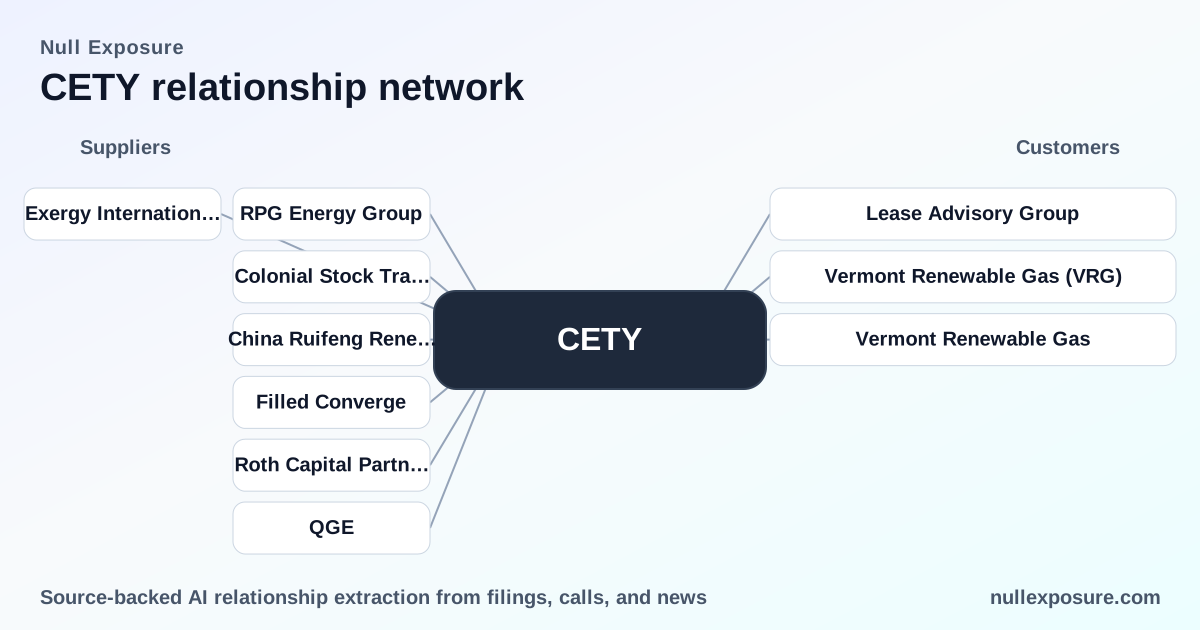
Clean Energy Technologies (CETY): Customer Relationships That Drive Project Revenue — and Concentration Risk
Clean Energy Technologies, Inc. (Nasdaq: CETY) is a small-cap clean-energy engineering and manufacturing company that monetizes through three principal channels: (1) EPC and turn‑key services for renewable and waste‑to‑energy projects, (2) equipment sales and integrated system deployments using proprietary platforms (including Clean Cycle and HTAP), and (3) commercial natural gas sourcing and resale through regional trading and distribution operations. The company’s revenue profile is project-driven and episodic, with meaningful receivables tied to a small number of counterparties — a structural characteristic investors must weigh when valuing future growth. For direct access to more relationship intelligence, visit https://nullexposure.com/.
Key takeaway up front: CETY’s commercial progress is real and tangible — LOIs and EPC contracts anchor near-term backlog — but the business exhibits high customer concentration and short-term contracting posture that amplify counterparty and execution risk.
Why the relationship map matters to investors
CETY operates as a hybrid manufacturer, EPC contractor, and gas reseller. That mix produces lumpy revenue streams (project milestones and EPC billing) alongside transactional spot sales in gas trading. The company’s commercial links — LOIs with project developers, an active EPC pipeline, and related‑party projects — reveal where near‑term revenue and receivables are concentrated. For investors, two truths follow: project execution and counterparty credit are the dominant financial levers, and balance‑sheet stability depends on converting LOIs to firm contracts and collecting on large receivables.
Detailed relationship summaries (every disclosed counterparty)
Hoppy Power Ltd.
CETY executed a non‑binding Letter of Intent with Hoppy Power to evaluate deployment of its High Temperature Ablative Pyrolysis (HTAP™) waste‑to‑energy technology, advancing a first deployment in Alberta and targeting scalable rollout across Canada. The LOI is presented publicly as the catalyst for an initial project evaluation and potential regional expansion. According to a GlobeNewswire press release (March 30, 2026), the engagement centers on moving an HTAP proof point into deployment in Alberta and exploring broader scalability. Additional press coverage reiterated the LOI and its role in CETY’s waste‑to‑energy push (Investing.com synopsis and Manila Times coverage, March–May 2026).
Why it matters: this relationship signals CETY’s move from demonstration to commercialization in waste‑to‑energy, but it is structured initially as a non‑binding LOI rather than a firm EPC contract — underscoring development‑stage revenue potential rather than immediate, guaranteed cash flow.
Sources: GlobeNewswire press release (Mar 30, 2026); Investing.com news summary (May 2026); Manila Times syndicated GlobeNewswire item (May 2026).
Lease Advisory Group (LAG)
CETY has an LOI with Lease Advisory Group to act as the Engineering, Procurement and Construction (EPC) contractor for multiple Battery Energy Storage System (BESS) projects in New York. The LOI was disclosed in a GlobeNewswire release filed in October 2025 and positions CETY to secure project‑level engineering and construction work in the U.S. Northeast market.
Why it matters: BESS EPC work represents repeatable services revenue and strengthens CETY’s pipeline in grid‑scale storage — projects that convert LOIs into staged EPC billing can produce predictable milestone cash flows if execution and permitting proceed on plan.
Source: GlobeNewswire press release (Oct 8, 2025).
Vermont Renewable Gas (VRG / VRG, LLC)
CETY is integrally involved in the Vermont Renewable Gas development (VRG-Lyndon). CETY’s Renewables business executed a turnkey EPC agreement to design and build the organics‑to‑energy facility and booked related‑party revenue: $801,086 in 2023 and $110,517 in 2024, with accounts receivable from VRG reported at $1,556,531. Public disclosures and trade coverage indicate VRG is an affiliated project and a material receivable on CETY’s balance sheet; Quiver Quant and GlobeNewswire items in early 2026 describe the project’s move into permitting and CETY’s role as the integrator under a roughly $12 million EPC scope.
Why it matters: VRG is both customer and related party, representing a multi‑million dollar project relationship and a concentrated receivable that materially impacts CETY’s working capital. The $1.56M accounts receivable figure is an explicit, disclosed claim on the company’s liquidity.
Sources: Quiver Quant coverage (Mar 2026); GlobeNewswire conference/exhibit announcements (Feb–Mar 2026).
Operational constraints and what they signal about the business model
CETY’s public excerpts and relationship disclosures create a coherent picture of operating posture and risk:
- Contracting posture: short‑term and spot‑priced transactions coexist with longer EPC agreements. Excerpts indicate natural gas sales are transacted at prevailing daily spot prices and invoicing commonly occurs on Net 30 terms; simultaneously, the company undertakes multi‑month EPC contracts. This hybrid posture produces both transactional margin volatility and project cash‑flow milestones.
- Customer mix spans municipalities (government), small and mid‑market private developers, and related‑party projects. The company explicitly serves municipal and industrial customers and small/mid‑size projects across North America, Europe and Asia, indicating a geographically diversified sales strategy but limited scale in any single market.
- High receivables concentration is a critical balance‑sheet risk. Management disclosed that seven customers represented approximately 98% of accounts receivable as of December 31, 2024 — a clear indication that shortfalls with any single counterparty would materially stress liquidity.
- Multi‑role business model: CETY acts as manufacturer, seller, and service provider — designing and producing equipment, reselling natural gas in distribution channels (CETY HK), and performing EPC services. This integration improves margin capture per project but concentrates execution risk internally.
- Segment mix includes distribution and services. Natural gas trading and distribution activities coexist with engineering and consulting services, creating exposure to commodity price swings alongside project delivery risk.
- Spend and scale signal: the VRG engagement demonstrates mid‑sized project economics — explicit receivable and billing figures place at least one customer in the $1M–$10M spend band, implying that CETY’s project ticket sizes are meaningful but not enterprise scale.
Combined, these constraints imply a company in early commercialization: real projects and receivables exist, but revenue is uneven and concentrated, and the business requires tight working‑capital management and successful contract conversions to sustain growth.
Investment implications and risk checklist
- Positive: LOIs and EPC bookings (VRG, LAG, Hoppy Power) establish a visible project pipeline and demonstrate product application across waste‑to‑energy, BESS, and organics‑to‑energy.
- Negative: extreme accounts‑receivable concentration and a hybrid spot trading exposure raise short‑term liquidity and counterparty risk; execution risk on EPC projects and the non‑binding nature of some LOIs limit near‑term revenue certainty.
- Catalysts to watch: conversion of LOIs to firm EPC contracts, successful collection of VRG receivables, and first commercial deployment of HTAP in Alberta.
For investors evaluating commercial counterparties and credit exposure, the relationship map is decisive: CETY’s upside is project‑based and tangible, but it is tightly coupled to a small set of customers and to the firming of LOIs into executable contracts.
If you want a deeper, relationship‑level briefing and ongoing monitoring of these counterparties, explore more analysis at https://nullexposure.com/.