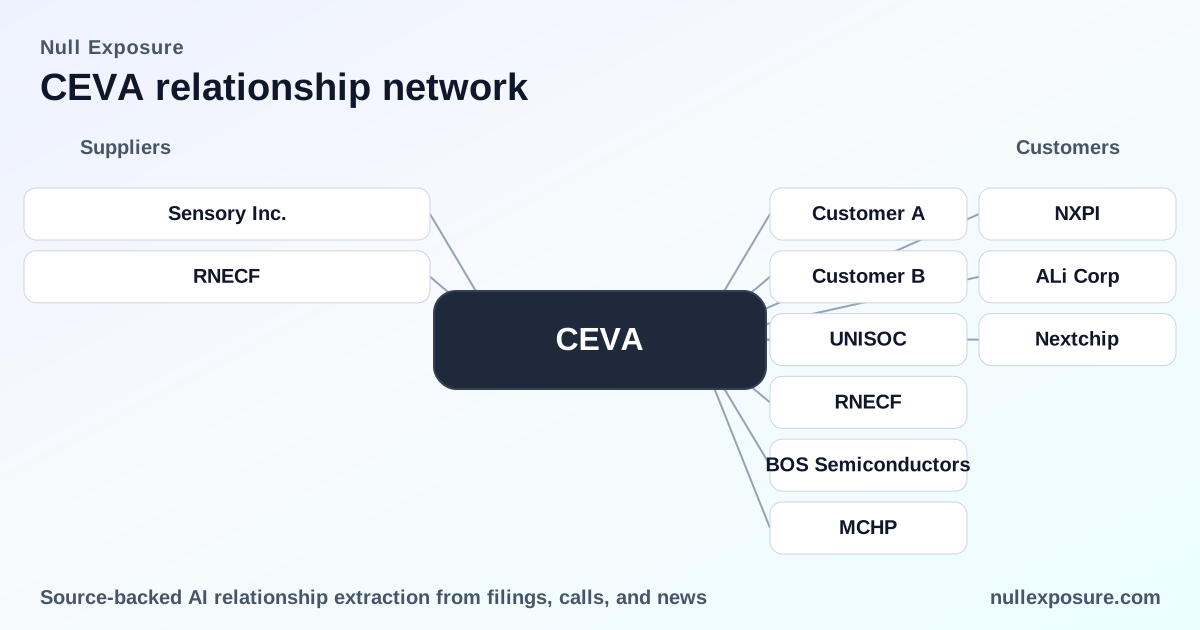
CEVA Inc — Customer Relationships That Drive a Licensing Business
CEVA operates as a pure-play IP licensor and royalty engine: the company sells architecture licenses, software stacks and validated IP cores to semiconductor vendors and OEMs, then collects upfront license fees plus usage‑based royalties on each chip that ships. This monetization model creates high gross margins on revenue recognized from licensing activity while concentrating economic exposure in a relatively small number of large customers and in APAC markets. For investors, the question is whether new AI DSP and wireless wins translate to durable royalty streams that offset customer concentration and cyclical semiconductor demand. Learn more at https://nullexposure.com/.
How CEVA makes money — simple, scalable, and usage‑tethered
CEVA’s revenue model is straightforward: license fees for access to IP and architecture plus royalties calculated per unit or as a percentage of licensee revenue. The company discloses that royalties are calculated either on a per‑unit basis or as a percentage of the licensee’s product revenues, and that it operates a licensing and royalty business with a mix of architecture grants and customer‑specific modifications. That mix creates predictable upfront cash from licensing and potentially long tails of recurring revenue as licensees ship silicon. CEVA manages the business as a single reportable segment focused on IP licensing to semiconductor companies and OEMs (CEVA 2024 10‑K).
The roster that matters — every documented relationship, explained
Customer A
Customer A was a materially large customer: it represented 15% of CEVA’s revenues for 2024 and 24% of trade receivables as of December 31, 2024, marking it as a critically material payer on the balance sheet. Source: CEVA 2024 10‑K (FY2024).
Customer B
Customer B accounted for 12% of CEVA’s trade receivables in 2024, indicating a significant short‑term receivable concentration even if its revenue share is not disclosed in these excerpts. Source: CEVA 2024 10‑K (FY2024).
UNISOC / Unisoc (formerly Spreadtrum)
Sales to UNISOC contributed 16% of total revenues in 2024 (15% noted for 2024 in alternate phrasing), establishing Unisoc as one of CEVA’s top revenue contributors over multiple years. Source: CEVA 2024 10‑K (FY2024).
Sony
Sony is listed among large OEMs that license CEVA’s wireless technologies, demonstrating CEVA’s penetration into major consumer electronics platforms. Source: Embedded.com, May 2026.
Vivo
Vivo is named as a maker of consumer electronics licensing CEVA wireless IP, reflecting CEVA’s reach into high‑volume smartphone OEMs. Source: Embedded.com, May 2026.
Apple
Apple is cited as a likely licensee of CEVA wireless technologies in industry reporting, signaling CEVA’s credibility with top‑tier, vertically integrated OEMs. Source: Embedded.com, May 2026.
Nokia
Nokia appears on a list of large OEMs licensing CEVA’s wireless IP, underscoring CEVA’s role in both handset and network‑adjacent ecosystems. Source: Embedded.com, May 2026.
Xiaomi
Xiaomi is referenced among consumer device makers licensing CEVA wireless technologies, supporting CEVA’s customer mix across high‑volume APAC smartphone players. Source: Embedded.com, May 2026.
Ambiq
Ambiq is identified as an example of a small fabless developer that licenses CEVA’s wireless solutions, showing CEVA’s breadth from startups to large enterprises. Source: Embedded.com, May 2026.
Renesas (Renesas Electronics Corporation / RNECF)
Renesas selected Ceva‑Waves Wi‑Fi 6 and Bluetooth LE IPs for its first combo MCUs, a design win announced in March 2026 that positions CEVA inside Renesas’ RA6W1/RA6W2 combo microcontrollers for IoT and connected‑home markets. Source: PR Newswire and StockTitan, March 2026.
BOS Semiconductors
BOS Semiconductors licensed CEVA’s SensPro™ AI DSP architecture for its Eagle‑A standalone ADAS SoC, a direct AI DSP design win that places CEVA in automotive ADAS silicon. Source: Markets.FT and company press releases, January–March 2026.
Microchip Technology (MCHP / Microchip)
Microchip signed a comprehensive NeuPro NPU portfolio license, adopting Ceva’s NPUs across Microchip product families to embed AI capabilities broadly; the agreement was highlighted in March 2026 reporting. Source: EETAsia / EET India, March 2026.
NXP Semiconductors (NXPI / NXP)
NXP integrated Ceva’s SensPro AI DSP into S32Z2 and S32E2 processors designed for real‑time domain and zonal control modules in software‑defined vehicles, a design win reported in early 2026. Source: EETIndia and StockTitan, March 2026.
Intel
Industry coverage lists Intel among companies that have worked with CEVA for foundry‑validated IP cores across Wi‑Fi/Bluetooth and UWB, reinforcing CEVA’s engineering credibility with major semiconductor houses. Source: Embedded.com, May 2026.
ALi Corp
ALi Corp is noted as one of several additional NPU engagements in 2025–2026, expanding CEVA’s footprint into consumer electronics and video platform silicon. Source: EETAsia / StockTitan, March 2026.
Nextchip
Nextchip was announced as another NPU engagement, extending CEVA’s presence in automotive and video processing markets. Source: EETAsia / StockTitan, March 2026.
(If you require primary copies of the press releases and filings cited above, see CEVA’s 2024 Form 10‑K and company press coverage linked in newsroom posts and industry journals.)
What these relationships mean for commercial and investment risk
-
Contracting posture: CEVA uses a mix of upfront architecture licenses and usage‑based royalties; this creates near‑term cash from licenses with upside tied to licensee unit shipments. Evidence in the 2024 10‑K states royalties are charged either per unit or as a percentage of licensee revenue, and architecture deals can be structured as long‑term grants.
-
Concentration and criticality: The company reports material customer concentration—two royalty‑paying customers represented nearly half of royalty revenues in 2024 and Customer A alone accounted for double‑digit shares of revenue and receivables—making CEVA economically sensitive to the shipping cadence of a few large licensees.
-
Geographic exposure: APAC is the dominant revenue region, with China constituting the single largest country share (49% of revenues for 2024), while EMEA and the U.S. provide secondary contributions; this creates sensitivity to APAC semiconductor demand cycles and regulatory dynamics.
-
Counterparty profile and maturity: CEVA’s customers skew toward large enterprise licensees and Tier‑1 semiconductor/OEM players, though the company’s IP is also licensed by smaller fabless developers, indicating both scale and breadth in customer type. CEVA manages an active pipeline of design wins in AI DSP and wireless connectivity that indicate maturity in its IP portfolio.
-
Commercial upside vs. downside: Design wins with Renesas, Microchip, NXP and BOS show near‑term product integrations that can generate multi‑year royalties if the licensees achieve volume shipments; conversely, CEVA’s financials reflect negative EPS and tight operating margins, so the timing and scale of royalty realization are decisive for valuation.
Key takeaways for investors
- CEVA is a licensing-first business with usage‑based royalty economics.
- Revenue concentration and APAC exposure are primary risk factors; a small set of customers drives a large portion of royalties and receivables.
- Recent 2025–2026 design wins in AI DSP and wireless (Microchip, NXP, Renesas, BOS) materially improve the runway for recurring royalties if product shipments scale.
- CEVA’s client list spans small fabless firms to top‑tier OEMs (Apple, Sony, Nokia), which validates technology breadth but does not eliminate concentration risk.
For a closer read of CEVA’s filing details and to monitor customer‑level developments, visit https://nullexposure.com/ — the company page aggregates filings and market signals that matter to active investors.
Conclusion: CEVA’s monetization is robust in structure — license fees plus usage‑tied royalties — and recent AI and wireless wins expand its addressable royalty base, but material customer concentration and APAC revenue reliance remain central top‑down risks that will determine whether these wins convert into predictable earnings growth.