CF Industries: How customer ties and commercial signals shape the investment case
CF Industries is a vertically integrated manufacturer and distributor of nitrogen fertilizers that monetizes through the sale of anhydrous ammonia and derived nitrogen products, long‑term offtake contracts, and an extensive North American distribution network. The company captures margin by owning production capacity, logistics, and by pursuing low‑carbon ammonia projects and long‑term export arrangements that convert commodity exposure into durable cash flows. Explore full coverage at https://nullexposure.com/ for deeper relationship analytics.
What investors need to know up front
- Core revenue driver: anhydrous ammonia and derivative fertilizers (urea, UAN, AN) sold to cooperatives, retailers, distributors and industrial users.
- Commercial posture: CF combines spot commodity sales with long‑term offtake agreements and joint ventures to de‑risk cash flow and underwrite capital projects.
- Geographic reach and scale: North American production and logistics with global export ambitions, including EMEA/UK operations and dedicated export capacity for low‑carbon ammonia.
- Contract scale: public disclosures indicate material contracted minimums (cumulative minimums of roughly $1.2 billion as of December 31, 2024), which signals large counterparty billing and concentration.
A comprehensive roll‑call of reported relationships (news and calls) Below are every relationship mention captured in the feed, presented as one‑line summaries with source references for diligence.
- ARBE (Arbe Robotics Ltd.) — Canaccord Genuity acted as sole bookrunner for Arbe’s $16M registered direct offering. Source: Manila Times / GlobeNewswire press coverage (FY2026).
- CRDL (Cardiol Therapeutics Inc.) — Canaccord Genuity closed a US$13.5M public offering as sole bookrunner per the company release. Source: NewsfileCorp press release (FY2024 / FY2026 filings).
- VERU (Veru Inc.) — Canaccord Genuity LLC and Oppenheimer were joint book‑running managers for Veru’s public offering. Source: GlobeNewswire press release (Oct 2025).
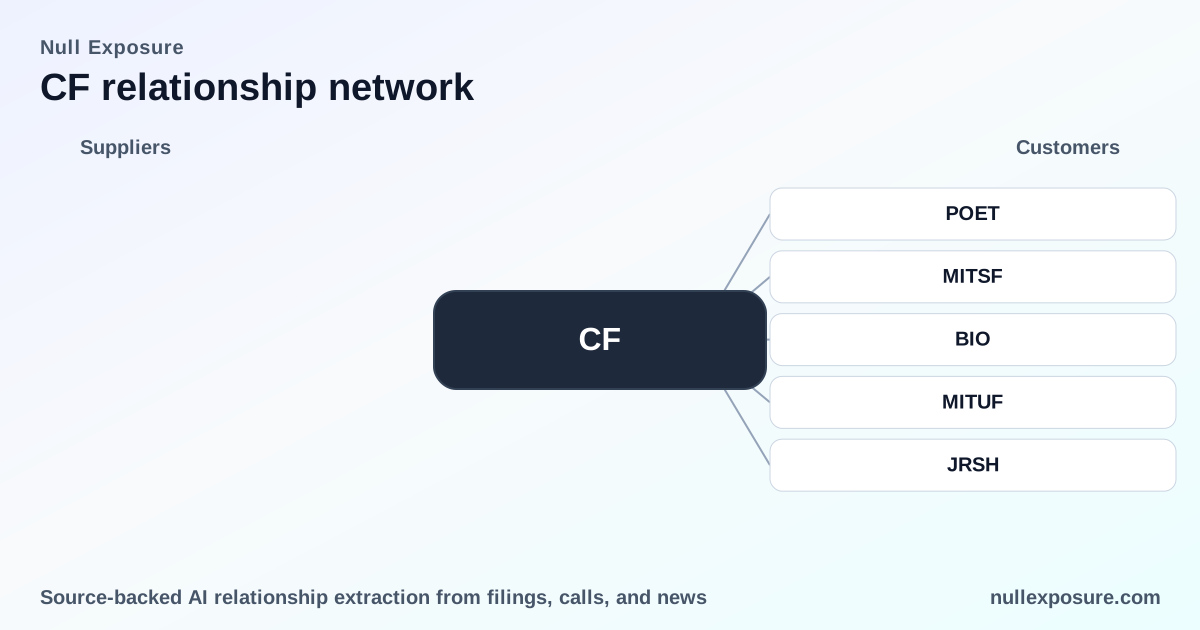
- POET (Poet, the biofuels producer) — CF advanced a pilot project with POET to enable production of low‑carbon ethanol, per CF’s Q4 2025 earnings call. Source: CF earnings call transcript (2025Q4).
- ARBE (alternate report) — A QuiverQuant recap confirms Canaccord as sole bookrunner for Arbe’s public offering, with co‑managers noted. Source: QuiverQuant summary (FY2026).
- CGC (Canopy Growth Corp.) — Canaccord Genuity Corp. acted as exclusive financial advisor to Canopy Growth on its MTL Cannabis acquisition. Source: Morningstar / BusinessWire coverage (FY2026).
- CTGO (Contango Ore Inc.) — Canaccord provided a fairness opinion and advised Contango on a plan of arrangement; the firm acted as sole bookrunner on a subsequent offering. Source: PR Newswire and Finviz / MarketScreener reports (FY2025–FY2026).
- DFLI (Dragonfly Energy) — Canaccord acted as sole bookrunner on a proposed offering and as lead agent on an ATM equity distribution agreement. Source: StockTitan / The Globe and Mail (FY2025–FY2026).
- GRO (Brazil Potash) — Canaccord served as lead bookrunner for a proposed public offering announced in press coverage. Source: Yahoo Finance / press notice (FY2026).
- NFGC (New Found Gold) — Canaccord was part of an underwriting group raising C$115M to advance a project, per Canadian Mining Journal. Source: Canadian Mining Journal (FY2026).
- FURY (Auryn / Eastmain financing) — The bought‑deal financing was co‑led by Canaccord Genuity Corp. and Beacon Securities. Source: Resource‑Capital.ch recap (FY2020 / cited in FY2026 feed).
- LUCD (Lucid Diagnostics) — Canaccord Genuity and BTIG acted as joint bookrunners on an $18M underwritten offering. Source: TradingView / PR Newswire (FY2026).
- ITRG (Integra Resources Corp.) — Canaccord led co‑underwriting of an oversubscribed $61.6M offering alongside Stifel Nicolaus Canada. Source: Finviz / Investing.com coverage (FY2026).
- ANVS (Annovis Bio) — Canaccord served as sole bookrunner on a $10M underwritten transaction. Source: Investing.com / Yahoo Finance notice (FY2026).
- AURE (Aurelion Inc.) — A sales agreement for an ATM equity program included Canaccord Genuity among the dealers under the arrangement. Source: TipRanks news report (FY2026).
- VGFC (The Very Good Food Company) — Canaccord managed the IPO and exercised the overallotment in earlier coverage of the company’s listing. Source: CrowdfundInsider historical report (FY2020 / referenced FY2026).
- USAS (Americas Gold and Silver / USAS) — A bought‑deal private placement was led by Canaccord Genuity and BMO Capital Markets. Source: InsiderMonkey summary (FY2025).
- BTCT (Bitcoin Treasury Corp.) — The offering involved Canaccord among multiple financial institutions in the syndicate supporting Toronto trading debut. Source: CoinDesk coverage (FY2025).
- CHSCN (CHS Inc. news) — CF is working with CHS Inc. to accelerate production and distribution of low‑carbon nitrogen fertilizer, per CHS corporate communications. Source: CHS Inc. press (2023, referenced FY2023).
- CHSCL (CHS cluster) — CHS publicly announced partnership with CF to distribute low‑carbon nitrogen fertilizer to support sustainability efforts. Source: CHS Inc. press (Nov 2023 / FY2023 reference).
- MITSF / Mitsui & Co. (Blue Point JV) — CF’s Blue Point joint venture with JERA and Mitsui is in civil works on a ~$4B project to export low‑carbon ammonia to Japan. Source: Markets.FinancialContent research feature (FY2026).
- JRSH / JERA (Blue Point JV) — CF reports the Blue Point JV with JERA progressed from FID through planned milestones by year‑end, per CF’s earnings call. Source: CF earnings call (2025Q4) and FinancialContent (FY2026).
- LPTH (Lightpath Technologies) — A prospectus supplement referenced a 90‑day lock‑up provision controlled by Canaccord Genuity for certain option holders. Source: MarketScreener notice (FY2026).
- AXGN (Axogen Inc.) — Canaccord and Raymond James acted as co‑managers for Axogen’s proposed offering, per market press. Source: StockTitan press release (FY2026).
- IONR (Ioneer Ltd.) — Canaccord (Australia) acted as joint lead manager on an institutional equity placement to support project development. Source: The Globe and Mail / press release (FY2026).
- MITUF / Mitsui (alternate tag) — CF noted Mitsui by alternate ticker when discussing Blue Point progress in the earnings commentary. Source: CF earnings call (2025Q4).
- BIO (bio / POET duplicate) — CF reiterated advancement of the pilot with the world’s largest producer of biofuels to enable low‑carbon ethanol at the Q4 call. Source: CF earnings call transcript (2025Q4).
- Additional CRDL entries (multiple press releases) — Several newswire items (NewsfileCorp, PR Newswire, Finance.Yahoo) document Canaccord acting as sole underwriter/bookrunner across sequential Cardiol financings and bought‑deal exercises. Source: NewsfileCorp / PR Newswire / Yahoo Finance (FY2024–FY2026).
- Additional CTGO entries — Multiple itemizations confirm Canaccord acted as sole bookrunner and provided fairness opinion fees in Contango transactions and financings. Source: PR Newswire / Finviz / SahmCapital (FY2025–FY2026).
- Additional DFLI / DFLIW entries — Different press reports confirm Canaccord’s lead agent role on ATM programs and sole bookrunner status across Dragonfly Energy offerings. Source: The Globe and Mail / Futunn / StockTitan (FY2025–FY2026).
- Additional VERU entry — GlobeNewswire repeat confirms the joint book‑running managers for consecutive Veru announcements (Oct 2025). Source: GlobeNewswire (FY2025).
- LUCD duplicate — PR Newswire confirms joint bookrunners (Canaccord and BTIG) on Lucid Diagnostics’ underwritten offering closing. Source: PR Newswire (FY2026).
- Other underwriting mentions (ANVS, ARBE, others) — Multiple brief items across Investing.com, QuiverQuant and stock news aggregators record Canaccord’s repeated role as sole or joint bookrunner across small to mid‑cap financings in 2025–2026. Source: Investing.com / QuiverQuant / various press (FY2025–FY2026).
How the relationships read as commercial signals
- Strategic customers and partners: CHS, POET, JERA and Mitsui are explicit commercial or JV partners that signal CF’s pivot toward low‑carbon ammonia and export markets; these are high‑criticality, high‑maturity engagements with direct project risk and large capex exposure.
- Market activity and financial intermediation: The large group of press items naming Canaccord as an underwriter for third parties reflects market‑level noise in the feed rather than direct CF counterparty revenue; these items are useful for tracking financial services touchpoints, but they are not CF customers in the product sense.
- Contracting posture: Company disclosures include long‑term offtake commitments and active pursuit of long‑term offtake/joint investment conversations, indicating a commercial strategy that blends commodity sales with longer‑dated, higher‑certainty contracts.
- Concentration and scale: The aggregate contracted minimums (approximately $1.2 billion as disclosed as of Dec 31, 2024) signal large counterparty billing and concentration risk, which supports valuation models that stress test off‑take counterparty performance.
- Geography and distribution: CF’s network and the Blue Point JV demonstrate a global export ambition with a specific UK/EMEA production footprint for industrial and agricultural markets.
Investment takeaway and risks
- Positive: CF’s combination of production ownership, logistics scale, and explicit long‑term offtake/JV deals positions it to monetize the transition to low‑carbon nitrogen and capture export premia.
- Risks: Execution on the Blue Point JV and long‑term offtakes introduces project execution, capital intensity, and counterparty concentration risk; the company’s revenue profile remains exposed to commodity cycles despite contractual hedges.
- Action: For granular counterparty diligence and relationship mapping, institutional readers can review CF’s filings and the press items compiled at NullExposure — see https://nullexposure.com/ to access the networked relationships and primary‑source links.
Bold, business‑facing signals above summarize what the relationship feed shows: strategic industrial partners (CHS, POET, JERA, Mitsui) underpin the low‑carbon strategy, while the remainder of the feed reflects financial market activity and underwriting coverage that contextualizes CF’s capital markets visibility.