Citizens Financial Group (CFG): Customer Relationships and Commercial Footprint
Citizens Financial Group monetizes through a diversified banking model: retail deposits and consumer lending deliver low‑cost funding while Corporate & Commercial Banking and Citizens Capital Markets generate fee income from credit facilities, syndications, and capital markets advisory. This review parses recent customer relationships where Citizens acted as lender, administrative agent, arranger, book‑runner or advisor—useful signals for investors tracking revenue mix, credit exposure, and franchise depth. Explore our platform for deeper feeds: https://nullexposure.com/
Quick read: what matters for investors
- Core monetization: deposit funding + net interest margin from loans; fees from underwriting, syndication, and advisory.
- Distribution: a stable regional branch footprint concentrated in North America supports retail deposit stickiness.
- Capital markets activity: Citizens Capital Markets is an active underwriter and agent across middle‑market and specialty deals, supporting fee income variability.
What Citizens is doing in the market — relationship by relationship
- JCAP (Jefferson Capital): Citizens Capital Markets served as a book‑running manager on Jefferson Capital’s secondary public offering, per Sahm Capital (Jan 8, 2026). Source: https://www.sahmcapital.com/news/content/jefferson-capital-announces-pricing-of-secondary-public-offering-and-concurrent-share-repurchase-2026-01-08
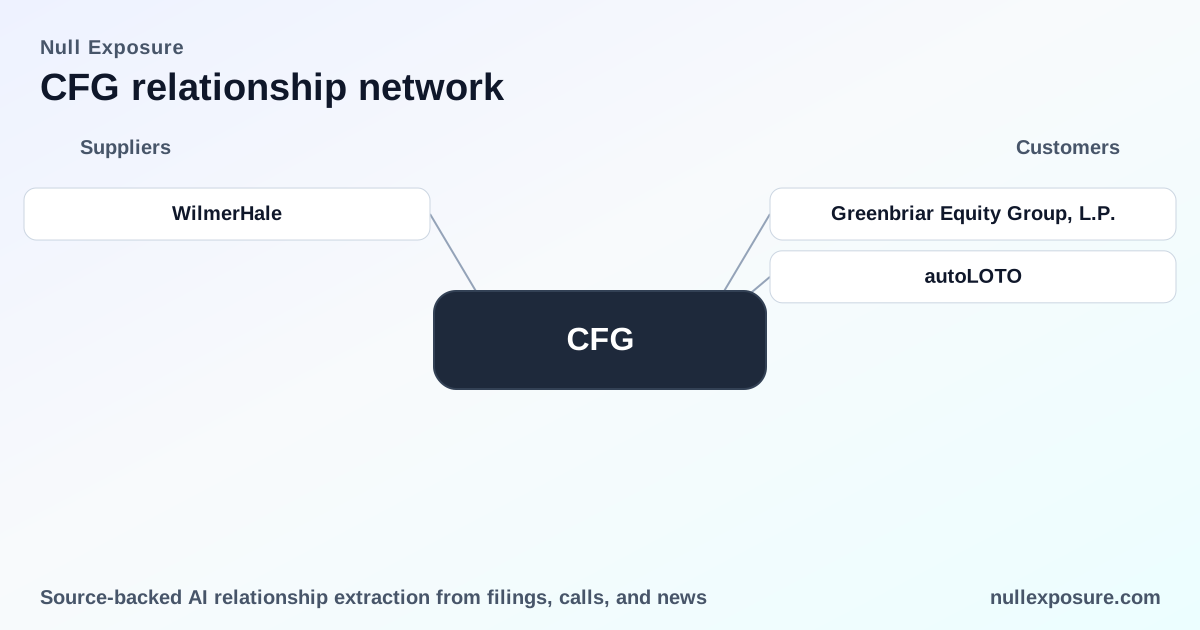
- Greenbriar Equity Group, L.P.: Citizens Capital Markets & Advisory acted as lead financial advisor to Greenbriar on its strategic partnership with AIT Worldwide Logistics, according to Marketscreener (Mar 9, 2026). Source: https://www.marketscreener.com/news/citizens-financial-advises-greenbriar-equity-group-on-its-strategic-partnership-with-ait-worldwide-ce7e5cdbd18df123
- JCAP (duplicate filing): GlobeNewswire confirms Citizens Capital Markets was among book‑running managers for Jefferson Capital’s proposed offering (Jan 2026). Source: https://www.globenewswire.com/news-release/2026/01/05/3213215/0/en/Jefferson-Capital-Announces-Launch-of-Secondary-Public-Offering-and-Concurrent-Share-Repurchase.html
- XZO (Exzeo Group, Inc.): Citizens Capital Markets acted as joint active book‑running manager on Exzeo’s IPO, per GlobeNewswire (Oct 2025). Source: https://www.globenewswire.com/news-release/2025/10/16/3167990/0/en/Exzeo-Group-Inc-Launches-Initial-Public-Offering.html
- CCLDO / CCLD (CareCloud, Inc.): Citizens Bank, N.A. closed and acted as lead arranger/administrative agent on a $50 million credit facility with Provident Bank (Apr 13, 2026), reported by GlobeNewswire and Investing.com. Source: https://www.globenewswire.com/news-release/2026/04/14/3273210/0/en/carecloud-secures-50-million-credit-facility-and-full-redemption-of-series-b-preferred-stock.html
- LFMD (LifeMD, Inc.): LifeMD closed a senior secured revolving credit facility with Citizens Bank, N.A., per Sahm Capital and GlobeNewswire (Jan 6, 2026). Source: https://www.sahmcapital.com/news/content/lifemd-announces-closing-of-50-million-revolving-credit-facility-with-citizens-bank-na-2026-01-06
- EML (Eastern Company): Eastern disclosed a new $100 million, 5‑year revolving credit facility with Citizens Bank in its earnings call and filings (Oct 2025). Source: https://www.investing.com/news/transcripts/earnings-call-transcript-eastern-co-q4-2025-results-miss-forecasts-stock-dips-93CH-4541675
- CCLD (CareCloud duplicate): Manila Times re‑reported the closing of CareCloud’s $50M facility with Citizens as lead arranger (Apr 2026). Source: https://www.manilatimes.net/2026/04/14/tmt-newswire/globenewswire/carecloud-secures-50-million-credit-facility-and-full-redemption-of-series-b-preferred-stock/2319847/amp
- SNDA (Sonida Senior Living): Citizens Bank served as a Co‑Syndication Agent on Sonida’s $930M permanent financing tied to a merger, per CityBiz (Apr 2026). Source: https://www.citybiz.co/article/817098/sonida-senior-living-completes-1-8-billion-merger-with-cnl-healthcare-properties/
- GPCR (Structure Therapeutics): Citizens Capital Markets acted as a co‑manager on a proposed offering, per Yahoo Finance (FY2025 filing reports). Source: https://finance.yahoo.com/news/structure-therapeutics-announces-proposed-500-210100526.html
- AMPY (Amplify Energy): Citizens Bank, N.A. served as administrative agent on an amended senior secured reserve‑based revolving credit facility that extended maturity to Dec 31, 2028, per multiple listings including GlobeNewswire (Dec 31, 2025). Source: https://www.globenewswire.com/news-release/2025/12/31/3211941/0/en/Amplify-Energy-Announces-Closing-of-Amended-Revolving-Credit-Facility.html
- JA (Janus/Anemoy tokenized fund references): Market listings reference the protocol that underpins tokenized funds managed by institutions including Janus Henderson; Citizens’ explicit role is indirect in content but the entry shows coverage in 2026 market pages. Source: https://www.mexc.com/en-GB/price/defi-janus-henderson-anemoy-aaa-clo-fund
- CCLDO (CareCloud, Investing duplicate): Investing.com reiterated Citizens Bank acted as lead arranger/admin agent on CareCloud’s facility (Apr 2026). Source: https://au.investing.com/news/company-news/carecloud-secures-50m-credit-facility-to-redeem-preferred-stock-93CH-4361072
- AMPY (Amplify Energy duplicate): GlobeNewswire and other outlets reported the amended RCF with Citizens as administrative agent (Dec 2025). Source: https://www.globenewswire.com/news-release/2025/12/31/3211941/18120/en/Amplify-Energy-Announces-Closing-of-Amended-Revolving-Credit-Facility.html
- JCAP (additional GlobeNewswire entry): Another GlobeNewswire notice lists Citizens Capital Markets among book‑running managers for the Jefferson Capital offering (Jan 2026). Source: https://www.globenewswire.com/news-release/2026/01/08/3215006/0/en/jefferson-capital-announces-pricing-of-secondary-public-offering-and-concurrent-share-repurchase.html
- IMMX (Immix Biopharma): Citizens Capital Markets served as co‑manager on an upsized underwritten offering, per GlobeNewswire and QuiverQuant (Dec 2025). Source: https://www.globenewswire.com/news-release/2025/12/09/3202839/0/en/Immix-Biopharma-Announces-Closing-of-Upsized-100-Million-Underwritten-Offering-of-Common-Stock-and-Pre-Funded-Warrants.html
- IMMX (duplicate registry): Another GlobeNewswire note confirms Citizens and Mizuho as co‑managers for Immix’s offering (Dec 2025). Source: https://www.globenewswire.com/fr/news-release/2025/12/07/3201157/0/en/immix-biopharma-announces-pricing-of-upsized-100-million-underwritten-offering-of-common-stock-and-pre-funded-warrants.html
- JCAP (SEC/filing on RCF amendment): Investing reported Jefferson Capital increased revolving credit commitments with Citizens Bank as administrative agent in a material amendment (2026). Source: https://m.investing.com/news/sec-filings/jefferson-capital-increases-revolving-credit-commitments-by-150-million-93CH-4634293?ampMode=1
- AMPY (Investing.com credit‑amend coverage): Investing.com noted Citizens Bank as administrative agent and established borrowing base figures tied to the amended facility (2025/2026 statements). Source: https://www.investing.com/news/company-news/amplify-energy-extends-credit-facility-maturity-to-2028-93CH-4427053
- autoLOTO: Citizens Capital Markets & Advisory served as exclusive financial advisor to autoLOTO on its majority recapitalization by Baird Capital, per Marketscreener (Mar 2026). Source: https://www.marketscreener.com/news/citizens-financial-serves-as-exclusive-financial-advisor-to-autoloto-on-its-majority-recapitalizat-ce7e5fdbdb81f125
- OrboGraph: Citizens Capital Markets & Advisory acted as exclusive financial advisor on OrboGraph’s sale to Kinective, reported by Marketscreener (May 2026). Source: https://www.marketscreener.com/news/citizens-financial-serves-as-exclusive-financial-advisor-to-orbograph-on-its-sale-to-kinective-ce7f59d3d98df32c
- LFMDP (LifeMD related press): Market coverage flags the LifeMD revolving credit facility with Citizens Bank (Jan 2026), cited in class action notice reporting. Source: https://www.marketscreener.com/news/lifemd-inc-securities-fraud-class-action-lawsuit-pending-contact-the-gross-law-firm-before-octobe-ce7d5adcdb8ef422
- PLMR (Palomar / Gray Surety acquisition): Citizens Bank served as a co‑documentation agent on acquisition financing, per Reinsurance News (2026). Source: https://www.reinsurancene.ws/palomar-completes-acquisition-of-gray-surety/
- ARCC (Ares Capital): StockTitan reports Citizens Bank, N.A. acting as lender in a material filing for Ares Capital (2026). Source: https://www.stocktitan.net/sec-filings/ARCC/8-k-ares-capital-corp-reports-material-event-66a634607ca1.html
- RCMT (RCM Technologies): RCM amended its loan agreement with Citizens Bank to temporarily increase its RCF commitment from $65M to $75M, per The Globe and Mail (Feb 20, 2026 filing). Source: https://www.theglobeandmail.com/investing/markets/stocks/RCMT/pressreleases/425895/rcm-technologies-temporarily-expands-revolving-credit-facility-commitment/
- AMPY (TradingView coverage): TradingView noted Citizens Bank as administrative agent and lender group for Amplify’s credit amendment (Dec 2025). Source: https://www.tradingview.com/news/tradingview:10aac0574794a:0-amplify-energy-signs-credit-agreement-amendment-with-citizens-bank/
- LFMD (TradingView duplicate): TradingView summarized LifeMD’s financing package with Citizens, describing an RCF up to $30M expandable by $20M (Jan 2026). Source: https://www.tradingview.com/news/tradingview:6685185048f2b:0-lifemd-signs-multiple-material-agreements/
- LFMD (SimplyWall.St coverage): SimplyWall.St highlighted the Citizens RCF as key to LifeMD’s financial flexibility while scaling higher‑priced offerings (Mar 2026 commentary). Source: https://simplywall.st/stocks/us/healthcare/nasdaq-lfmd/lifemd/news/lifemd-lfmd-is-up-173-after-expanding-telehealth-access-to-w/amp
- OOMA (FluentStream acquisition): Ooma funded its acquisition of FluentStream with a term loan facility from Citizens Bank, per CityBiz (Dec 2025). Source: https://www.citybiz.co/article/778123/ooma-acquires-fluentstream/
- IMMX (QuiverQuant): QuiverQuant recorded Citizens Capital Markets as co‑manager on Immix’s offering closing (Dec 2025). Source: https://www.quiverquant.com/news/Immix+Biopharma%2C+Inc.+Closes+%2493.7+Million+Underwritten+Offering+of+Common+Stock+and+Pre-Funded+Warrants
- EML (Reuters/TradingView filing): TradingView republished a Reuters item documenting Eastern Company’s credit agreement with Citizens Bank noted in SEC filings (2025). Source: https://www.tradingview.com/news/reuters.com,2025:newsml_FWN3WF2H6:0-eastern-co-on-oct-28-company-entered-credit-agreement-with-citizens-bank-sec-filing/
- AMPY (The Globe and Mail duplicate): The Globe and Mail detailed Amplify’s amended facility with Citizens resetting the borrowing base and commitments (Dec 31, 2025). Source: https://www.theglobeandmail.com/investing/markets/stocks/AMPY/pressreleases/36855154/amplify-energy-amends-credit-facility-extends-maturity-to-2028/
- AMPY (QuiverQuant duplicate): QuiverQuant also reported on Amplify’s amendment naming Citizens Bank as administrative agent (Mar 2026 repost). Source: https://www.quiverquant.com/news/Amplify+Energy+Corp.+Completes+Amendment+of+Revolving+Credit+Facility%2C+Extending+Maturity+to+2028
- JCAP (TradingView duplicate): TradingView covered Jefferson Capital’s increase in revolving commitments with Citizens as Administrative Agent (May 2026). Source: https://www.tradingview.com/news/tradingview:d782c70ef442b:0-jefferson-capital-lifts-revolving-credit-commitments-to-1-15-billion-adds-275-million-upsize-capacity/
- HTGC (Hercules Capital): A financing release noted Citizens JMP Securities among co‑managers on institutional notes (2026). Source: https://finance.yahoo.com/news/hercules-capital-closes-institutional-notes-180600119.html
- EML (Marketscreener duplicate): Marketscreener listed Eastern’s SEC filing noting the credit agreement with Citizens (Oct 2025 filing). Source: https://www.marketscreener.com/news/eastern-announces-timing-of-third-quarter-fiscal-year-2025-earnings-release-and-conference-call-ce7d5ad8d189ff23
- AII (American Integrity): StockTitan reported Citizens Capital Markets and Raymond James acted as passive bookrunners on a secondary offering (2025/2026). Source: https://www.stocktitan.net/news/AII/american-integrity-announces-pricing-of-secondary-offering-of-common-nptp5o8uuxnq.html
- WULF (Terawulf): Citizens Capital Markets acted as co‑manager along with Santander on Terawulf’s common stock offering, per Terawulf investor release (2026). Source: https://investors.terawulf.com/news-events/press-releases/detail/137/terawulf-announces-closing-of-common-stock-offering
- IMMX (GlobeNewswire duplicate): GlobeNewswire reiterated Citizens and Mizuho as co‑managers on Immix’s offering (Dec 2025). Source: https://www.globenewswire.com/news-release/2025/12/07/3201157/0/en/Immix-Biopharma-Announces-Pricing-of-Upsized-100-Million-Underwritten-Offering-of-Common-Stock-and-Pre-Funded-Warrants.html
What the constraints tell investors about Citizens’ operating model
Citizens’ disclosures and the relationship evidence generate several company‑level signals relevant to operational risk and revenue durability:
- Contracting posture and maturity: Citizens underwrites and arranges both short‑term commercial facilities and long‑term consumer mortgages; this indicates a mix of short‑cycle fee work and long‑dated asset generation that stabilizes NIM over time. (Constraint evidence: mortgage repayment terms and letters‑of‑credit durations.)
- Counterparty mix and concentration: The bank serves individuals, small businesses, mid‑market and large enterprises, reflecting deliberate product segmentation—retail deposit depth plus middle‑market commercial lending and capital‑markets relationships that drive fee diversity.
- Geographic concentration: Revenue and assets are predominantly U.S., concentrated in New England, Mid‑Atlantic and Midwest states, which concentrates credit and deposit risk regionally but supports retail funding stability.
- Criticality and role: Customer deposits are identified as a primary, low‑cost funding source, flagging high criticality of retail relationships to liquidity and margins; concurrently, Citizens acts as seller/arranger/advisor in capital markets, which is material to fee income but more variable.
- Service breadth: The firm functions both as lender/administrative agent on syndicated credits and as capital markets underwriter/advisor, showing maturity across delivery models from transaction banking to advisory services.
Investment implications and risk signals
- Revenue mix advantage: The combination of deposit‑funded lending and fee‑generating capital markets activity supports diversified earnings, as demonstrated by recent syndicated facilities, credit amendments, and multiple underwriting roles across industries.
- Credit exposure monitoring: Multiple RCFs and large syndicated financings (Amplify, LifeMD, CareCloud, Jefferson Capital) imply ongoing corporate credit exposure; underwriters and arrangers’ reputational risk and underwriting standards should be watched.
- Regional concentration: U.S. regional footprint is a strength for deposit funding but concentrates sensitivity to regional economic cycles.
For active monitoring and a continuous feed of customer‑level insights, see the platform: https://nullexposure.com/
Bottom line
Citizens leverages its retail deposit base to underwrite and syndicate credit while Citizens Capital Markets drives fee income across middle‑market and specialty capital markets transactions. That dual model yields stable funding with episodic fee upside, and warrants attention to credit underwriting outcomes and regional economic trends as primary risk drivers.