Citizens Financial Group (CFG-P-E): Customer relationships that shape fee income and niche lending
Citizens Financial Group operates as a regional bank with diversified income streams: traditional interest-bearing lending and deposits supplemented by specialized business units that monetize through fees and structured lending. Its Citizens Pay merchant platform generates fee income and partnership-led loan flows from large technology merchants, while a dedicated sports finance arm structures stadium and franchise financing that produces large, episodic fee and interest revenue. These customer relationships underpin Citizens’ strategy to broaden noninterest income and originate asset-backed credit outside conventional retail banking.
For more background and signal coverage on corporate relationships, visit https://nullexposure.com/.
Why these relationships matter for investors
Citizens is not a pure-play retail bank; its commercial relationships shift the revenue mix toward fee-driven and structured lending opportunities, enhancing yield diversity but concentrating exposures in a few specialized verticals. The contracting posture looks hybrid: long-term merchant agreements for Citizens Pay coexist with deal-by-deal underwriting in sports and stadium finance. The criticality of these relationships is material for the affected clients—merchant payment rails and stadium capital structures are high-friction to replace—so retention drives recurring fees and repeat lending. Citizens Pay has been operating since 2015, which signals product maturity in the payments space rather than early-stage experimentation.
The customer list — concise takeaways for each relationship
-
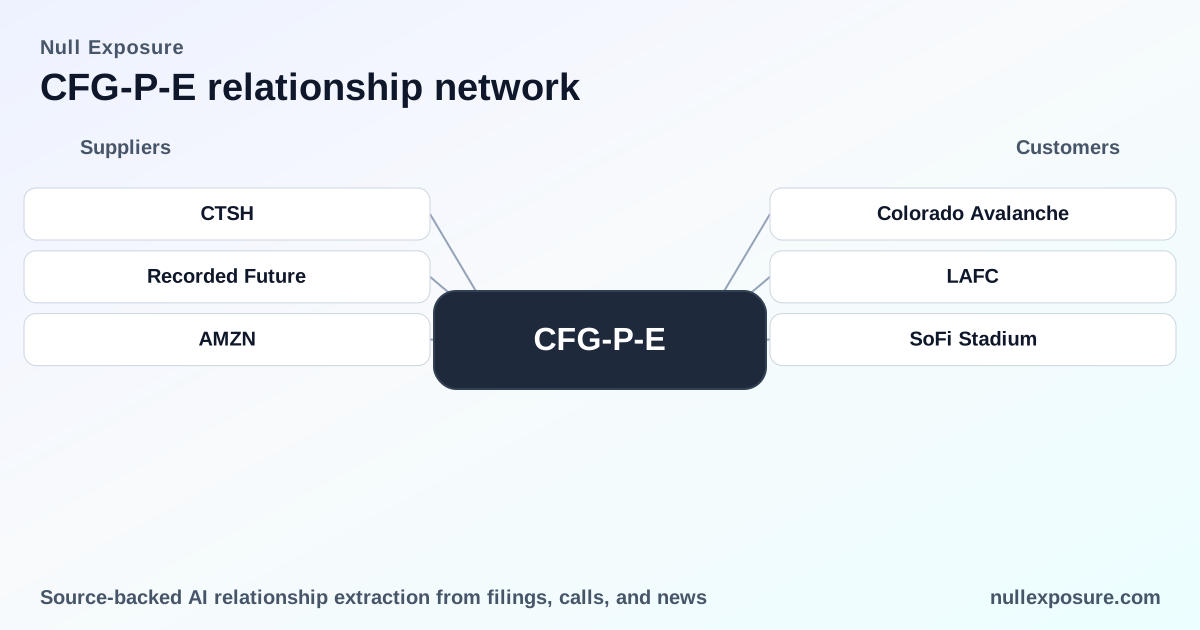
SoFi Stadium — Citizens’ sports finance team led the financing for SoFi Stadium, demonstrating capability to structure large, complex stadium transactions that generate fee and interest income tied to long-lived assets. Source: Sportico (2024), https://www.sportico.com/business/finance/2024/citizens-bank-sports-finance-1234766602/
-
Colorado Avalanche — The bank’s sports finance division has worked with NHL franchises such as the Colorado Avalanche, positioning Citizens as a go-to underwriter for team and facility financing within professional sports. Source: Sportico (2024), https://www.sportico.com/business/finance/2024/citizens-bank-sports-finance-1234766602/
-
LAFC — Citizens partnered on deals with Major League Soccer’s LAFC, reinforcing the bank’s footprint across multiple North American leagues and its ability to tailor financing to franchise and stadium economics. Source: Sportico (2024), https://www.sportico.com/business/finance/2024/citizens-bank-sports-finance-1234766602/
-
Best Buy (BBY) — Citizens Pay counts Best Buy among its large technology merchant clients, indicating material merchant-acquiring volume and fee capture from national retail checkout flows. Source: Banking Dive (FY2023), https://www.bankingdive.com/news/citizens-partners-with-wisetack-on-bnpl-loans-for-smbs/653557/
-
Microsoft (MSFT) — Microsoft is listed as a client for Citizens Pay, which signals the platform’s ability to handle enterprise-scale merchant relationships and supports recurring fee revenue from big-ticket technology transactions. Source: Banking Dive (FY2023), https://www.bankingdive.com/news/citizens-partners-with-wisetack-on-bnpl-loans-for-smbs/653557/
-
Apple (AAPL) — Apple’s inclusion among Citizens Pay merchants demonstrates access to premium retail flows and strengthens Citizens’ payments revenue base through high-frequency consumer transactions. Source: Banking Dive (FY2023), https://www.bankingdive.com/news/citizens-partners-with-wisetack-on-bnpl-loans-for-smbs/653557/
-
Vivint — Vivint’s relationship with Citizens Pay indicates reach into consumer durable and services merchants beyond pure tech, diversifying merchant verticals that feed fee and lending channels. Source: Banking Dive (FY2023), https://www.bankingdive.com/news/citizens-partners-with-wisetack-on-bnpl-loans-for-smbs/653557/
How these ties affect Citizens’ operating posture
The collection of merchant and sports clients reveals a dual operating model:
-
Citizens Pay operates as a mature payments and merchant-acquiring platform (established 2015) that generates recurring fees and brings predictable merchant volume, with concentration in a handful of large retail and technology clients that drive scale economics. This is a deliberate strategy to convert transaction flow into fee income and potential loan originations.
-
The sports finance practice acts as a specialized underwriting business that pursues episodic, high-ticket financing mandates (stadia and franchise deals), producing outsized fees and longer-tenor lending but creating lumpy revenue and underwriting concentration risks.
These dynamics combine to produce a hybrid revenue profile: steady, lower-margin fee flows from payments plus infrequent, higher-margin structured deals.
Risk implications investors should price in
-
Concentration risk: Large merchants such as Apple, Microsoft, and Best Buy account for disproportionate payments volume; loss or re-pricing of any major client would compress noninterest income. This is a company-level signal rather than tied to a single relationship.
-
Underwriting and credit risk: Sports and stadium financing are capital intensive and dependent on sponsorships, ticketing, and lease structures; these deals are profitable but sensitive to macro and industry-specific shocks.
-
Operational and platform risk: Maintaining a competitive merchant platform requires technology investment and partnership execution (e.g., BNPL integrations); Citizens Pay’s maturity mitigates early-stage execution risk but increases the need for ongoing scale and product evolution.
-
Reputational exposure: High-visibility financings such as SoFi Stadium elevate brand recognition but also concentrate reputational risk if transactions become contentious.
Near-term monitoring checklist for investors
- Watch merchant client retention and pricing in Citizens Pay to assess sustainability of fee income.
- Track deal flow and pipeline in the sports finance arm to anticipate lumpy fee recognition.
- Monitor regulatory or competitive shifts in BNPL and merchant acquiring that could alter contract economics and partnership dynamics.
- Assess changes to large-client relationships (Apple, Microsoft, Best Buy) for concentration stress.
Bottom line
Citizens Financial Group leverages specialized client relationships to diversify beyond traditional banking into payments and structured sports finance. These relationships support a strategy that increases noninterest income and access to unique lending markets, while concentrating exposures in a limited set of large merchants and episodic stadium deals. Investors should value Citizens not just as a regional lender but as a payments and structured-finance operator whose return profile depends on client retention, underwriting discipline, and continued scale.
For a deeper read on customer signals and relationship-level exposure, explore the full coverage at https://nullexposure.com/.