ConforMIS (CFMS) — Customer Relationships and What They Mean for Investors
ConforMIS builds and sells patient‑specific joint replacement implants and monetizes through direct product sales, licensing of instrumentation/IP, royalty streams, and supply agreements with larger orthopedic OEMs. The company’s revenue mix reflects a hybrid model: clinical sales to hospitals and surgeons combined with strategic licenses and settlements that convert IP into near‑term cash. Explore the company’s customer exposures and partner dynamics at https://nullexposure.com/ for a concise investor-facing map.
Why the customer map matters for valuation and risk
ConforMIS’s commercial footprint is defined by selective OEM partnerships, royalty/licensing uplifts, and clinical adoption at specialty centers. That combination produces a revenue profile that is lumpy but defensible: licensing and settlements deliver discrete cash inflows while surgical adoption drives recurring consumable sales. For investors, the key variables are partner concentration, the criticality of ConforMIS technology to OEM product lines, and the maturity of partner agreements.
Relationship inventory — what each customer/partner contributes
Below I run through every named relationship in the results, with a short plain‑English summary and source reference.
Stryker Corporation (SYK)
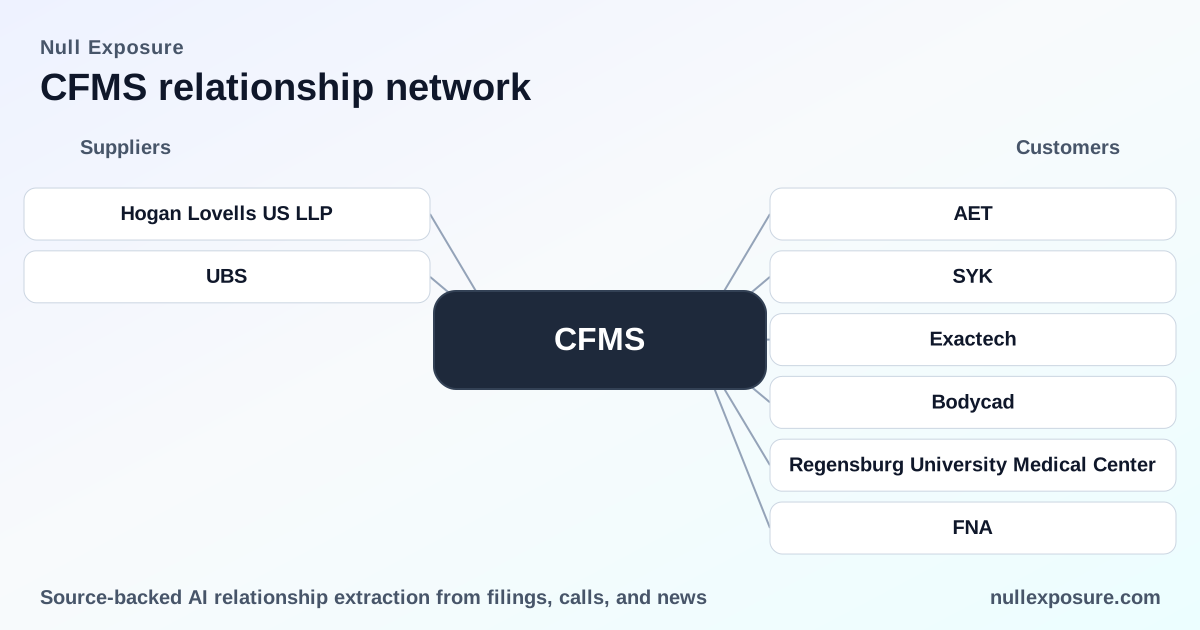
ConforMIS sold certain patient‑specific instrumentation (PSI) assets to Stryker and entered development, manufacturing and supply agreements for PSI to be used with Stryker’s knee implants; Stryker paid up‑front consideration and committed to milestone payments, and later executed a patent settlement that included a one‑time payment and a non‑exclusive license. According to a GlobeNewswire release in October 2019 and subsequent reporting, the deal included an upfront payment (reported as $14 million in one account) plus milestone upside and culminated in a $15 million settlement related to patent litigation in FY2021. (GlobeNewswire 2019; MedTechDive and RyOrtho reporting 2021.)
Zimmer Biomet (ZBH)
Zimmer Biomet engaged with ConforMIS in IP litigation that was resolved by a payment to close disputes over patient‑specific instrumentation; earlier reporting indicates Zimmer agreed to pay approximately $9.6 million to settle past claims. A MedTechDive summary of FY2021 litigation outcomes cites the Zimmer Biomet payment to resolve disputes over patient‑specific and partially patient‑specific instrumentation. (MedTechDive 2021.)
Wright Medical / Wright
ConforMIS has licensed patient‑specific instrument technology to Wright, with documentation indicating a license granted in 2015 and referenced in later settlement reporting; older arrangements gave Wright rights to use ConforMIS instrument technology with off‑the‑shelf implants. Reporting on the FY2021 settlements and historical licenses describes the Wright arrangement as a long‑standing license to ConforMIS IP. (MedTechDive and RyOrtho 2021.)
Tornier, Inc.
Tornier is referenced as part of the “Stryker Parties” that resolved patent litigation with ConforMIS, resulting in a one‑time payment and license grant; the name appears in the settlement reporting around FY2021. RyOrtho’s coverage of the settlement lists Tornier among the settling entities. (RyOrtho 2021.)
Aetna, Inc. (AET)
Aetna’s historical coverage decisions are the subject of litigation alleging that Aetna covered ConforMIS’s system for several years following FDA clearance and later denied coverage, prompting a suit. RyOrtho reported on the Aetna coverage dispute and related claims in FY2020. (RyOrtho 2020.)
Bodycad
Bodycad is a licensee whose agreement contributed to a material increase in ConforMIS’s royalty and licensing revenue year‑over‑year, supporting a jump in reported royalty receipts in FY2023. ConforMIS reported that license agreements with Bodycad accounted for a substantial portion of royalty growth reported in 2023. (Healio 2023.)
Exactech
Exactech likewise contributed to the royalty and licensing revenue uplift in FY2023 through license agreements that generated recognized royalty income. Healio’s FY2023 revenue coverage attributes the royalty increase to license agreements with Exactech and Bodycad. (Healio 2023.)
Paragon 28 (FNA)
ConforMIS entered a license agreement with Paragon 28 to adapt patient‑specific instrumentation for Paragon 28’s Total Ankle Replacement System, reflecting an extension of ConforMIS’s IP into ankle applications. The FY2022 earnings release noted the Paragon 28 license. (ConforMIS FY2022 release reported via Yahoo Finance 2022.)
Ascension Saint Thomas Hospital
ConforMIS systems were used in early clinical procedures for the company’s Actera hip system, with the first procedure in Nashville performed by Dr. William Kurtz, demonstrating hospital‑level clinical adoption of ConforMIS hip offerings. OrthospineNews reported the first Actera procedure in FY2022. (OrthospineNews 2022.)
Regensburg University Medical Center
Academic clinical evidence includes a retrospective study where ConforMIS custom unicondylar implants (iUni G2) were used in cases from 2010–2012, signaling clinical utilization and research interest in European centers. The peer‑reviewed study appears in BMC Musculoskeletal Disorders (2020). (BMC Musculoskeletal Disorders 2020.)
Coastal Orthopaedic & Sports Medicine
A named surgeon at Coastal Orthopaedic praised ConforMIS’s Imprint solution as a simple transition from previous workflows and highlighted operational efficiencies in ambulatory surgery centers, illustrating surgeon‑level advocacy and commercial feedback in FY2022 communications. The commercial launch announcement included the testimonial. (Yahoo Finance/ConforMIS press release 2022.)
Operational and business model signals investors should use
- Contracting posture: ConforMIS duplicates revenue channels — upfront and milestone payments from OEM licenses, recurring royalties, and direct sales — indicating a hybrid contracting posture that mixes one‑time monetizations with longer‑term supply obligations.
- Concentration: A small number of large OEM relationships (notably Stryker and historic arrangements with Wright and Zimmer‑related disputes) create counterparty concentration risk; license and settlement economics can dominate reported cash inflows in any quarter.
- Criticality: ConforMIS’s PSI and implant designs have meaningful integration value for OEM knee systems (Stryker Triathlon example) and are clinically adopted in specialized centers, so the technology is commercially important though not universally essential to large OEM product portfolios.
- Maturity: The presence of long‑running licenses, clinical studies dating back to 2010–2012, and recent commercial launches suggests product maturity in knee PSI with continuing expansion into hips and ankles; concurrently, reliance on discrete license events keeps revenue profile uneven.
No explicit contractual constraints were provided in the results; treat these operating signals as company‑level characteristics inferred from the relationship set.
Investment implications — what matters next
- Catalysts: Additional license deals, royalty ramps with Exactech/Bodycad, and expanded OEM supply for knee/hip systems will drive predictable revenue growth and improve cash visibility.
- Risks: The business is sensitive to litigation outcomes and partner negotiations; large settlements can swing cash but are not a recurring revenue substitute.
- Valuation sensitivity: Investors should model both recurring sales adoption curves at specialty hospitals and the probability/timing of further OEM licensing deals to capture the dual monetization streams.
For a focused investor map and to see how these customer relationships connect to counterparty risk, visit https://nullexposure.com/ and review the ConforMIS customer view.
ConforMIS’s strategy converts proprietary imaging and instrumentation IP into both clinical differentiation and monetizable agreements with industry players; the company’s near‑term value realization depends on pairing surgeon adoption with further OEM licensing and royalty growth.