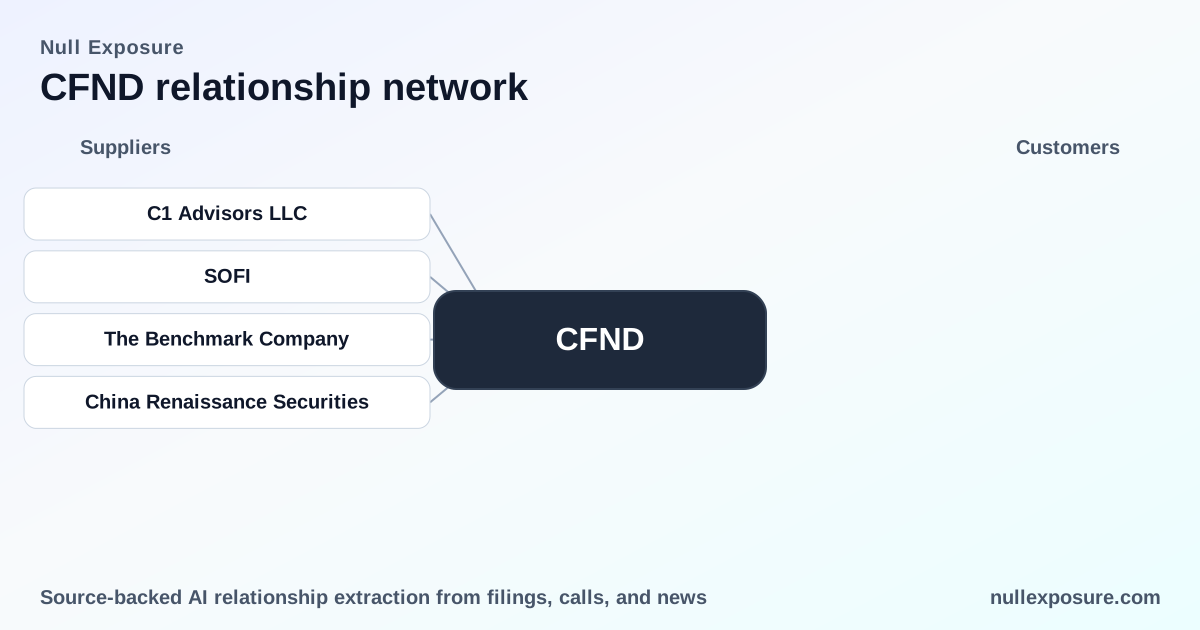
CFND: A Fund That Monetizes Crypto Infrastructure Exits
C1 Fund Inc. (NYSE: CFND) operates as a publicly traded investment vehicle that accumulates early-stage stakes in crypto infrastructure and frontier-technology companies and monetizes through realized liquidity events such as public listings and strategic sales. For investors and operators, CFND’s economics are driven by capital appreciation from a concentrated portfolio, selective exit timing, and periodic realizations that convert illiquid stakes into distributable value.
Learn more about how we surface relationship intelligence at https://nullexposure.com/
What this report covers — one clear relationship, one portfolio signal
This note focuses on the single, disclosed third‑party relationship surfaced in public reporting: an announcement from OGBC Group tied to CFND’s first portfolio realization. The record is concise but meaningful because it documents an exit event — a concrete monetization that validates CFND’s investment-to-exit pathway.
OGBC Group: an investor-relationship tied to CFND’s first exit
OGBC Group, an investment and innovation platform led by founder Jayden Wei, confirmed that its early-stage investment in C1 Fund Inc. produced its first portfolio realization following BitGo’s public listing in January 2026. The announcement frames OGBC’s stake in CFND as having participated in the ripple effects from a successful infrastructure IPO. According to a Business Insider Markets report (May 2026), OGBC and Wei marked that realization publicly, underscoring CFND’s pathway from private stakes to liquidity events. Source: Business Insider Markets press report, May 2, 2026 — https://markets.businessinsider.com/news/stocks/ogbc-group-and-founder-jayden-wei-marks-c1-fund-s-first-portfolio-exit-validates-crypto-infrastructure-investment-thesis-1036016380
What this relationship implies for CFND’s operating model
The OGBC announcement is not merely PR; it communicates structural aspects of CFND’s business model that are relevant to investors evaluating counterparty exposure and the fund’s monetization cadence.
- Contracting posture: CFND acts like an active investor, taking equity positions in early-stage infrastructure companies and holding through to liquidity events. Its contracting posture is oriented toward long‑dated equity commitments rather than recurring fee-for-service agreements.
- Concentration and concentration risk: The fund’s strategy emphasizes concentrated, high-conviction positions in a narrow segment — crypto infrastructure. Concentration amplifies upside on successful exits while increasing idiosyncratic risk on any single asset.
- Criticality: For portfolio companies, CFND’s participation is strategic capital rather than an operational supplier; conversely, CFND’s returns are highly dependent on a small number of exit events rather than stable recurring revenue.
- Maturity of book: The BitGo listing and the OGBC statement indicate an evolving maturity profile: CFND’s holdings are reaching liquidity stages, transitioning portions of the portfolio from paper value to realizable cash.
These are company‑level signals derived from the exit event and investor commentary rather than a granular audit of contractual terms.
Why the OGBC notice matters to investors and operators
The OGBC disclosure serves three practical functions for market participants:
- Proof of monetization: Publicly announced exits convert valuation theory into cash events that can fund distributions or redeployments. BitGo’s listing is a documented monetization point for CFND’s portfolio.
- Validation of strategy: An investor announcing that its stake in the fund has been realized signals external investor confidence in CFND’s ability to identify and support viable infrastructure companies.
- Market signaling for dealflow and partnerships: Exit publicity raises CFND’s profile among founders and co-investors, which can improve access to future rounds or syndicates.
Risks and what to watch next
The OGBC announcement confirms a realized event, but it also sharpens focus on ongoing risks that stem from CFND’s model:
- Exit timing dependency: CFND’s returns are event-driven; extended market cycles delay realizations and compress near-term liquidity.
- Concentration sensitivity: As CFND focuses on a niche, macro shocks to crypto markets disproportionately affect portfolio valuations.
- Transparency and disclosure cadence: Public filings and partner press releases provide the primary visibility into CFND’s monetization; the market will prioritize periodic clarity on realized gains and redeployment plans.
Key takeaway: CFND’s model delivers outsized upside on successful listings like BitGo but carries concentrated, timing-sensitive risk.
How investors should position research and operational due diligence
For investors and counterparties evaluating CFND:
- Prioritize verification of realized proceeds and how they translate into NAV adjustments or shareholder distributions in public filings.
- Monitor the fund’s redeployment policy: whether realized cash is returned to shareholders, retained for follow-on investments, or used to cover fees.
- Track co-investor statements and partner announcements as leading indicators of additional realized or impending liquidity events.
If you want ongoing tracking of CFND’s relationship network and realized exits, see detailed relationship briefings at https://nullexposure.com/
Bottom line
The OGBC Group announcement provides concrete evidence of CFND’s path from early-stage stakes to realized liquidity, validating the fund’s role in the crypto infrastructure value chain. For investors and operators, CFND represents a high-conviction, event-driven vehicle: capable of producing outsized returns on successful exits, while also concentrated and timing-dependent. Continued scrutiny of disclosure flow and partner statements will be the most reliable method to monitor CFND’s progress.