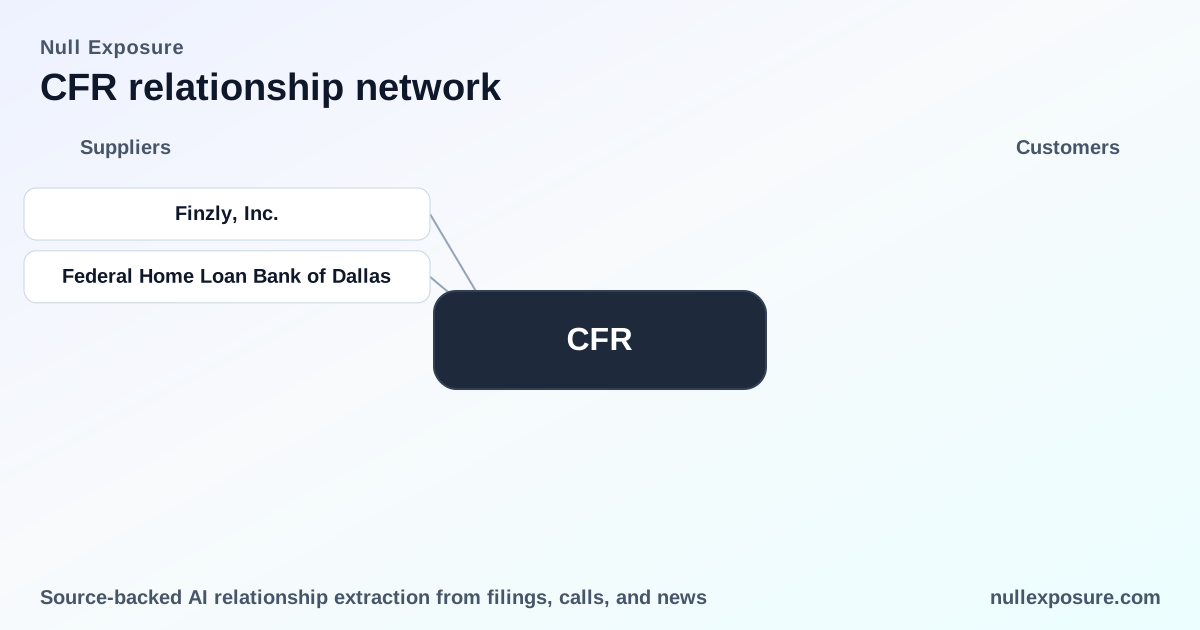
Cullen/Frost Bankers (CFR): Customer Relationships and Commercial Footprint — What Investors Need to Know
Cullen/Frost Bankers operates as a Texas-focused regional bank holding company that monetizes through deposit gathering, commercial lending, and fee-based services (treasury management, trust and investment management, insurance and brokerage). Frost’s model blends stable retail and small-business deposits from a dense Texas branch network with higher-margin commercial loans and capital-markets activity; the firm supplements core banking with strategic sponsorships and corporate lending relationships that extend brand visibility and recurring fee income. For investors, the essential trade-off is stable regional deposit economics and high service stickiness versus concentration risks in large credits and geographic exposure to Texas and cross-border flows from Mexico. For deeper company relationship analytics, visit https://nullexposure.com/.
Quick take: why customers and counterparties matter to CFR investors
Cullen/Frost generates revenue as both a seller of financial services and a service provider to other institutions. Key revenue drivers are loan interest margins, deposit funding stability, and fee income from trust, treasury and correspondent banking services. The customer set — from local sports partnerships that drive consumer brand value to mid‑market and energy borrowers that drive credit earnings — maps directly to Frost’s risk profile: brand-building increases deposit capture while corporate credit facilities increase concentration risk.
- Concentration risk is real: Frost disclosed qualitative adjustments tied to large credit relationships, reflecting sensitivity to single large obligor deterioration.
- Geographic footprint is concentrated in Texas but includes meaningful international banking activity, particularly with Mexico, where average foreign deposits were material in 2025.
- Service breadth increases criticality: correspondent banking and administrative agent roles make Frost operationally important to lenders and borrowers alike.
Sponsorships and consumer-facing partnerships: local brand investments
These relationships expand Frost’s consumer reach across Texas sports audiences and support financial literacy programming.
San Antonio Spurs
Frost includes the San Antonio Spurs in its portfolio of Texas sports partnerships as part of a broader sponsorship push to increase local brand visibility and community engagement (Sahm Capital press note, Apr 1, 2026: https://www.sahmcapital.com/news/content/frost-bank-becomes-official-financial-literacy-partner-of-texas-rangers-in-frosts-first-mlb-deal-2026-04-01). This is a marketing-driven relationship intended to strengthen deposit and retail customer acquisition.
Texas Rangers
Frost Bank was designated the Official Financial Literacy Partner of the Texas Rangers, a formal partnership aimed at delivering practical money-skills programming to fans and families (Sahm Capital / PR coverage, Mar–Apr 2026; also summarized on Finviz, Mar 2026: https://finviz.com/news/291682/frost-bank-nyse-cfr-reports-q4-cy2025-in-line-with-expectations). The arrangement is explicitly educational and brand-focused, increasing Frost’s consumer engagement in major Texas markets.
Rangers Foundation
In collaboration with the Rangers Foundation, Frost will provide youth-focused financial literacy programming, connecting philanthropy with customer outreach and community relations (Sahm Capital press note, Apr 1, 2026). This extends Frost’s CSR and brand strategy into measurable community programs that support long-term deposit relationships.
Austin FC
Frost lists Austin FC among the teams in its growing sponsorship portfolio used to broaden regional visibility, particularly in Central Texas markets (Sahm Capital press note, Apr 1, 2026). This relationship targets retail and small-business segments through sports marketing.
Houston Rockets
The Houston Rockets are included in Frost’s sponsorship roster, reinforcing the bank’s presence in Houston and supporting cross-market consumer marketing across major Texas metros (Sahm Capital press note, Apr 1, 2026). Sponsorships like this are low-margin marketing spend that translate into modest long-term deposit and fee benefits.
Corporate lending and structured credit relationships
These engagements illustrate Frost’s role as a commercial lender and administrative agent — higher-margin, higher-criticality functions that increase credit and concentration exposure.
AMSF (Amerisafe, Inc.)
Amerisafe renewed a line of credit with Frost Bank for borrowings up to $20.0 million, ensuring access to additional liquidity under Frost’s lending facilities (TradingView summary of AMSF SEC 10‑K, Mar 9, 2026: https://www.tradingview.com/news/tradingview:a187f511893c6:0-amerisafe-inc-sec-10-k-report/). This is a standard corporate credit facility that reflects Frost’s traditional commercial-lender role with mid‑market borrowers.
EPSN (Epsilon Energy Ltd.)
Epsilon closed a new and revised senior secured reserve‑based revolving credit facility with Frost Bank as administrative agent and lender, alongside Texas Capital Bank (GlobeNewswire release, Oct 13, 2025: https://www.globenewswire.com/news-release/2025/10/13/3165727/0/en/epsilon-announces-new-and-revised-senior-secured-reserve-based-revolving-credit-facility.html). Serving as administrative agent signals elevated operational importance and fee income, but also increases Frost’s credit exposure to commodity-price and oilfield-cycle volatility.
Operating-model constraints and business-model signals investors must weight
Frost’s customer and counterparty relationships reflect several company-level constraints that shape future returns and risk.
- Contracting posture — both seller and service provider. Frost executes traditional loan and deposit contracts while also acting as a service provider (treasury management, correspondent banking, administrative agent). This dual posture generates diversified fee streams but creates counterparty operational dependencies.
- Concentration risk is material. Management disclosed qualitative allowance adjustments tied to large, concentrated credit relationships, indicating that single-obligor stress can have disproportionate earnings and capital impacts.
- Geographic concentration with international plumbing. Frost is heavily concentrated in Texas retail and commercial markets (about 204 financial centers statewide), while international banking ties — notably deposits from Mexico averaging roughly $1.2 billion in 2025 — embed some cross-border funding sensitivity.
- Maturity and criticality. Frost’s banking franchise is mature and entrenched in Texas; correspondent banking for roughly 178 institutions positions Frost as critical infrastructure for regional banks. Administrative agent and reserve-based roles for energy borrowers elevate operational criticality and fee capture.
Investors should treat these signals as structural characteristics of Frost’s franchise: stable deposit economics and fee diversification are balanced against concentrated credit risk and regional geopolitical/fx funding exposure.
Investment implications and risk checklist
- Positive case: Durable deposit base, diversified fee products, and visible brand-building through sports partnerships support stable core revenues and predictable ROE.
- Negative case: Large single-credit exposure or a downturn in Texas energy markets would meaningfully pressure provisions and capital ratios because management explicitly adjusts for concentrated credits.
- Monitoring priorities: loan-loss provisioning trends, growth or reduction in large commercial exposures, Mexican deposit flows, and fee income from administrative agent roles.
Next steps for analyst teams
For a full relationship map and ongoing monitoring of counterparties, Frost’s mix of retail sponsorships and corporate lending requires both marketing ROI and credit-cycle analysis. Explore more company-level relationship intelligence and configurable monitoring at https://nullexposure.com/ for ongoing coverage.
Bottom line
Cullen/Frost combines a steady, retail-funded commercial bank with targeted high-value lending and administrative roles that boost fees but also introduce concentration and sectoral risks. Investors should value Frost’s brand-driven deposit capture and fee diversification while underwriting downside scenarios for large credits and regional economic stress.