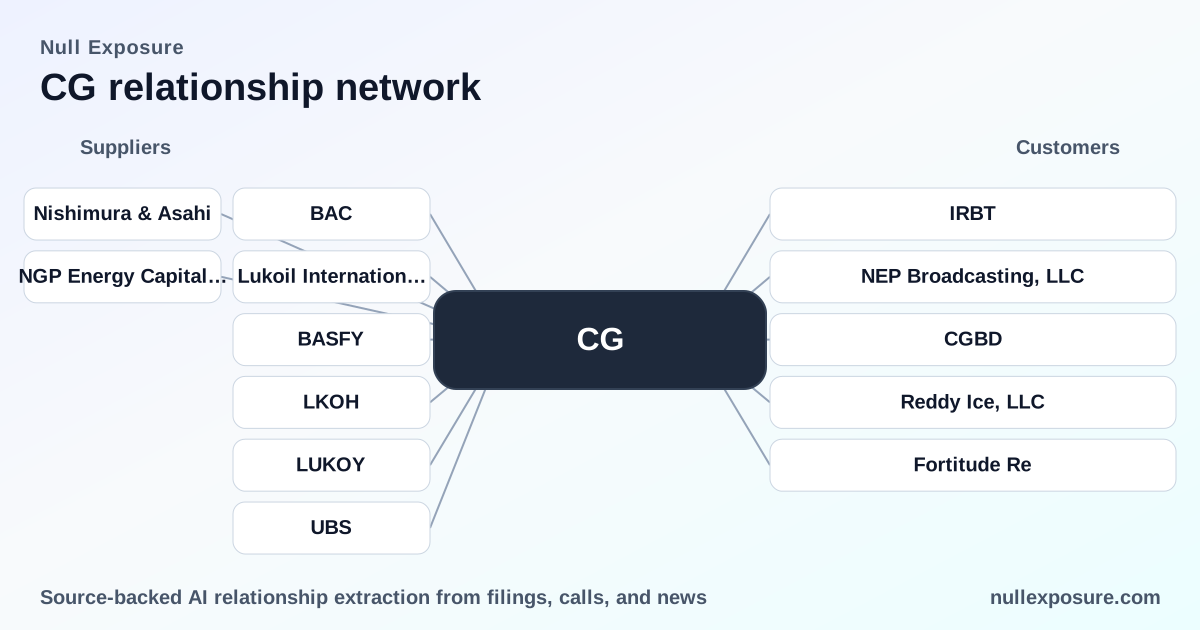
Carlyle Group (CG): Customer Relationship Map and Investor Takeaways
Carlyle Group Inc. operates as a global alternative asset manager that monetizes through recurring management fees and performance (carried interest) fees across buyout, credit, real assets and insurance-related strategies. The firm acts both as an investment principal and an outsourced manager for third-party capital, generating fee income from long-lived fund mandates and advisory agreements while capitalizing on realized gains and carried interest from successful exits.
For a deeper relationship audit and data-driven coverage of private-market counterparties, visit https://nullexposure.com/ — the companion hub for this relationships briefing.
What this relationship set reveals at a glance
Carlyle’s customer universe in the sampled news footprint is dominated by fund management and advisory roles, capital commitments into portfolio companies, and occasional asset dispositions. The list mixes three commercial patterns: (1) asset-management mandates where Carlyle earns recurring fees, (2) capital-provider roles where Carlyle co-invests or underwrites facilities, and (3) portfolio-company exits where Carlyle is a seller. These interactions show a business that is service-centric, contractually oriented toward multi-year mandates, and globally diversified.
Company-level constraints and what they imply for investors
Based on public excerpts relating to Carlyle’s contracts and investor base, the following operating model characteristics are material to valuation and risk analysis:
- Contracting posture — long-term, fee-bearing: Carlyle signs management agreements that commonly span five to ten years for CLOs and roughly ten years for carry funds, creating durable fee streams and cash-flow visibility.
- Counterparty mix — institutional and retail reach: Evidence points to meaningful exposure to sovereign, pension, insurance investors as well as high-net-worth individuals and some retail-facing products, implying diversified capital sources but sensitivity to public pension allocation cycles.
- Geographic scope — truly global with APAC exposure: Carlyle serves investors across North America, Europe and Asia and sponsors funds that invest in Asia-denominated assets, supporting its international fee base.
- Role concentration — service provider and principal: Carlyle regularly serves as GP, investment manager, or collateral manager, collecting ongoing management and performance fees while also making principal investments.
- Materiality and maturity — fee and carried-interest dependent: Carried interest is a significant contributor to income, making realized investment performance and exit timing critical to earnings volatility.
- Relationship stage — active: Multiple excerpts demonstrate active, multi-year relationships such as the strategic advisory arrangement with Fortitude, indicating entrenched fee relationships and growth opportunities in insurance-linked strategies.
These signals should be read as firm-level characteristics rather than assertions about any single counterparty unless the original excerpt explicitly named that counterparty.
Relationship roll call — one-line investor summaries (source-cited)
-
Bridgepoint Group plc — Bridgepoint agreed to acquire a majority stake in iC Consult Group from Carlyle Europe Technology Partners IV, reflecting Carlyle’s exit activity in technology holdings; reported by MarketScreener on May 2, 2026. (https://www.marketscreener.com/news/the-carlyle-group-inc-nasdaqgs-cg-agreed-to-acquire-basf-india-coatings-private-limited-from-basf-ce7e51deda8df726)
-
CGBD (Carlyle Secured Lending, Inc.) — Carlyle Global Credit Investment Management L.L.C. agreed to support a merger by capping adviser-covered expenses up to $5 million to facilitate transaction benefits for CGBD stockholders, illustrating Carlyle’s role as an active adviser and deal facilitator; announced via GlobeNewswire, FY2024 disclosure. (https://www.globenewswire.com/news-release/2024/08/05/2924141/0/en/Carlyle-Secured-Lending-Inc-Announces-Merger-with-Carlyle-Secured-Lending-III.html)
-
TFPM (Triple Flag Precious Metals) — Triple Flag’s structured streaming arrangements were noted in coverage discussing Kemess, with staged funding tied to project milestones; this reflects commodity counterparties and structured finance activity in which Carlyle intersects as investor or co-financier; reported on Yahoo Finance, May 4, 2026. (https://finance.yahoo.com/markets/commodities/articles/triple-flag-precious-metals-updates-070647271.html)
-
CGBD (FY2025 pricing disclosure) — Public coverage identified Carlyle Global Credit Investment Management as the SEC-registered adviser and Carlyle subsidiary that manages CGBD, underscoring the group’s role in externally managed credit vehicles; covered on Yahoo Finance, March 2026. (https://finance.yahoo.com/news/carlyle-secured-lending-inc-prices-210100269.html)
-
IRBT — MarketScreener reported that Carlyle lost over $100 million on a loan to bankrupt iRobot, highlighting downside credit exposure tied to portfolio financing or lending arrangements; article dated March 9, 2026. (https://www.marketscreener.com/news/carlyle-group-loses-over-100-million-on-loan-to-bankrupt-irobot-ce7d50dedf81f523)
-
iRobot — The same MarketScreener piece referenced iRobot in the context of a distressed loan, reinforcing the credit-loss event tied to a Carlyle exposure; March 9, 2026 coverage. (https://www.marketscreener.com/news/carlyle-group-loses-over-100-million-on-loan-to-bankrupt-irobot-ce7d50dedf81f523)
-
NEP Broadcasting, LLC — NEP obtained $700 million in funding from 26North Partners, Carlyle and other investors, indicating Carlyle’s co-investment role in media infrastructure financings; reported on MarketScreener on March 9, 2026. (https://www.marketscreener.com/news/nep-broadcasting-llc-announced-that-it-has-received-700-million-in-funding-from-26north-partners-l-ce7d5adddc80f72d)
-
VNTG (Vantage Group Holdings Ltd.) — Carlyle-managed funds committed up to an additional $200 million alongside Hellman & Friedman to support Vantage’s U.S. insurance growth, showing strategic capital allocation into insurance-linked businesses; reported on Reinsurance News, March 10, 2026. (https://www.reinsurancene.ws/vantage-targets-us-insurance-growth-with-200m-capital-injection-from-carlyle-and-hf/)
-
CGBD (MarketBeat consensus) — Broker consensus coverage reiterated that Carlyle Global Credit oversees investment activities for Carlyle Secured Lending, linking analyst coverage to the adviser structure; MarketBeat alert, Feb 27, 2026. (https://www.marketbeat.com/instant-alerts/carlyle-secured-lending-inc-nasdaqcgbd-receives-consensus-rating-of-hold-from-brokerages-2026-02-27/)
-
GHG (Green Tree Inns / hotel brand) — Reporting indicated a Chinese budget operator pursued an €1 billion bid for a French hotel brand held by Carlyle, a typical private equity exit process; Mingtiandi coverage, March 9, 2026. (https://www.mingtiandi.com/real-estate/outbound-investment/chinese-budget-operator-bidding-for-carlyles-1-1b-french-hotel-chain/)
-
GLOP-P-B (GasLog Ltd.) — GasLog entered a note purchase agreement with Carlyle and EIG for up to $325 million of notes due 2029, demonstrating Carlyle’s participation in structured lending to maritime counterparties; GlobeNewswire press release, Oct 12, 2021 (archival). (https://www.globenewswire.com/news-release/2021/10/12/2312378/0/en/GasLog-Ltd-Announces-New-Credit-Facility.html)
-
Carlyle Secured Lending, Inc. (entity-level disclosure) — Company filings and press reports confirm that Carlyle Global Credit Investment Management is the SEC-registered external manager of Carlyle Secured Lending, reiterating the governance and fee-capture architecture; Futunn coverage, March 2026. (https://news.futunn.com/en/post/63341295/carlyle-secured-lending-inc-schedules-earnings-release-and-quarterly-earnings?level=1&data_ticket=1760640894633173)
-
CGBD (Globe and Mail / FY2026 results) — Reporting of CGBD’s financial results explicitly states management by Carlyle Global Credit Investment Management, reinforcing recurring fee and dividend distribution dynamics; The Globe and Mail press release, March 2026. (https://www.theglobeandmail.com/investing/markets/stocks/CGBD-Q/pressreleases/36510692/carlyle-secured-lending-inc-announces-financial-results-for-fourth-quarter-and-full-year-ended-december-31-2025-declares-first-quarter-2026-dividend-of-0-40-per-common-share/)
-
Reddy Ice, LLC — Reddy Ice agreed to acquire Arctic Glacier from Carlyle, indicating an asset disposition in the cold-chain sector and monetization of a portfolio company; coverage on StockTitan, March 9, 2026. (https://www.stocktitan.net/news/CG/)
-
Skerritt Consultants Limited — Skerritt agreed to acquire a majority stake in Argentis Group from Carlyle, another example of Carlyle executing exits via strategic buyers; MarketScreener, May 2, 2026. (https://www.marketscreener.com/news/the-carlyle-group-inc-nasdaqgs-cg-agreed-to-acquire-basf-india-coatings-private-limited-from-basf-ce7e51deda8df726)
-
Fortitude Re — Reporting linked Carlyle’s strategic advisory and asset-management relationship with Fortitude (which materially augmented Carlyle’s fee-earning AUM), highlighting insurance-adjacent fee streams and concentration risk tied to large strategic partners; Yahoo Finance analysis, March 2026. (https://finance.yahoo.com/news/carlyle-turnaround-halts-1t-merger-161100051.html)
Investment implications and risk checklist
- Revenue durability: Long-term management agreements and recurring fee mechanics create stable baseline revenue, but carried interest drives episodic earnings volatility.
- Concentration and counterparty mix: The investor base includes sovereigns, pensions and HNWIs, providing diversification but leaving Carlyle exposed to institutional allocation cycles and public-pension funding trends.
- Operational risk: Active roles as GP and manager create governance responsibilities and potential reputational/legal exposure when portfolio credits fail, as with the iRobot loan loss.
- Growth vectors: Insurance-related mandates (Fortitude, Vantage) and structured credit vehicles expand fee-bearing AUM and cross-sell potential.
For further access to structured relationship maps and periodic updates on Carlyle counterparties, visit https://nullexposure.com/ for the full suite of investor tools.
Conclusion: Carlyle’s earnings profile is anchored in durable management fees and amplified by carry, while its customer map demonstrates the firm’s dual identity as both a service provider and active investor — a combination that supports growth but concentrates returns around realized investment outcomes.