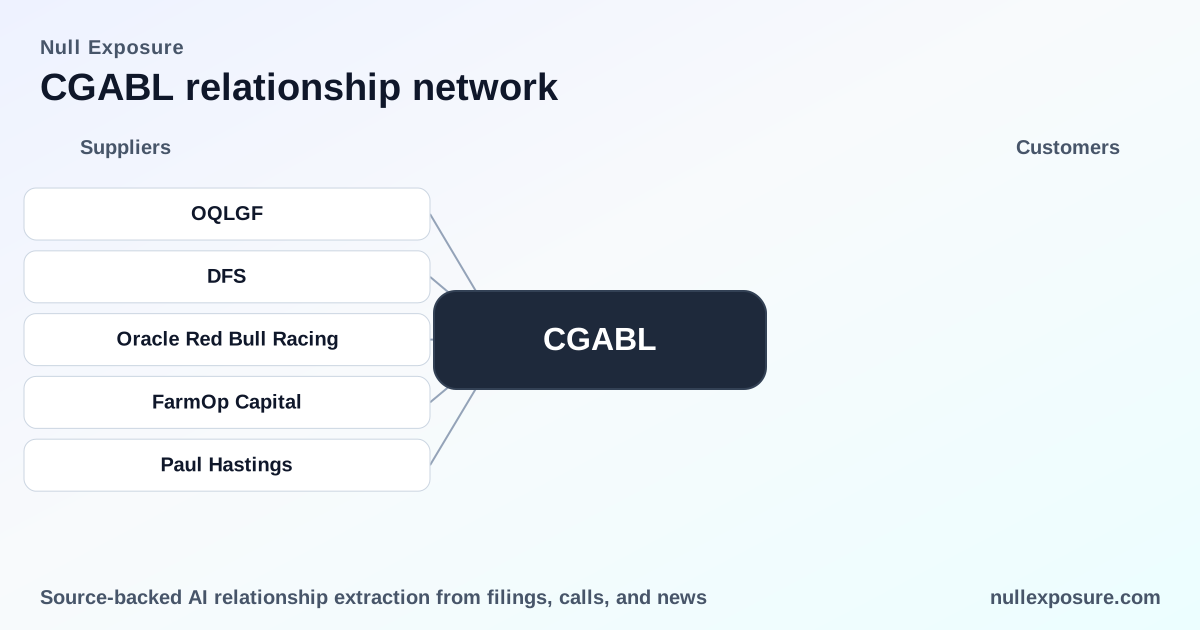
Carlyle’s Subordinated Notes (CGABL): Customer Relationships Drive the Fee Engine
Carlyle funds its operating engine primarily through recurring management fees and performance allocations earned by serving as an investment adviser and manager to a large, global investor base; the CGABL subordinated notes are a fixed-income claim on Carlyle’s consolidated balance sheet that benefits from the firm’s fee-bearing relationships across private equity and credit. For investors evaluating CGABL, the most relevant signal is not a single borrower but Carlyle’s ongoing role as a service provider and lender via its Global Credit platform—deploying direct financings and structured credit into corporate borrowers and sponsors and deriving steady cash flow from management fees and subordinated fee streams. Learn more about how these relationship signals evolve at https://nullexposure.com/.
Operationally, the firm monetizes by raising capital commitments, calling capital into funds, charging management fees over long life cycles, and capturing carried interest on realized gains. The CGABL instrument sits behind operating cash flows that are highly dependent on the scale and stickiness of Carlyle’s investor and borrower relationships, and on the frequency of direct financings originated by Carlyle Global Credit.
What the relationship footprint reveals about Carlyle’s operating posture
Carlyle’s customer relationships frame several structural characteristics that matter to bond and credit investors:
- Contracting posture — long-term, fee-bearing arrangements. Company filings make clear that management fee arrangements commonly run for a decade from closing and can extend in limited circumstances, creating a predictable fee runway for the firm. This is a structural support for subordinated creditors seeking steady cash coverage.
- Capital commitment (subscription) model underpins liquidity demand. Carlyle calls committed capital from investors during prescribed windows, a model that supports transaction activity while concentrating funding on committed partners rather than ad hoc capital raises.
- Counterparty mix is diversified and institutionally oriented. Public pensions, sovereign wealth funds, insurers and high-net-worth individuals populate the investor base, with occasional governmental counterparties in specific jurisdictions—this breadth reduces single-investor concentration risk.
- Global footprint and active origination. Carlyle operates across private equity, credit and investment solutions with international deployment increasing over time; its Global Credit franchise explicitly originates direct financings in Europe and North America.
- Role and materiality — service provider with critical cash flows. Management fees are both a near-term cash cover for operating costs and the primary pathway to carried interest. Filings state management fees have materially covered operating costs, making client relationships critical to cash generation.
- Maturity and spend scale. Carlyle reports substantial fee receipts from structured credit and CLO activity, indicating large spend bands and meaningful recurring revenue from credit product lines (CLO fees >$200m in 2024 before consolidation).
Together, these company-level signals point to a business that is contractually rooted, globally diversified, fee-centric, and materially dependent on the health of its investor and borrower relationships—critical context for assessing recovery and cash-conversion risk for CGABL.
The active counterparties Carlyle has been financing recently
Below are the customer and portfolio counterparties referenced in recent press and filings; each relationship is summarized concisely with its source.
Mecachrome Group — large European industrial financing
Carlyle provided a €290 million financing package to Mecachrome Group to support expansion of a high-precision aerospace and defense supplier, reflecting Carlyle Global Credit’s direct lending appetite in strategic European industrials. According to Pulse2 (May 2, 2026), this transaction underscores Carlyle’s willingness to deploy sizeable credit facilities in support of buy-and-build growth.
Litmus Music — strategic credit and equity commitment to a media platform
Carlyle Global Credit committed $500 million in initial capital—structured as both equity and debt—to support Litmus Music’s launch and growth, aligning the credit platform with sector-focused investments in media and rights management. This financing was reported by Variety in 2022 and demonstrates Carlyle’s cross-product commitments where equity and credit are used in tandem.
ADDEV — recurring French financing activity
Carlyle Global Credit included ADDEV among several French financings, indicating continued activity in industrial services and solutions within France; this transaction was cited alongside others such as Fitness Park and Argon. Pulse2’s reporting (May 2, 2026) places ADDEV in a pattern of regional portfolio builds for Carlyle’s credit arm.
Fitness Park — consumer/leisure credit exposure in France
Fitness Park was noted as part of Carlyle Global Credit’s growing activity in France, representing consumer- and services-oriented direct lending in a regional market where Carlyle is increasing its footprint. Pulse2 (May 2, 2026) lists Fitness Park among recent financings that broaden Carlyle’s European credit reach.
BayPine LP — advisory and financing support for sponsor transactions
Carlyle Global Credit acted as the financing counterparty in support of BayPine LP’s majority investment in Harbor, with Latham & Watkins representing Carlyle on the debt financing; this illustrates Carlyle’s role as both advisor and capital provider in sponsor-backed transactions. The Latham press release (June 2025) reports the representation and financing arrangements.
Argon (ARNGF) — another French financing illustrating sector reach
Argon was identified among recent financings in France, reinforcing the theme of targeted regional credit activity; Argon’s transaction surfaced in the same Pulse2 piece (May 2, 2026) and is listed with an inferred symbol ARNGF in reporting feeds, confirming market attention to this borrower.
What investors should take away from these relationships
- Direct lending and sponsor finance are active engines for Carlyle Global Credit. The listed counterparties demonstrate a pattern: Carlyle uses its balance sheet and credit platform to support buyouts, growth financings and sector roll-ups across Europe and the U.S., which supports fee and interest income for the firm.
- Fee resiliency comes from long-term contracts and a diversified investor base. The firm’s long-duration advisory relationships and subscription-style capital commitments reduce short-term revenue volatility and provide underlying cash to service subordinated obligations.
- Concentration risk is moderate but present in regional campaigns. Carlyle’s growing cluster of financings in France shows targeted regional exposure; while diversification across asset classes and geographies offsets single-country risk, credit investors should monitor regional macro and sector cycles.
- Operational criticality of these relationships is high. Management and advisory fees cover operating costs and materially influence distributable earnings, making client retention and deal flow essential to credit coverage.
If you want a deeper, deal-by-deal view of how Carlyle’s credit commitments feed into its consolidated cash flow profile, visit https://nullexposure.com/ for our expanded analytics and relationship dashboards.
Final assessment: credit-sensitive, but structurally supported
Carlyle’s subordinated notes trade against a firm that is operationally centered on long-lived, fee-bearing relationships and an active direct lending franchise. That structural profile provides predictable revenue under normal conditions, but it also ties creditor outcomes to continued fund-raising success, origination volume, and the performance of financed portfolio companies. For credit investors in CGABL, the central questions remain: can Carlyle sustain strong origination and fee capture across economic cycles, and does credit portfolio performance remain within loss expectations? The relationships summarized above show the firm is actively deploying capital across sectors and geographies, supporting near-term cash generation while exposing the capital structure to conventional private credit cycle risks.