Canopy Growth (CGC): How customer relationships — and provincial contracts — drive the revenue base
Canopy Growth monetizes through a vertically integrated model: it cultivates, manufactures and distributes cannabis and hemp products for adult-use retail and medical markets across Canada, Europe and Australia, and it sells both to government-controlled provincial distributors and to end customers via direct medical channels. Revenue derives from B2G wholesale supply contracts with provincial cannabis control authorities, B2B retail distribution agreements, and direct-to-patient medical sales, with product mix spanning dried flower, vapes, oils and medical vaporizers.
If you evaluate counterparty exposure or procurement risk for CGC, the provincial supply dynamic is central; see more on the company’s homepage for broader intelligence: https://nullexposure.com/
Why the provinces matter: the commercial reality behind the FY2025 disclosures
Canopy’s FY2025 10‑K defines an explicit wholesale relationship with Canadian cannabis control authorities — the provincially mandated distributors and, in some provinces, the exclusive retailers. For adult‑use markets the company maintains agreements to supply all provinces and territories (except Saskatchewan’s different model), positioning those authorities as de facto customers for significant volumes. According to the FY2025 Form 10‑K, Canopy reported approximately $101.3 million in gross sales to cannabis control authorities for the year ended March 31, 2025, and one such authority accounted for at least 10% of net consolidated revenue. (Source: Canopy Growth FY2025 10‑K, March 31, 2025)
Atomic view: the listed customer relationship
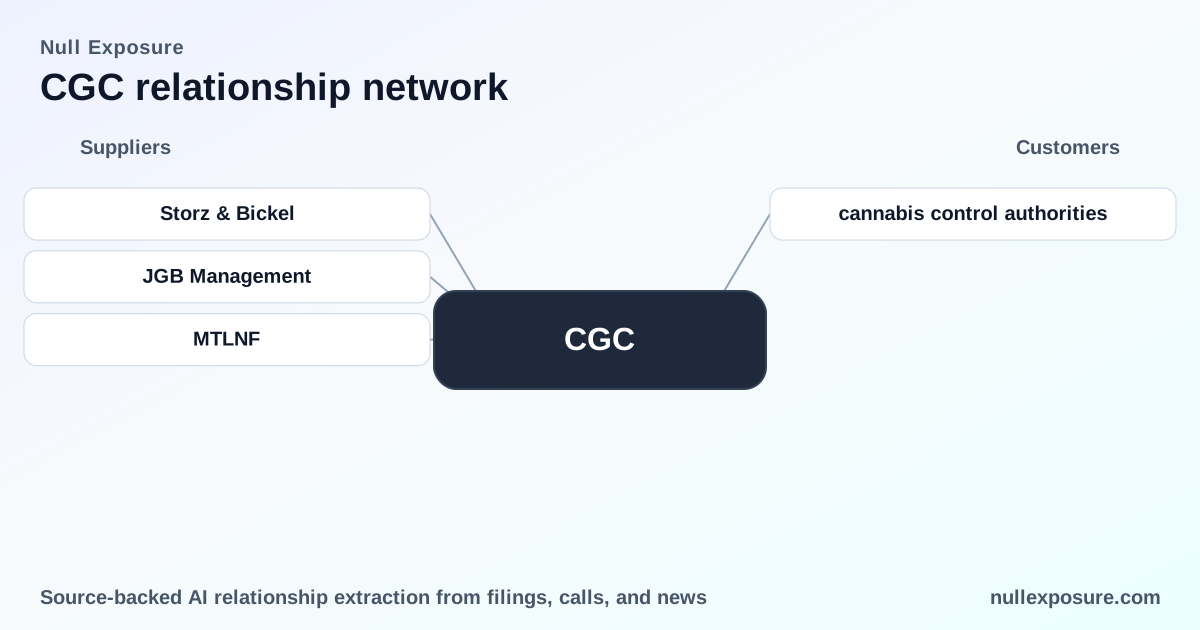
Cannabis control authorities — Canopy supplies adult‑use product into the provincially controlled wholesale and retail networks across Canada; these authorities act as the primary distribution channel and, in many provinces, the exclusive wholesale purchaser for adult‑use cannabis. The relationship is contractual, material to revenue, and centrally embedded in Canopy’s Canadian commercial footprint. (Source: Canopy Growth FY2025 10‑K, cgc‑2025‑03‑31)
How this relationship changes the company’s operating model and risk profile
-
Contracting posture: Canopy operates under commercial supply contracts and standing agreements with provincial authorities rather than open retail competition in those channels. The company characterizes these as business‑to‑business wholesale arrangements where the provinces act as sole wholesale distributors in many jurisdictions. This creates a procurement-style relationship with government entities that favors compliance, reliability of supply, and negotiated pricing terms. (Source: Canopy Growth FY2025 10‑K)
-
Concentration: The FY2025 reporting highlights that one cannabis control authority represented at least 10% of net revenue, and gross sales to cannabis control authorities totaled roughly $101.3 million for the year. Concentration is material — loss, repricing or reduced volume from a single provincial counterparty could materially affect top line. (Source: Canopy Growth FY2025 10‑K)
-
Criticality: For adult‑use Canada revenue, provincial supply contracts are a significant component of current revenues. These contracts are operationally critical: they drive production scheduling, packing allocations and distribution logistics. The provincial channel is not peripheral; it is central to Canopy’s Canadian go‑to‑market. (Source: Canopy Growth FY2025 10‑K)
-
Maturity and stability: The relationship is an established commercial channel rather than a pilot program. Canopy’s disclosures describe ongoing, multi‑jurisdictional supply arrangements across provinces and territories and note active medical and adult‑use programs in Canada supported by Spectrum Therapeutics for direct patient fulfillment. That institutional nature reduces churn risk relative to ad hoc retail models, at the cost of dependence on provincial procurement policies. (Source: Canopy Growth FY2025 10‑K)
Company‑level signals that shape how investors should think about customers
Beyond the provincial government channel, Canopy runs a blended customer ecosystem:
-
The company sells directly to registered medical patients through Spectrum Therapeutics’ online platform, using mail delivery under the Cannabis Act; this creates a direct-to‑individual revenue stream alongside B2G and B2B channels. (Source: Canopy Growth FY2025 10‑K)
-
Canopy operates globally: core operations span Canada, Europe (notably Germany), and Australia, and the firm cites EU‑GMP certification enabling exports to European medical markets. The company’s revenue tables reference Canada and Germany explicitly, and foreign‑currency exposure shows active international operations. Customer exposure is therefore geographically diversified but still weighted toward regulated markets. (Source: Canopy Growth FY2025 10‑K)
-
Product segmentation includes core cannabis products, distribution services, and manufacturing of vaporizers through Storz & Bickel, giving the company multiple customer entry points (provincial wholesale, third‑party retailers, medical patients and accessory channels). (Source: Canopy Growth FY2025 10‑K)
What investors should watch next: commercial, policy and margin levers
-
Policy shifts and provincial procurement cycles drive near‑term revenue variability. Because one provincial authority represented >10% of revenue in FY2025, procurement timing, tender outcomes and pricing renegotiations are direct earnings levers. (Source: Canopy Growth FY2025 10‑K)
-
Operational execution on filling provincial orders — inventory cadence, EU‑GMP compliance for exports, and medical direct‑fulfillment — determines how contracted volumes convert to cash. Canopy’s global manufacturing footprint supports exports but also introduces FX and regulatory complexity tied to customer fulfillment. (Source: Canopy Growth FY2025 10‑K)
-
Product mix and channel margins matter: wholesale pricing to a provincial retailer has a different margin profile than direct medical or accessory sales; a shift in sales mix toward lower‑margin wholesale could compress gross margins even if volumes hold. (Source: Canopy Growth FY2025 10‑K)
If you want a concise view of customer concentration and contract positioning across Canopy’s book, the company’s FY2025 10‑K is the primary reference for contractual descriptions and revenue attribution.
Explore more structured customer intelligence and related risk matrices at Null Exposure: https://nullexposure.com/
Bottom line: provincial contracts are a strength — and a single‑point test
Canopy Growth’s commercial model leverages institutionalized provincial purchasing to deliver scale in Canadian adult‑use cannabis while preserving diversified medical and global channels. That structure provides predictable, contract‑based demand, but it also creates meaningful counterparty concentration and policy dependence. Investors evaluating CGC should weigh the stability of existing provincial contracts, the pipeline of renewals/tenders, and exposure to a limited number of large government buyers when modeling revenue and downside scenarios. (Source: Canopy Growth FY2025 10‑K)
For ongoing monitoring of customer relationships and procurement concentration across regulated markets, visit Null Exposure for updated coverage and alerts: https://nullexposure.com/