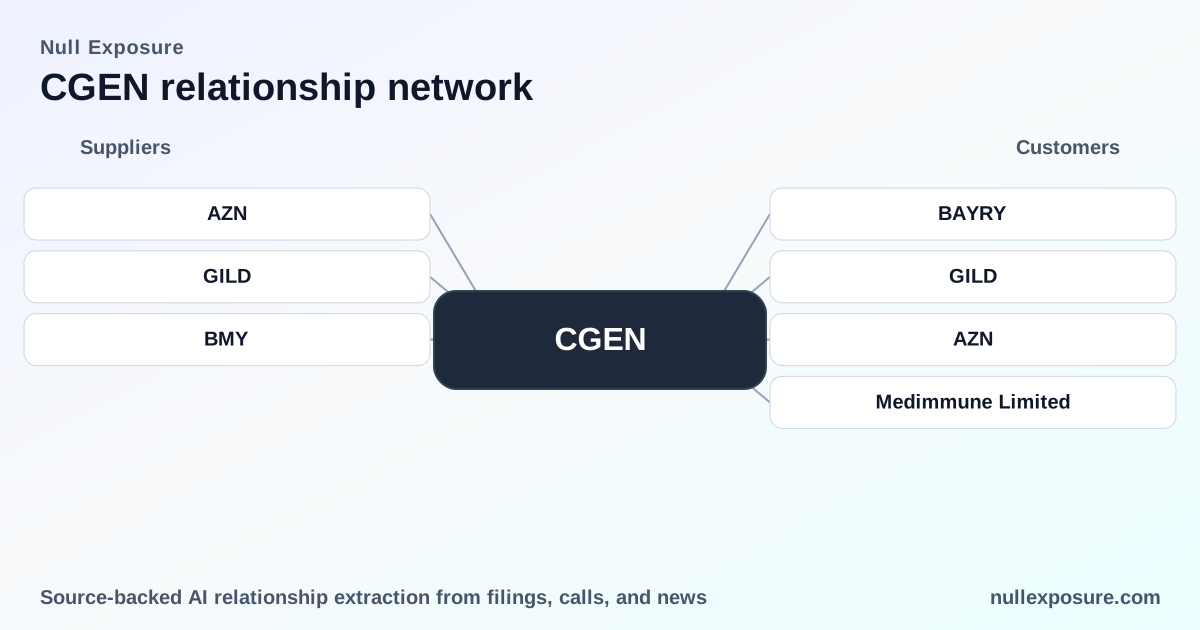
Compugen’s partner-led value model: licensing, milestones and non‑dilutive monetization
Compugen (NASDAQ: CGEN) operates as a discovery-to-license biotech: it discovers therapeutic assets, out‑licenses promising candidates to large pharma partners, and monetizes those licenses through upfronts, milestone payments and royalties. Revenue today is partner-driven rather than product sales, with AstraZeneca and Gilead providing the primary cash inflows that fund internal programs and extend the company’s runway. For investors, the thesis is simple: Compugen is a small, high‑upside IP originator whose valuation and near‑term cash profile are dominated by a handful of large pharmaceutical relationships.
If you want a consolidated view of these customer relationships and their financial implications, start here and then consult Compugen’s filings for tranche details: https://nullexposure.com/
Why Compugen’s model works for investors — and where it concentrates risk
Compugen’s operating model is outsourced commercialization plus selective retained programs. The company leverages large partners for late‑stage development and regulatory execution while retaining discovery-stage assets (e.g., COM902, COM701) that can either be advanced internally or re‑licensed. That model generates:
- Upfront cash and milestone timing that materially change the balance sheet — 2025 revenue jumped largely because of a $65 million upfront monetization tied to AstraZeneca and payments from Gilead.
- Concentration of counterparty and program risk — a small number of pharma partners account for the lion’s share of near‑term cash and the optionality of future royalties.
- Mixed maturity profile across programs: some assets are in Phase 3 (rilvegostomig), others in Phase 1 (GS‑0321 / COM503, COM701, COM902), which staggers binary outcomes and valuation catalysts.
Compugen extended its non‑dilutive cash runway into 2029 through royalty monetization, demonstrating an explicit emphasis on preserving equity while extracting near‑term value from partner economics. This is a strategic, finance‑centric posture: license, milestone, monetize.
The partners that matter — concise, source‑backed summaries
AstraZeneca (AZN)
Compugen’s rilvegostomig program—an Fc‑reduced PD‑1/TIGIT bispecific whose TIGIT component derives from Compugen’s COM902—has been advanced by AstraZeneca through multiple Phase‑3 trials and commercial plans; Compugen amended the license to monetize a portion of future royalties for up to $90 million, including a $65 million upfront that materially drove 2025 revenue. According to Compugen filings and press coverage, the monetization transaction extended the company’s cash runway into 2029 and re‑priced a portion of future royalty streams (company 6‑K and related press, Dec 2025 / Mar 2026).
Source: Compugen SEC/6‑K and company press releases reported via Reuters/TradingView and StockTITAN (Dec 17, 2025; filings reported Mar 2026).
Gilead Sciences (GILD)
Compugen licensed GS‑0321 (previously COM503), an anti‑IL‑18 binding protein antibody, to Gilead; Gilead paid an upfront and triggered a $30 million IND milestone when GS‑0321 received IND clearance, and Compugen reports additional potential milestones and royalties totaling hundreds of millions. Management indicated dosing initiation in a Phase‑1 trial and treated Gilead payments as validation and a recurring revenue driver.
Source: Compugen 2025 Q4 earnings call transcript and public press coverage (earnings call Mar 7–9, 2026; Globe and Mail / Yahoo Finance reporting).
Bayer (BAYRY)
Bayer has historical dealings with Compugen dating to 2013 when it acquired two oncology candidates and provided an immediate $10 million investment plus subsequent payments; that earlier partnership established Compugen’s licensing model and industry validation. The Bayer relationship is legacy but relevant as proof‑point for Compugen’s externalization of late‑stage development.
Source: Globes reporting on Compugen’s strategic pivot and the 2013 Bayer collaboration (article referencing FY2022 context).
MedImmune Limited (part of AstraZeneca group)
Compugen and MedImmune (AstraZeneca’s biologics arm) executed Amendment Number 4 to the March 30, 2018 license agreement covering rilvegostomig, updating economic terms of Compugen’s royalty interest and facilitating the royalty monetization structure announced in December 2025. This is an internal amendment tied to the broader AstraZeneca commercial relationship and the royalty monetization mechanics.
Source: Company announcements and market reporting (Marketscreener / StockTITAN reporting Dec 2025 / Mar 2026).
How these relationships translate into operating characteristics
Compugen’s contracting posture is license‑centric and capital‑efficient: the firm trades later‑stage development risk for upfronts, milestones and royalty streams. That posture minimizes near‑term clinical spend but concentrates value capture in counterparty payments and royalty economics.
Concentration is a primary business risk: two pharma partners (AstraZeneca and Gilead) dominate 2025 cash inflows, making partner execution and milestone timing critical to the company’s near‑term valuation. At the same time, Compugen mitigates dilution risk through monetization (the AstraZeneca royalty monetization is a direct example).
Criticality is asymmetric by program maturity: rilvegostomig (AZN) is a high‑criticality asset for Compugen because it is in Phase‑3 with large peak sales assumptions referenced by AstraZeneca; GS‑0321 (Gilead) is an earlier but strategically important validation of Compugen’s discovery platform. Program maturity creates a ladder of catalysts rather than a single binary event.
Finally, the company uses amendments and structured monetization to actively manage cash; that is an operational characteristic investors must model alongside headline milestones.
Investment takeaways and risk checklist
- Catalyst list: Phase‑3 readouts and AstraZeneca trial execution, Gilead’s GS‑0321 Phase‑1 progress, and any additional milestone or royalty monetizations. (Sources: company filings and earnings calls, Mar 2026.)
- Balance‑sheet leverage: The $65 million upfront and royalty monetization materially improved 2025 revenue and extended runway into 2029 per management commentary (2025 Q4 filing and press).
- Top risks: partner concentration, timing risk on milestone triggers, and clinical/regulatory outcomes for AstraZeneca’s and Gilead’s programs; these are direct drivers of future cash and valuation.
For investors focused on partner‑driven biotech models, Compugen is a classic small‑cap licensor with asymmetric upside tied to a few high‑value programs and explicit non‑dilutive financing mechanics.
If you want this mapped into a counterparty‑weighted cash model or a relationship risk scorecard, visit https://nullexposure.com/ to see structured intelligence on partner exposures and calendar risk.
Final read
Compugen’s current valuation and cash posture are built from licensing execution and royalty structures rather than product sales: AstraZeneca and Gilead are the primary levers, with historical validation from Bayer and contractual detail involving MedImmune underpinning current economics. Investors should treat near‑term returns as contingent on partner milestones and commercialization execution while recognizing Compugen’s deliberate non‑dilutive financing strategy as a central company characteristic.