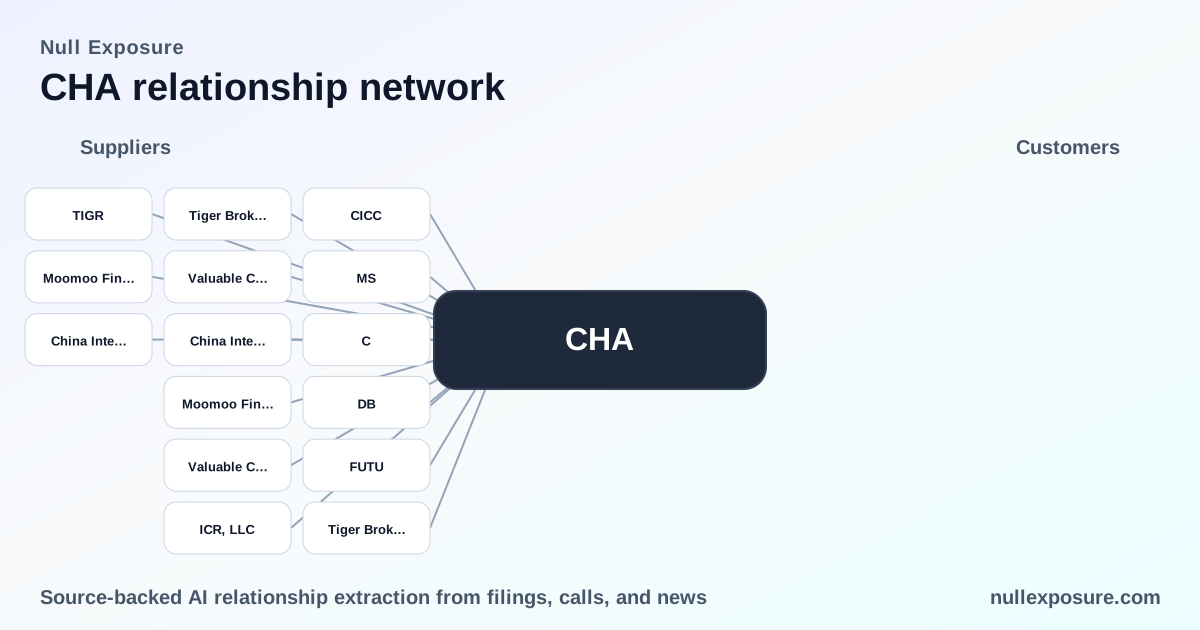
Chagee Holdings (CHA): Customer Relationships, Operational Posture, and Investment Implications
Chagee Holdings operates a fast-growing chain of freshly made tea outlets and sells related raw materials, packaging, and teahouse equipment; the company monetizes through point-of-sale retail beverage sales and ancillary product sales to partners and franchisees. Revenue scale is substantial — trailing twelve‑month revenue exceeds RMB 12.9 billion (converted reporting) — and the model mixes high-volume retail receipts with product and equipment sales that generate gross margin leverage. Explore deeper CHA customer intelligence at https://nullexposure.com/.
How Chagee makes money and why customer links matter
Chagee’s core economics rest on high-frequency retail transactions combined with B2B product channels. The public financial snapshot shows strong gross profits (gross profit TTM ~5.9 billion) but a tighter operating margin profile, reflecting investments in expansion and store operations. For investors and operators, the character and concentration of customer relationships translate directly into demand stability, distribution economics, and working-capital dynamics. In other words, who buys Chagee’s beverages and who sources its supplies are strategic levers for margin and growth.
Business model signals that shape risk and opportunity
- Contracting posture is predominantly transactional and retail-focused. Chagee’s operating footprint implies many small-value, high-frequency customer interactions rather than a small set of large, long-term contracts. That posture reduces counterparty credit risk per sale but increases operational execution risk at scale.
- Revenue concentration and channel mix are central. Public metrics show a large retail revenue base; product and equipment sales provide margin diversification. Concentration risks therefore live in geographic store density and any large B2B buyers, not in single heavyweight contracts.
- Criticality of third-party partners is moderate but material. Logistics, packaging suppliers, and point-of-sale partners are essential to daily operations; disruptions ripple quickly into sales and margins.
- Corporate maturity is early-mid stage. Founded in 2017 and now listed on NASDAQ, Chagee is commercially scaled but still in an aggressive expansion phase, explaining operating-margin pressure despite healthy gross profits.
These company-level signals are the right lens for evaluating customer relationships: investors should prioritize visibility into material B2B customers, any large wholesale buyers, and strategic partnerships that underpin distribution or technology.
Customer relationships we identified
The public customer-scope scan returned a single named relationship in available materials. Below is the explicit result and its source.
JZ (Jianzhi)
Stock scanning lists JZ (Jianzhi) as a customer relationship for CHA. A StockTitan news item dated May 3, 2026, reported that under a collaboration, Jianzhi’s cloud-ready educational content and platforms are intended to be integrated into China Telecom’s cloud center infrastructure (https://www.stocktitan.net/overview/JZ/). This entry is recorded in the customer relationship results associated with CHA.
What the relationship set — or lack of it — tells investors
The scan returned only one referenced customer relationship. Limited public naming of customers is itself informative: it signals relatively low transparency around material B2B counterparties in public sources. For an operator of Chagee’s size and public profile, that limited visibility raises two concrete implications:
- Concentration risk is opaque. With few named customers, investors cannot fully assess whether a small number of B2B buyers contribute a disproportionate share of revenue or working capital exposure.
- Operational criticality is concentrated in retail execution and suppliers. The absence of named large institutional customers in the public record suggests that the company’s day‑to‑day revenue dependency is on retail foot traffic and franchise or distributor relationships rather than a few strategic corporate customers.
Note: the regulatory and disclosure environment for many China-based consumer franchisors often limits granular public naming of retail or small B2B partners; the single listed relationship in our scan is a reflection of publicly scrubbable sources, not necessarily the complete commercial map.
Contractual constraints and disclosure posture
The customer-scope constraint set provided no explicit contractual constraints. As a company-level signal, the lack of disclosed contractual constraints in our scan highlights two operational facts:
- Contract risks are not visible in public filings, which elevates the importance of primary diligence for material B2B arrangements (supplier credit terms, minimum purchase commitments, and exclusivity clauses).
- Management’s disclosure posture is conservative on partner detail, increasing reliance on alternative intelligence channels to understand counterparty risk and concentration.
Investors evaluating CHA should treat the absence of detailed constraints as a call for targeted questions in diligence: request schedules of major customers and supplier concentrations, and probe contract tenors for equipment and raw-material channels.
Investment implications and recommended next steps
- Positive: scale and gross-profit base are real. CHA’s top-line scale and gross margin provide a strong foundation for long-term value creation if operating leverage is captured.
- Risk: customer/supplier transparency gap increases uncertainty on concentration and contract risk. Limited public naming of customers elevates event and counterparty risk for investors who require predictable cash flows.
- Action for analysts and operators: prioritize primary diligence on large B2B relationships, vendor credit terms, and store-level unit economics. For those tracking CHA’s commercial links on an ongoing basis, use targeted monitoring and ask for a verified list of material counterparties in investor outreach.
For continued, structured coverage of customer relationships and counterparty risk across public companies, visit NullExposure for expanded intelligence and monitoring tools: https://nullexposure.com/.
Final takeaway
Chagee is a scaled retail-and-product business with robust gross profitability but limited public visibility into its B2B customer base. That combination creates an attractive top-line platform with a challenge for risk-aware investors: extractability of operating leverage depends on management’s ability to convert scale into stable, disclosed customer contracts and predictable supplier economics.