City Holding Company (CHCO): Customer relationships, operating posture, and investment implications
City Holding Company operates as the holding company for City National Bank of West Virginia, monetizing through traditional community-bank channels: net interest income from lending, deposit services, trust and investment management fees, and transaction-based fees such as interchange and service charges. The business model is built on a regional retail footprint (97 branches) that generates a mix of long-dated consumer and commercial loans and recurring asset-management revenue streams that settle either over time or at discrete points. For investors, the critical lens is how that mix shapes funding stability, margin durability, and concentrated exposures—especially commercial real estate. Learn more at the NullExposure homepage: https://nullexposure.com/
How City Holding generates revenue and where customer value is captured
City Holding’s operating economics reflect a classic community bank: lending spread is the primary engine, while trust and investment management provide recurring fee income tied to quarter-end asset values. CHCO’s FY2024 results show strong profitability metrics (profit margin ~41.3%, ROE ~17%), underpinned by community-banking activities: lending, deposit-taking, and fiduciary services. Transaction fees—debit card interchange and point-in-time service fees—supplement income but are smaller and sensitive to volumes and payment-network economics. The bank’s asset mix includes a significant commercial real estate stock, which represents a material credit bucket in the balance sheet and a major driver of interest income and capital allocation.
What the SEC filing directly links CHCO to (relationship details)
City National (full name)
City Holding’s filings describe City National as the retail bank operating the community franchise, responsible for deposits, credit, and trust services across its regional branch network. This entity is the operational face of CHCO’s customer relationships and the vehicle for both interest income and fee-based trust services. According to CHCO’s FY2024 Form 10‑K, City National manages liquidity and funding to satisfy customer needs and operates 97 branches across West Virginia, Kentucky, Virginia and southeastern Ohio (CHCO 10‑K, FY2024).
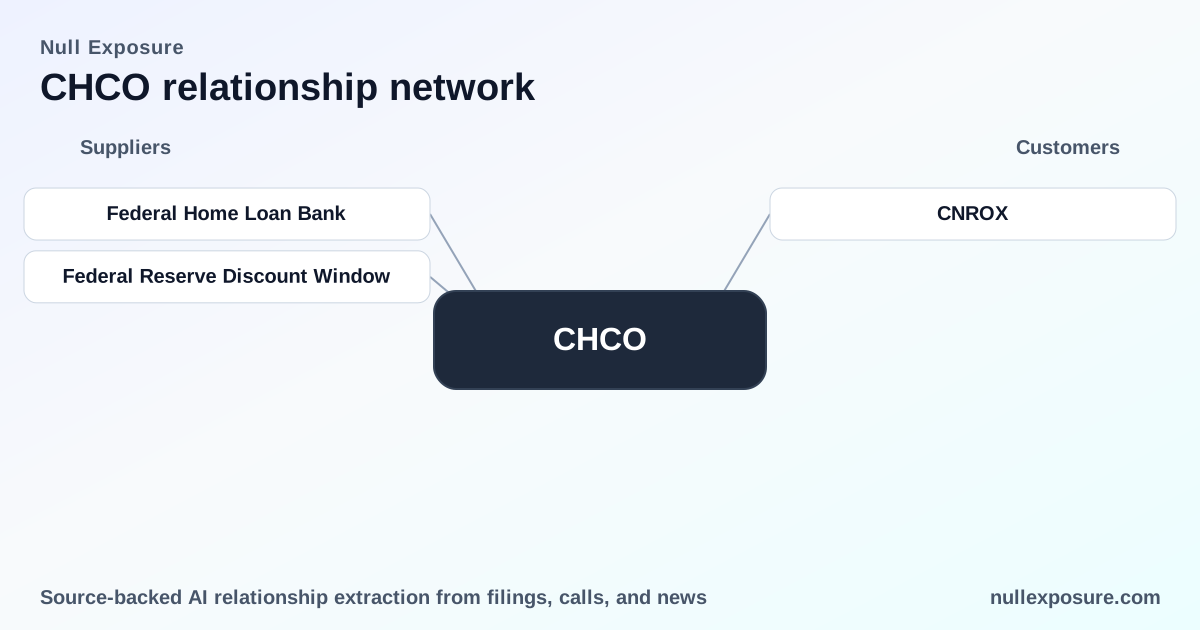
CNROX (inferred symbol for City National reference)
A parallel filing reference lists the same operational excerpt under an inferred symbol CNROX; the language reiterates that City National manages liquidity to meet its customers’ funding needs, effectively identifying the same customer-facing organization described above. Source: CHCO FY2024 Form 10‑K (document chco-2024-12-31).
Operating model characteristics and contractual posture (what the constraints say)
The constraints extracted from CHCO’s FY2024 disclosure reveal a multi-faceted customer contract profile and concentration pattern that define operational risk and revenue stability:
- Long-term lending backbone. CHCO’s loan portfolio includes longer-term consumer mortgage structures—five- and seven-year adjustable-rate mortgages that amortize up to 30 years—indicating duration in the asset base and sensitivity to rate resets while preserving long-term funding relationships.
- Point-in-time transaction revenue. Transaction-based fees—account service fees and card-related charges—are recognized at a point in time, which makes this revenue line volatile and volume-dependent.
- Recurring trust / subscription-like revenue. Trust and investment management fees are recognized over time, typically quarterly and based on quarter‑end market values, producing predictable, asset-linked fee streams that settle shortly after quarter close.
- Usage-based card income. Debit-card interchange is usage-based and indexed to payment-network flows, so consumer spending patterns drive a portion of non-interest income.
- Customer mix dominated by local retail and small-to-mid commercial borrowers. The filings identify City National explicitly as a retail, consumer-oriented community bank with a commercial and industrial loan book concentrated in small and mid-size companies, reinforcing a local, relationship-driven lending posture.
- Geographic concentration in the U.S. Mid-Atlantic/Appalachian corridor. The bank’s branch network is concentrated in West Virginia, Kentucky, Virginia and southeastern Ohio, which creates regional economic exposure while supporting dense customer relationships.
- Materiality signal: diversified depositor base. Management states that no single depositor could have a material adverse effect on liquidity or capital, reflecting low counterparty concentration among depositors.
- Active, seller and service-provider roles. City National functions both as a creditor/seller of financial products and as a service provider for trust and investment management—dual revenue roles that create recurring and transactional cash flows.
- Scale of commercial real estate exposure. CHCO reported $1.77 billion in commercial real estate loans as of December 31, 2024, which is a meaningful balance-sheet allocation that drives interest income and credit-risk monitoring priorities.
How these relationships translate into investment risks and opportunities
- Durability of core margins. The combination of long-term retail mortgages and commercial CRE creates steady net interest income but leaves the portfolio exposed to interest-rate reset and local CRE cycles. Rate increases compress margins on adjustable products until repricing occurs; they also change asset valuations that determine trust fees.
- Fee mix stability. Subscription-like trust fees are sticky and tied to AUM, offering a counterweight to the cyclicality of point-in-time transaction fees and usage-based interchange. This diversification supports margin stability through business cycles.
- Regional concentration risk. A dense branch network in a limited geography concentrates economic exposure; local downturns in energy, manufacturing, or CRE have outsized effects on asset quality. The $1.77 billion CRE stock positions CHCO as sensitive to regional commercial property cycles.
- Funding and liquidity posture. Management’s emphasis on liquidity management indicates an operational focus on funding stability across depositor segments. The company’s statement that no single depositor is materially significant reduces short-term run risk.
- Counterparty composition. The mix of individuals, small businesses, and mid-market corporates supports diversified loan-flow economics, but demands active credit oversight because small-business defaults can cluster in a single region or industry.
Actionable investor takeaways
- Positive: CHCO’s business model blends stable lending spreads with recurring trust revenue, producing strong margins and ROE metrics; the diversified depositor base and branch footprint create durable customer relationships.
- Watchlists: Monitor regional CRE performance, quarter‑end AUM trends that feed trust fees, and debit-card volume trends for transaction income. Rising rate environments and local economic stressors are the principal earnings risk drivers.
- Where to dig deeper: Review CHCO’s subsequent quarterly filings for shifts in CRE delinquency, AUM flows, and deposit mix to gauge near-term earnings resilience.
For a structured view of CHCO’s customer relationships and comparative signals across peers, visit NullExposure for the full research toolkit: https://nullexposure.com/
Bottom line: City Holding’s customer relationships are operationally broad but regionally concentrated, combining long-term loan economics with recurring fiduciary fees and point-in-time transactional income—an attractive mix for investors who accept geographic exposure in exchange for predictable core profitability.