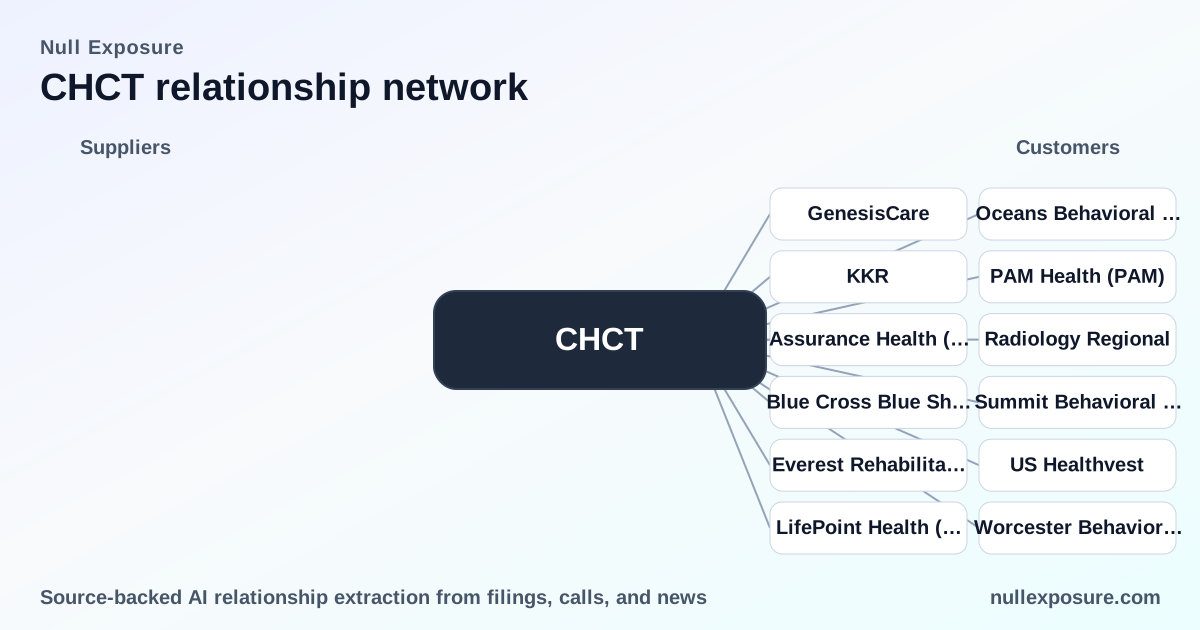
Community Healthcare Trust (CHCT): tenant map, operating posture, and what buyers should know
Community Healthcare Trust is a self‑managed, self‑administered healthcare REIT that acquires and leases outpatient and specialty healthcare properties to hospitals, health systems and operating providers. It monetizes primarily through long‑term lease cash flow on properties concentrated in outpatient settings, with a weighted average remaining lease term of roughly 6.7 years and portfolio occupancy north of 90%, while maintaining an active at‑the‑market capital program to fund growth and liquidity. For investors and operators assessing CHCT relationships, the question is straightforward: stable rent roll and long leases versus tenant credit events and regional concentration — the pending acquisition by KKR crystallizes near‑term value but leaves operational contract risk squarely on the table. Read more on tenant positions and filings at https://nullexposure.com/.
Quick read: the deal context and immediate implications
An ad‑hoc news release in March 2026 reported that KKR agreed to acquire CHCT for roughly $1.45 billion in cash, a transaction that locks in value for shareholders and changes the negotiating backdrop for lease rollovers and capital allocation going forward. The deal closes a value gap in a beaten‑down healthcare REIT sector and short‑circuits longer‑term public market recovery dynamics (ad‑hoc news, Mar 2026).
How CHCT contracts and capital posture shape risk and optionality
CHCT’s filings establish several company‑level operating signals that drive both valuation and execution risk:
- Long‑term contractual posture. The company reported a weighted average remaining lease term of approximately 6.7 years and a portfolio that was ~90.9% leased as of December 31, 2024, which underpins predictable rent collection and valuation stability (FY2024 10‑K).
- Material capital flexibility. Public filings reference an at‑the‑market equity program in the hundreds of millions: one excerpt references a $300 million ATM while another filing cited a $500 million program with approximately $426.3 million available as of Dec 31, 2024 — a clear signal that management uses equity issuance as a recurring financing lever (FY2024 filings).
- Large‑enterprise tenant base. CHCT’s tenant roster includes nationally recognized healthcare operators, an intentional concentration that reduces small counterparty idiosyncrasy while increasing exposure to sector‑wide credit cycles (FY2024 10‑K).
- U.S. geographic concentration. The portfolio spans 36 states but is meaningfully skewed: ~38.4% of annualized rent came from Texas, Illinois and Ohio as of Dec 31, 2024, concentrating execution risk in those jurisdictions (FY2024 10‑K).
- Active operating stance. Filings and recent 8‑K disclosures show an active leasing and asset management program rather than a passive hold posture; the company functions as both owner and operator in the outpatient healthcare real‑estate niche (FY2024 10‑K and 8‑K disclosures).
These signals combine to create a business that is lease‑driven and capital‑intensive, with liquidity and credit of tenants as the primary operational variable.
Explore CHCT relationship intelligence for detailed tracking and alerts.
Tenant list and what each relationship means for cash flow and credit
GenesisCare
GenesisCare is disclosed as one of CHCT’s tenants that filed a voluntary Chapter 11 petition in June 2023, an event CHCT recorded in its FY2024 10‑K and used to explain counterparty credit exposure and lease enforcement considerations. (CHCT FY2024 10‑K)
US Healthvest
CHCT’s 8‑K lists US Healthvest as accounting for 7.3% of the referenced rent pool, making it one of the larger single operating payors in the portfolio and a meaningful contributor to recurring cash flow. (CHCT Form 8‑K reported via StockTitan, Mar 2026)
LifePoint Health
LifePoint Health represented 6.4% of the rent cited in CHCT’s Form 8‑K, marking it as a top‑tier tenant whose credit and clinical footprint materially affect valuation. (CHCT Form 8‑K reported via StockTitan, Mar 2026)
PAM Health
PAM Health is reported at 4.9% of the rent mix in the same CHCT 8‑K disclosure, a mid‑sized tenant exposure that matters for concentrated market performance. (CHCT Form 8‑K reported via StockTitan, Mar 2026)
Everest Rehabilitation Hospital Lakeland, LLC
Everest Rehabilitation Hospital Lakeland, LLC is disclosed at 2.4% of the referenced rent; these specialized inpatient/rehab relationships carry different operational risk profiles than outpatient clinics. (CHCT Form 8‑K reported via StockTitan, Mar 2026)
Summit Behavioral Healthcare
Summit Behavioral Healthcare accounted for 2.9% of the rent cited, reflecting CHCT’s exposure to behavioral health operators, a segment with distinct reimbursement and occupancy dynamics. (CHCT Form 8‑K reported via StockTitan, Mar 2026)
Assurance Health
Assurance Health is listed at 2.9% of the rent pool in CHCT’s material event filing, representing another regional operator contribution to stable cash flow. (CHCT Form 8‑K reported via StockTitan, Mar 2026)
Worcester Behavioral Innovations Hospital
Worcester Behavioral Innovations Hospital shows up at 2.5% of rent in the 8‑K, reinforcing the company’s exposure to behavioral health assets in certain markets. (CHCT Form 8‑K reported via StockTitan, Mar 2026)
Oceans Behavioral
Oceans Behavioral is cited at 2.3% of rent, another behavioral health operator where occupancy and reimbursement trends will drive localized performance. (CHCT Form 8‑K reported via StockTitan, Mar 2026)
Radiology Regional
Radiology Regional accounted for 2.2% of the referenced rent, reflecting CHCT’s exposure to outpatient imaging and ancillary services. (CHCT Form 8‑K reported via StockTitan, Mar 2026)
Blue Cross Blue Shield of Louisiana
Blue Cross Blue Shield of Louisiana (BCBS of LA) appeared at 2.2% in the 8‑K disclosure, indicating a contractual payment or contractual relationship line that supports certain facility revenues. (CHCT Form 8‑K reported via StockTitan, Mar 2026)
Operational takeaways for investors and operators
- Lease term and occupancy are the primary stabilizers: WALE of ~6.7 years and ~90.9% leased translate into predictable near‑term cash flow that underpins valuation multiples in the sector (FY2024 10‑K).
- Tenant credit heterogeneity matters more than single‑name concentration: the largest tenant exposures reported are in the single‑digit percentage range, which limits catastrophic single‑tenant dependency but keeps portfolio‑level credit risk elevated if multiple operators weaken simultaneously (CHCT 8‑K disclosures).
- Capital flexibility exists but is deployment‑sensitive: large ATM capacity in filings signals the company can raise equity quickly, but financing dilutes public holders and becomes a different calculation under private ownership following the KKR transaction (FY2024 filings; ad‑hoc news, Mar 2026).
- Geographic concentration is a real execution vector: nearly 40% of rent from three states concentrates policy, reimbursement and demand risk in specific markets (FY2024 10‑K).
Bottom line
CHCT runs a long‑lease, cash‑flow focused healthcare REIT model with large institutional tenants and an active capital program; that model produces stable near‑term rents but leaves managers exposed to tenant bankruptcy events and regional concentration. The announced KKR acquisition for about $1.45 billion crystallizes public equity value and alters the strategic calculus for lease renewals and capital deployment. Investors and operators should prioritize covenant quality, bankruptcy‑resistant lease structures, and the post‑close integration plan for asset management when evaluating CHCT exposure.
For ongoing tracking of CHCT tenant exposures and material filings, visit https://nullexposure.com/.