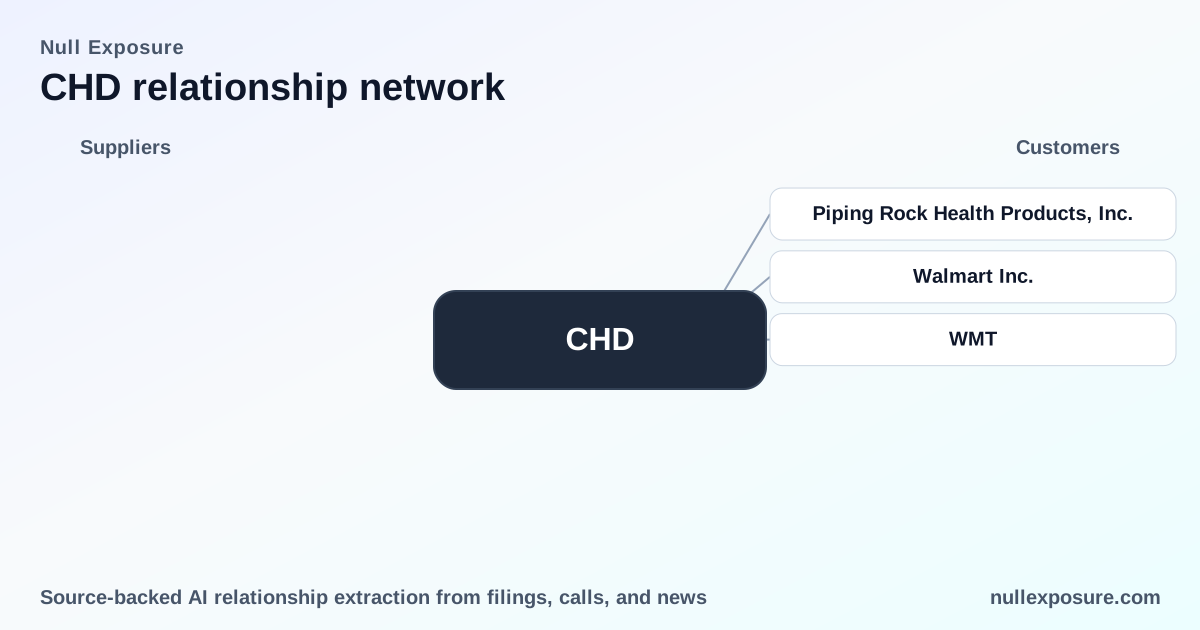
Church & Dwight monetizes by developing and selling branded household and personal care products through a broad network of retail and wholesale channels; the company generates cash primarily from spot sales to large retail customers and distributors, leverages brand equity to command retail shelf space, and supplements growth with selective brand transactions and international distribution. This mix produces stable margins but concentrated customer exposure that is central to any investor assessment.
Church & Dwight (CHD): customer relationships that define upside and risk
How Church & Dwight makes money — the operational contours investors must track
Church & Dwight is a branded consumer-products manufacturer that sells finished goods to supermarkets, mass merchandisers, wholesale clubs, drugstores, e-commerce platforms and specialty distributors. Revenue recognition and cash flow are driven by individual sales orders rather than long-term take-or-pay contracts, so pricing power, promotional cadence and retail placement determine near-term results. According to the 2025 Form 10‑K, the business is domestically concentrated (≈82% of sales in the U.S.) but global through an export and distributor network, and a small set of very large retail customers accounts for a material share of consolidated sales. For portfolio managers, that means Church & Dwight combines stable demand for everyday brands with customer concentration risk that can quickly transmit pricing or placement pressure to top-line growth and margins.
For deeper coverage and tools that parse these relationships, see https://nullexposure.com/.
Line-by-line customer read: every relationship in the source results
Below I cover each relationship found in the public documents and news coverage. Each item is a plain-English, 1–2 sentence takeaway with its source.
-
Walmart Inc. — Form 10‑K disclosure (FY2025): Walmart and its affiliates represented approximately 23% of Church & Dwight’s consolidated net sales in each of 2023–2025, making Walmart the company’s single largest customer and a material revenue driver. According to Church & Dwight’s 2025 Form 10‑K, that dependency is explicit and persistent. (Church & Dwight 2025 10‑K)
-
Piping Rock Health Products, Inc. — 10‑K announcement (Dec 9, 2025): Church & Dwight executed a definitive agreement to sell the VitaFusion and L’il Critters brands to Piping Rock, reflecting a strategic portfolio move to monetize non-core VMS assets. The 2025 Form 10‑K records the transaction announcement and positions these brands as divestitures. (Church & Dwight 2025 10‑K)
-
Target — ad-hoc news preview (FY2026 coverage): Market commentary highlights Target as a major distribution partner that helps Church & Dwight leverage brand equity and reach—Target is cited alongside Walmart and Amazon as key retail channels. The point is made in a May 2026 earnings preview on ad-hoc-news. (ad-hoc-news, May 2026)
-
Walmart — ad-hoc news preview (FY2026 coverage): Analysts and previews repeatedly list Walmart as a core distribution channel that underpins Church & Dwight’s shelf visibility and sales execution. The same May 2026 ad-hoc-news earnings preview references Walmart as a primary retail outlet. (ad-hoc-news, May 2026)
-
WMT (TradingView coverage) — customer-dependence highlight (FY2026 commentary): A TradingView write-up of Church & Dwight’s 10‑K emphasizes that the loss of principal customers such as Walmart could materially harm the company’s financial condition, underscoring the concentration risk investors must price. (TradingView, March 2026)
-
Amazon — ad-hoc news preview (FY2026 coverage): E‑commerce distribution via Amazon is cited as a complementary growth channel that extends Church & Dwight’s reach beyond brick‑and‑mortar partners. The May 2026 ad-hoc-news preview lists Amazon alongside Walmart and Target as a distribution pillar. (ad-hoc-news, May 2026)
-
Walmart — TradingView repeat (FY2026 commentary): TradingView again calls out Walmart as a top customer and reiterates the materiality of losing a principal retailer; this duplicate coverage reinforces how central Walmart is to market narratives and risk assessments. (TradingView, March 2026)
-
WMT — ad-hoc news summarization (FY2026 coverage): A second ad-hoc-news note frames Church & Dwight’s business model around innovation in everyday goods and distribution through “major retailers like Walmart, Target and Amazon,” restating the distribution-dependent revenue model. (ad-hoc-news, May 2026)
-
Amazon — InsiderMonkey earnings call excerpt (FY2026): Management commentary during the Q1 2026 call transcript called out specific channels—Toppik and club channels—and noted that Amazon “does well,” indicating strong e‑commerce performance for specific SKUs. (InsiderMonkey, May 2026)
What the filings say about contract terms, concentration and distribution roles
The public filings and coverage together create a clear picture of Church & Dwight’s operating model constraints that investors should treat as structural characteristics rather than transitory notes:
-
Contracting posture — short‑term, spot-driven: Church & Dwight states that business is “based primarily upon individual sales orders rather than long‑term contracts,” and many customer agreements include short-notice termination rights, so customer purchasing levels can change quickly (10‑K). This makes working capital and promotional funding cadence an ongoing tactical battleground for management.
-
Customer concentration — high and concentrated among very large retailers: A group of four customers contributed roughly 44% of consolidated net sales in 2025, and Walmart alone accounts for ~23%—an explicitly named concentration that is material to the company’s revenue profile (10‑K). That concentration creates asymmetric downside if one major retailer reduces assortment or intensifies promotional leverage.
-
Geographic mix — primarily North America, with global channels: Approximately 82% of sales were generated in U.S. markets in 2025, while the company also sells to over 100 countries via a global markets group and third‑party distributors, producing an 18% international mix. Investors should model near‑term performance with U.S. retail cycles dominating outcomes. (10‑K)
-
Role and channel complexity — seller, reseller, distributor: The company sells through a broad distribution platform that includes wholesalers, mass merchandisers, clubs, drugstores, dollar and specialty channels, and third‑party distributors for specialty products, making the business sensitive to channel‑specific inventory and promotional dynamics. (10‑K)
-
Product portfolio actions and materiality: While the VMS (vitamin, mineral and supplement) brands sold represented less than 5% of 2025 net sales, their sale to Piping Rock is a portfolio pruning move that is immaterial to revenue but material to strategic focus—freeing management to prioritize core household and personal care brands. (10‑K)
Investment implications — balancing stable cash flow with concentrated customer risk
-
Bull case: Church & Dwight owns durable consumer brands and benefits from predictable consumption patterns and margin resilience; retail partnerships with Walmart, Target and Amazon amplify distribution reach, providing an efficient route to consumers.
-
Bear case: The combination of short‑term contracting and a small set of very large retail customers creates outsized execution risk—loss of shelf space or worsened terms at Walmart, for example, would translate quickly into revenue pressure, a fact explicitly noted in filings and market commentary.
-
Tactical points for investors: Monitor retailer inventory levels, promotional allowances, and Church & Dwight’s merchandising wins or losses at Walmart and other club/mass channels; track any follow‑through from the Piping Rock transaction on supply chain and gross margin lines.
For institutional subscribers seeking more granular relationship analytics and to monitor customer concentration signals in real time, visit https://nullexposure.com/.
Bottom line
Church & Dwight’s earnings profile is anchored by recognized consumer brands and broad retail distribution, but its value hinges on execution with a small number of very large customers and on managing promotional intensity under largely short‑term commercial agreements. Investors should weigh the stock’s defensive consumption exposure against concentration and contract‑term risk when assigning multiples or stress scenarios.