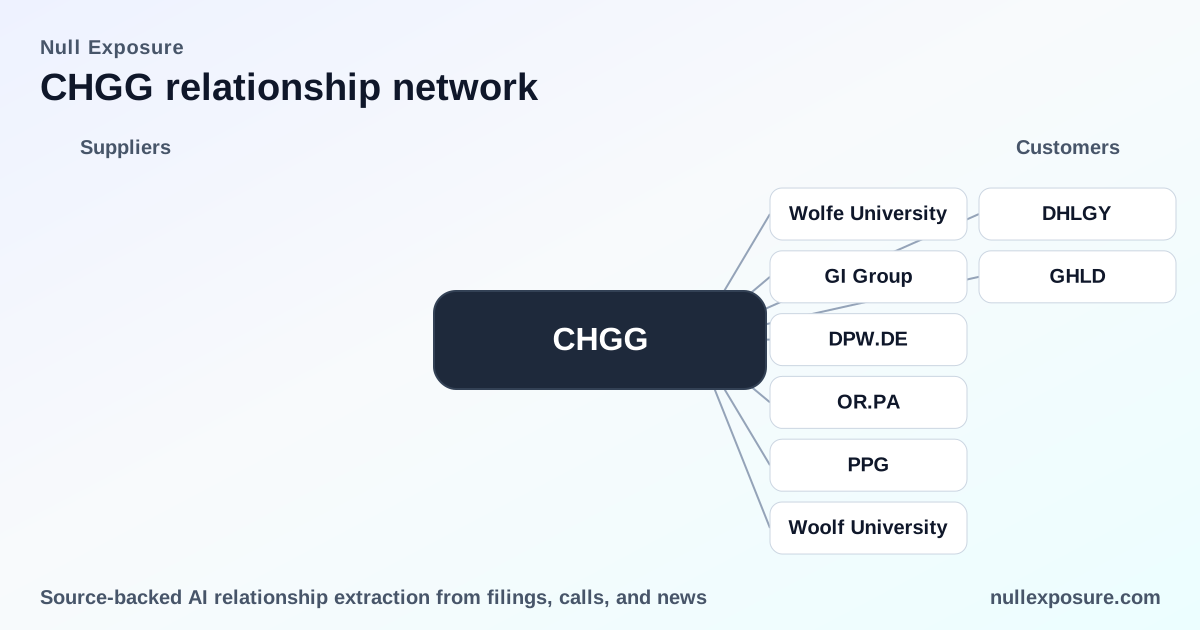
Chegg’s customer pivot: from mass subscriptions to contracted skilling revenue
Chegg operates a direct-to-student learning platform that historically monetizes through monthly subscription services (Study, Writing, Math, Busuu) and a growing B2B Skills & Other channel that sells courses and seat-based contracts to employers and institutions. Management’s Q4 2025 commentary frames the company as shifting from a high-volume, high-churn consumer subscription model toward a more contract-driven skilling strategy that leverages enterprise and university partnerships to embed Chegg content into accredited pathways. This dual revenue architecture—subscriber-led consumer cashflows plus nascent B2B contracts—defines the company’s near-term commercial thesis. For detailed exposure tracking and partner-level context visit https://nullexposure.com/.
Management put names to the pivot on the Q4 call
Chegg’s 2025 Q4 earnings call explicitly announced new partnerships intended to broaden distribution of Chegg courses and accelerate integration with accredited degree pathways. Management listed corporate partners and universities as examples of the B2B traction that underpins the skilling pivot, shifting investor focus from churn metrics to contract scale and seat adoption rates (Chegg 2025 Q4 earnings call, Mar 8, 2026).
Customer relationships called out by Chegg (one-by-one)
Below I enumerate every relationship mentioned in the results set, with a concise plain-English description and a source citation for each mention.
GI Group
Chegg named GI Group among new partners intended to expand reach for skilling offerings and to help position courses so they can count toward accredited credentials. (Chegg 2025 Q4 earnings call; Finviz write-up, Mar 9, 2026)
Wolfe University
Management highlighted Wolfe University as a partner for integrating Chegg’s courses into accredited degree pathways, positioning the university relationship as a strategic distribution and accreditation channel. (Chegg 2025 Q4 earnings call, Mar 8, 2026; Finviz, Mar 9, 2026)
Gil (GIL)
Chegg noted an expansion beyond an existing partner identified as Gil, marking the first time it broadened partnerships beyond that original relationship to add new partners in FY2026. (InsiderMonkey transcript referencing FY2026 commentary, May 2, 2026)
L Oreal
Chegg referenced extended contracts with large corporate customers including L Oreal, signaling renewal activity among enterprise clients that supports recurring B2B revenue. (InsiderMonkey transcript, May 2, 2026)
PPG
Chegg reported contract extensions with PPG as an example of enterprise-level renewal momentum, demonstrating client retention in the corporate skilling channel. (InsiderMonkey transcript, May 2, 2026)
Woolf University
A Globe and Mail piece noted that partnerships with entities like Woolf University underscore traction in the B2B channel and Chegg’s efforts to place courses into academic credit pathways. (The Globe and Mail, Mar 9, 2026)
DPW.DE
DPW.DE was used in reporting as the market ticker for DHL when management announced DHL among new partnerships, connecting Chegg’s skilling outreach to large global logistics employers. (Chegg 2025 Q4 earnings call, Mar 8, 2026)
L’Oreal (OR.PA)
Chegg’s commentary and the Q4 transcript referenced L’Oreal (reported in some sources as OR.PA) in the context of key contract extensions that validate enterprise interest in Chegg’s corporate learning offerings. (Chegg 2025 Q4 earnings call; Finviz/InsiderMonkey coverage, Mar–May 2026)
OR.PA
The OR.PA ticker appears in earnings-related coverage as the market identifier for L’Oreal; mentions tie to the same contract-extension narrative cited by management. (Chegg 2025 Q4 earnings call, Mar 8, 2026)
Coursera (COUR)
Analyst Q&A on the call asked about opportunities from the Coursera–Udemy merger; management framed Coursera as a potential distribution partner rather than a direct competitor, signaling a marketplace distribution strategy for Chegg’s proprietary content. (Finviz coverage of the Q4 analyst questions, May 2026)
Udemy (UDMY)
Management discussed Udemy alongside Coursera during Q&A as an example of an external marketplace where Chegg could distribute content, positioning platform relationships as channel multipliers for content monetization. (Finviz coverage, May 2026)
DHL GI Group (combined mention)
Some press transcripts combined DHL and GI Group in a single phrase when relaying management’s list of new partners; the combined mention reiterates Chegg’s focus on large employer channels and staffing organizations to scale seat sales. (InsiderMonkey transcript, May 2, 2026)
DHL
DHL was explicitly named by management as a new partner that can drive enterprise seat adoption and broaden Chegg’s B2B reach into corporate training programs. (Chegg 2025 Q4 earnings call, Mar 8, 2026; Finviz/Globe and Mail coverage, Mar 2026)
DHLGY (DHLGY)
Some news sources used the DHLGY ticker when reporting the DHL partnership; the coverage repeats the strategic intent to win corporate channel deals that accelerate accredited course adoption. (Finviz and Globe and Mail coverage, Mar 9, 2026)
Guild (GHLD)
Chegg’s stated pivot toward B2B skilling references an existing, successful partnership with Guild that has proven the contract-driven market thesis and helped stabilize the skilling segment. (Finviz write-ups, Mar 2026)
GHLD
GHLD is cited as the ticker for Guild in press coverage that attributes improving engagement and growing seat adoption to the Guild partnership, reinforcing skilling as Chegg’s next growth driver. (Finviz coverage, Mar 2026)
How these relationships map to the operating model constraints
Chegg’s operating profile displays a hybrid of consumer subscription economics and enterprise contracting:
- Contracting posture and revenue concentration: The company continues to depend heavily on subscription-based monthly payments from individuals (subscription evidence cited across the 2024–2025 disclosures), but management is actively pursuing contracted, seat-based enterprise deals to reduce topline cyclicality and churn. This is a company-level signal, not an attribute of any single partner.
- Customer mix and criticality: The core revenue engine remains dispersed, high-volume consumer subscribers, which management labels critical to present revenues (subscriptions were ~89% of net revenue in 2024). At the same time, enterprise partners increasingly serve as strategic distribution and accreditation channels.
- Geography and scale: Chegg operates globally, though disclosed revenue splits show a U.S.-heavy revenue base; international expansion for Skills and Other is a stated objective.
- Relationship maturity and role: The mix includes active, recurring individual subscriptions and increasingly active enterprise service-provider relationships with universities and corporate customers; management emphasizes contract renewals and seat adoption metrics as leading indicators for the skilling business.
Key takeaways for investors
- Chegg is pivoting from pure consumer-subscription economics toward a hybrid model that emphasizes enterprise contracts and accredited pathway integration. The Q4 2025 call named specific partners (DHL, GI Group, Wolfe/Woolf University, Guild) to make that shift tangible.
- Contract extensions with large corporates like L’Oreal and PPG validate early enterprise traction and retention. Those renewals matter more than single-seat wins because they convert skilling into recurring B2B revenue.
- Execution risk remains concentrated in scaling seat sales and embedding courses into accredited programs, but management has begun listing partners publicly—an early signal that go-to-market channels are operational.
If you want partner-level tracking and a consolidated view of Chegg’s contract exposure as the skilling strategy scales, explore our coverage at https://nullexposure.com/.
Sources referenced include Chegg’s 2025 Q4 earnings call (Mar 8, 2026), press coverage and transcripts on InsiderMonkey (May 2, 2026), Finviz summaries (Mar–May 2026), and The Globe and Mail analysis (Mar 9, 2026).