CHMI-P-A: Agency approvals and servicing relationships that underpin preferred yield
Cherry Hill Mortgage Investment Corporation issues CHMI-P-A, a series of cumulative preferred shares that deliver fixed, priority cash distributions funded by the firm’s mortgage-backed securities holdings and servicing economics. Cherry Hill monetizes through interest spreads on agency and non‑agency MBS, MSR (mortgage servicing right) fee streams, and opportunistic portfolio management; the preferred series is positioned for investors seeking predictable coupon income within that capital structure. For institutional readers evaluating counterparty and operational risk, the company’s agency servicing approvals and MSR acquisitions are central to cash‑flow durability and execution risk.
Explore our institutional coverage at https://nullexposure.com/.
Why agency servicing approvals matter to CHMI’s business
Cherry Hill’s operating model is not purely a passive bond holder—it acquires MSRs and operates servicing platforms that generate recurring fees and contribute directly to distributable cash. That means contracting posture is operational and approval‑driven: servicing relationships with government agencies impose compliance, capital, and operational obligations that are prerequisites for fee income. Agency approvals also create a two‑way effect on concentration and criticality: they expand possible funding and resale channels while simultaneously concentrating operational dependency on a small set of counterparties that control access to large mortgage pools.
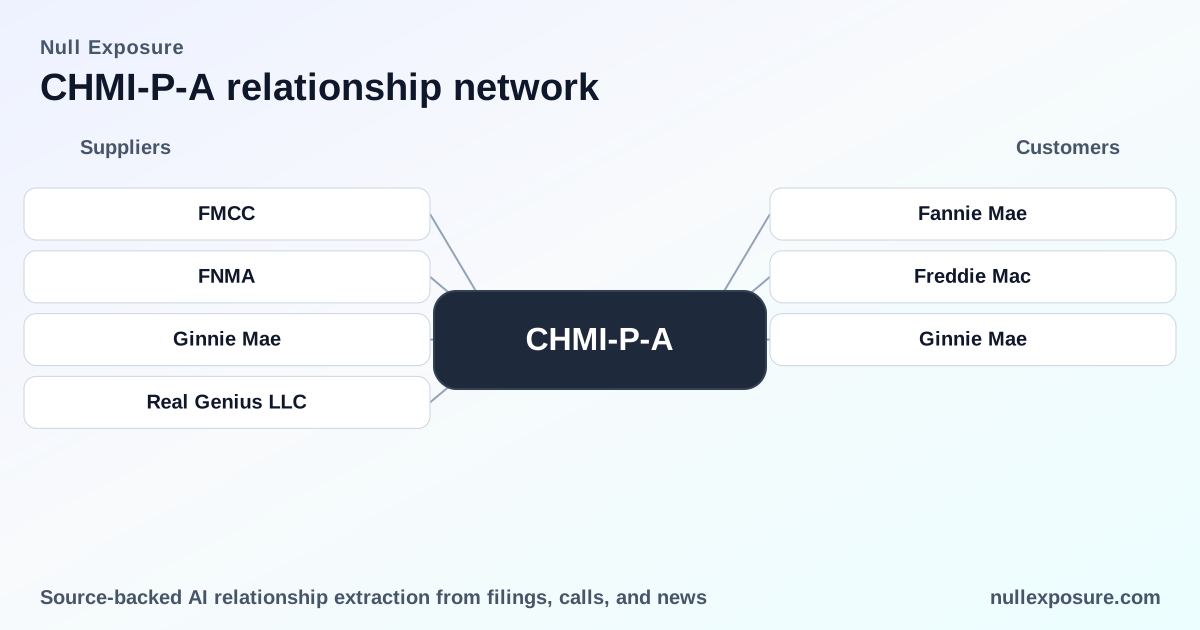
- Contracting posture: approvals required from Ginnie Mae, Fannie Mae and Freddie Mac to service agency loans.
- Concentration: agency pipelines and MSR economics create dependence on a few large counterparties for material servicing flows.
- Criticality: servicing rights and agency access are a material driver of fee income that supports preferred dividends.
- Maturity: the pursuit and receipt of agency approvals are indicative of a developed servicing infrastructure rather than a nascent business line.
These characteristics are company‑level signals about how Cherry Hill monetizes MSRs and manages operational risk; they are not tied to any single relationship unless explicitly stated in a source.
The recorded agency relationships investors should know
Cherry Hill’s public coverage includes direct references to the three primary agencies whose approvals are necessary for servicing activity. The following summarizes each documented relationship from the reviewed reporting.
Fannie Mae
Cherry Hill announced plans, in connection with an MSR acquisition, to seek a change‑of‑control approval from Fannie Mae to service agency loans and integrate a servicing portfolio of approximately $700 million UPB. According to a HousingWire article covering the transaction (FY2015), the approval was a required step to realize the servicing fee economics tied to the acquired MSR portfolio (https://www.housingwire.com/articles/32906-cherry-hill-mortgage-to-acquire-aurora-financial/).
Freddie Mac
The same acquisition announcement identified Freddie Mac as a counterparty from which change‑of‑control servicing approvals would be requested, reflecting the need to secure Freddie Mac servicing eligibility to operate the acquired loans. HousingWire’s reporting of the Aurora Financial acquisition specifies Freddie Mac alongside other agencies as part of the approval process (FY2015) (https://www.housingwire.com/articles/32906-cherry-hill-mortgage-to-acquire-aurora-financial/).
Ginnie Mae
Cherry Hill’s planned servicing of the acquired portfolio also required approvals from Ginnie Mae, which is critical for servicing loans backed by government guarantees and for accessing related securitization channels. The HousingWire article documenting the acquisition and the $700 million UPB servicing portfolio notes Ginnie Mae among the agencies from which change‑of‑control approvals were to be sought (FY2015) (https://www.housingwire.com/articles/32906-cherry-hill-mortgage-to-acquire-aurora-financial/).
Operational and governance constraints — company-level view
There are no explicit constraints recorded in the reviewed relationship data set; that absence itself is an actionable signal. Without formal constraint disclosures tied to specific counterparties, investors should evaluate operational risk through governance and process indicators:
- Compliance and approval risk is structural. Even in the absence of recorded constraints, servicing approvals impose ongoing operational controls and remediation obligations that can affect cash flows if not maintained.
- Counterparty dependence is measurable through portfolio mix. Agency servicing rights reduce credit risk but increase operational concentration; monitoring UPB mix and MSR roll‑forward disclosures is essential.
- Maturity of operations is inferred from acquisition behavior. Pursuit of larger MSR portfolios and agency approvals signals a transition from portfolio yield play to integrated servicing operator.
Treat these as company‑level considerations for CHMI rather than constraints attached to any single agency unless an explicit constraint statement names one.
Investment implications for CHMI-P-A holders
For preferred investors, the core investment thesis hinges on stable coupon coverage funded by recurring servicing fees and MBS cash‑flows. The presence of agency servicing relationships strengthens the revenue base by anchoring a predictable fee stream, but it also introduces operational concentration and regulatory compliance demands that can affect dividend coverage during stress.
Key investor takeaways:
- Revenue durability is enhanced by agency servicing approvals, which broaden fee opportunities and support preferred distributions.
- Operational execution is a primary risk factor. Loss or limitation of servicing approvals would directly pressure servicing income and therefore the preferred dividend cushion.
- Watch portfolio composition and MSR growth as leading indicators of both upside (fee growth) and exposure (operational concentration).
If you want an institutional briefing that integrates servicing counterparty risk into a capital‑structure view, visit https://nullexposure.com/.
What to watch next
- Disclosure updates on completed change‑of‑control approvals and any conditions imposed by agencies; these materially affect servicing economics. HousingWire’s FY2015 coverage flagged the $700 million UPB figure tied to the acquisition that drove the approval requests (https://www.housingwire.com/articles/32906-cherry-hill-mortgage-to-acquire-aurora-financial/).
- MSR portfolio roll‑forwards and UPB trends across agency and non‑agency segments to gauge fee sustainability.
- Regulatory or stewardship changes at Fannie Mae, Freddie Mac, or Ginnie Mae that could alter servicing standards or capital treatment and therefore the economics of servicing income.
Conclusion — CHMI-P-A is a yield instrument backed by an operator whose preferred cash flows are materially enhanced by agency servicing relationships; the investment case depends on continued operational competence and maintained agency approvals. For further analysis and monitoring tools tailored to preferred instrument credit and operational counterparty risk, consult our institutional resources at https://nullexposure.com/.