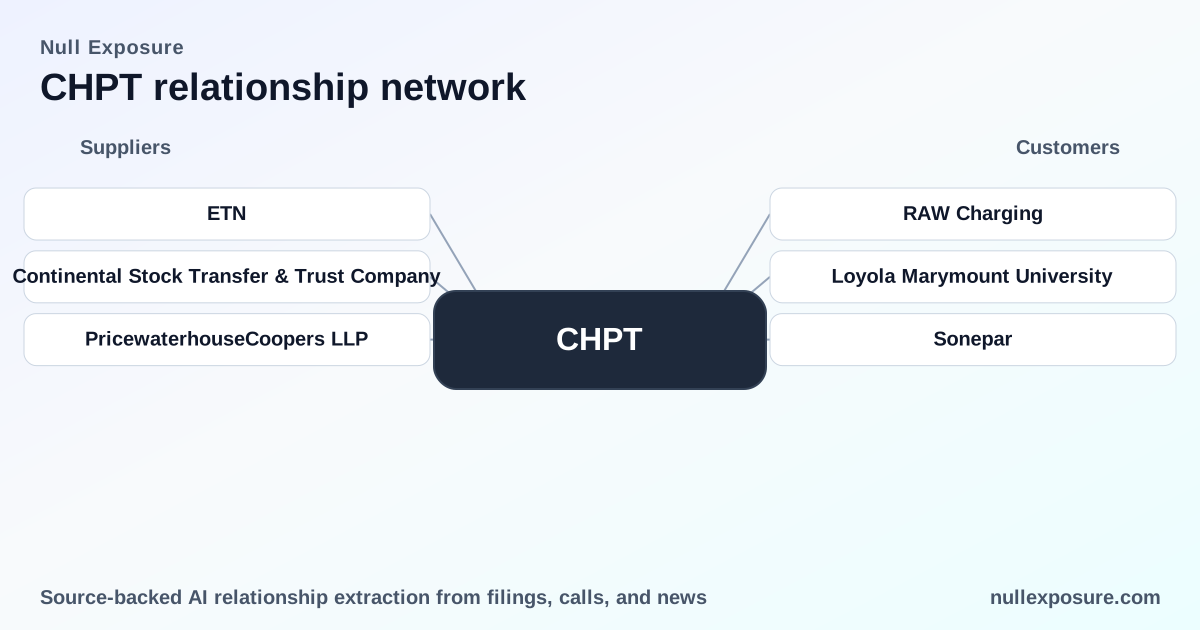
ChargePoint’s customer map: where revenue and resilience come from
ChargePoint builds and sells EV charging hardware, then layers recurring software and service contracts on top—selling networked charging systems as spot hardware transactions while monetizing long-term via subscriptions (ChargePoint Platform, Assure, CPaaS) and managed operations. For investors, the commercial profile is a hybrid supplier: hardware-driven bookings that convert into higher-margin, recurring software and service revenue that strengthens retention and lifetime value across fleets, fleets-as-a-service operators, CPOs, enterprise accounts and individual drivers. Learn more about relationship-level exposure and implications at https://nullexposure.com/.
What the relationships tell investors about the business model
ChargePoint’s customer signals show a diversified go-to-market: direct sales and distributors sell hardware, while subscriptions and licensed software capture ongoing economics. Company disclosures describe subscriptions billed upfront and recognized over time; hardware sales produce immediate revenue on shipment. This mix produces a contracting posture that is transactional at purchase but relationship-driven over time—the company needs to place hardware to seed recurring subscriptions, then retain customers through software, maintenance (Assure) and managed services (CPaaS).
Key operating characteristics as a company-level signal:
- Contracting posture: A blended model — spot hardware sales plus multi-year or annual subscriptions and licensed eMSP services that generate recurring revenue. Evidence in filings shows subscriptions are recognized over time and some services billed upfront.
- Concentration and counterparty mix: The business serves very large enterprises (ChargePoint cites broad adoption by Fortune companies), governments (FedRAMP authorization positions it for federal fleets), and millions of individual EV drivers via the ChargePoint app—creating revenue streams across counterparty types.
- Criticality and maturity: For enterprise and fleet customers, ChargePoint’s Platform and Assure programs are operationally critical; for retail/residential drivers, usage fees and payments are point-in-time revenue. The installed base (hundreds of thousands of ports across NA and EMEA) underscores operational scale and maturity in core markets.
- Geographic footprint: Active management across North America and Europe with explicit emphasis on EMEA expansion opportunities.
- Roles and routes to market: Revenue recognized from shipments to distributors/resellers and direct customers; service-provider roles (CPaaS, Assure) create stickiness and recurring billing.
If you want a relationship-level breakdown and source-backed summaries, see the next section — it catalogs every customer mention in the current coverage.
Customer roster (each relationship covered, with source)
RAW Charging
ChargePoint signed a multi-year partnership to expand DC fast charging across the UK, with an initial commitment reported at approximately $7.5 million and an expected rollout of more than 300 charge points; the agreement positions ChargePoint as RAW’s technology and hardware partner for fast-charging deployment. According to a March 2026 Morningstar release and accompanying 8‑K reporting, RAW Charging selected ChargePoint to accelerate UK fast-charging infrastructure (Morningstar, Mar 2026; SEC 8‑K via StockTitan, Mar 2026: https://www.morningstar.com/news/business-wire/20260227548520/raw-charging-selects-chargepoint-as-partner-to-expand-fast-charging-infrastructure-across-the-uk; https://www.stocktitan.net/sec-filings/CHPT/8-k-charge-point-holdings-inc-reports-material-event-a1f327a6c7eb.html).
Sonepar
ChargePoint is the exclusive software partner for EV charging equipment installed across Sonepar’s French distributor network, positioning ChargePoint as the platform provider behind Sonepar-installed charging stations in France. This partnership was reported in coverage of the collaboration (Zonebourse, FY2022: https://www.zonebourse.com/cours/action/CHARGEPOINT-HOLDINGS-INC-65220719/actualite/Sonepar-et-ChargePoint-s-associent-pour-deployer-des-bornes-de-recharge-en-France-37836910/).
AEPPZ (AEP partnership reference)
ChargePoint partnered with American Electric Power to provide tailored electrification evaluations for commercial and industrial customers considering fleet electrification, embedding ChargePoint into utility-led fleet electrification programs. This customer-facing collaboration was noted in AEP coverage describing joint fleet-electrification services (OKEnergyToday, FY2020: https://www.okenergytoday.com/2020/10/aep-plans-to-electrify-100-of-cars-and-light-duty-truck-fleet-by-2030/).
Loyola Marymount University (LMU)
LMU expanded its campus EV program with additional ChargePoint chargers, upgraded to the new ChargePoint Platform and added Safeguard Care for regular on-site inspections to improve uptime and user experience, reflecting the university’s move from hardware-only to platform plus ongoing maintenance. ChargePoint’s client announcement and subsequent coverage detail the upgrade and service addition (Quantisnow and SimplyWallSt, FY2025–FY2026: https://www.quantisnow.com/insight/chargepoint-scales-and-optimizes-ev-charging-at-loyola-marymount-university-6323113; https://simplywall.st/stocks/us/capital-goods/nyse-chpt/chargepoint-holdings/management).
Shoals Technologies Group (SHLS)
ChargePoint collaborated with Shoals on an eMobility Innovation Center, supporting accelerated deployments and improved site performance—an engineering and technology partnership aimed at reducing deployment costs and improving charging scalability. Company comments tied to the Shoals center were published in a press release (GlobeNewswire, FY2022: https://www.globenewswire.com/news-release/2022/02/15/2385217/0/en/Shoals-Technologies-Group-Unveils-eMobility-Innovation-Center-at-Company-Headquarters-in-Portland-TN.html).
Austin Subaru
ChargePoint expanded its charging infrastructure to support Austin Subaru, illustrating ongoing growth in dealer and retail automotive customer relationships where ChargePoint supplies hardware and site services to support customer EV charging. The expansion was reported in a market news item (TradersUnion, FY2026: https://tradersunion.com/news/companies/show/1581859-ev-chargepoint-user-benefits/).
South Coast Air Quality Management District
ChargePoint partnered with the South Coast AQMD to install 90+ EV chargers across Southern California, demonstrating public-sector and municipality relationships where deployment and air-quality goals align with ChargePoint’s offering. The district collaboration was noted in market coverage (MarketScreener, FY2024: https://www.marketscreener.com/quote/stock/CHARGEPOINT-HOLDINGS-INC-65220719/news/ChargePoint-Holdings-Inc-NYSE-CHPT-dropped-from-Russell-1000-Dynamic-Index-47313750/).
Investment implications: revenue quality, risk and upside
- Revenue quality improves as installed hardware converts to subscriptions. The company’s revenue recognition rules and product set show hardware as spot revenue and platform/Assure/CPaaS as recurring streams—the installed base is the vehicle for higher-margin, recurring income.
- Customer mix reduces single-channel risk. Serving very large enterprises, governments and individual drivers diversifies counterparty concentration; FedRAMP authorization expands addressable government revenue.
- Execution risk centers on deployment scale and uptime. Large CPO and public-sector relationships (RAW, Sonepar, South Coast AQMD) increase demand for reliable hardware, software integration and service SLAs—Assure and Safeguard Care are explicit product responses to that operational risk.
- Geographic expansion is a clear growth lever. EMEA activity (RAW, Sonepar) confirms ChargePoint’s strategic push beyond North America, leveraging software licensing and managed services in new regulatorily complex markets.
If you want a concise exposure map that links customer relationships to revenue types and contract tenors, visit https://nullexposure.com/ for a structured view and comparative analysis.
Bottom line
ChargePoint’s customer relationships demonstrate a repeatable commercial playbook: sell hardware to secure footprint, then convert that installed base into subscriptions, maintenance contracts and managed services. The result is a hybrid business where near-term revenue is hardware-driven and medium-term margin expansion depends on subscription and service adoption across enterprise, government and retail channels. Investors should watch conversion rates from installs to subscriptions, large-CPO contracts and EMEA deployments as primary drivers of the company’s path to profitability.