Cheer Holding (CHR): An ad- and content-services company facing two competing buyout proposals
Cheer Holding operates as an asset-light advertising and content production business headquartered in Beijing, monetizing through campaign production and placement services, licensing and distribution of owned content, and marketplace commissions on its CHEERS e‑Mall. In FY‑TTM the company reported roughly $149 million of revenue, while its public float and institutional ownership remain small—factors that compress liquidity and amplify the impact of strategic moves such as acquisition proposals. For investors evaluating customer and shareholder relationships, the near-term story centers on commercial stickiness, geographic concentration, and competing buyout interest. NullExposure
Business model in one paragraph: how Cheer makes money and where the leverage is
Cheer derives revenue from three clear channels: advertising services (design, production and campaign execution acting as an agent for media buys), content licensing/distribution for owned short videos and series, and e‑commerce commissions via a reseller model on the CHEERS App. The company’s footprint is concentrated in the PRC — all operations are conducted in China — but content distribution extends internationally through licensing and IPTV sales. This structure delivers high gross margins on production/placement work and recurring commission income from third‑party merchants, but it also produces revenue volatility because advertising relationships are not secured by long‑term contracts. The combination of concentrated geography, short contract tenor with advertisers, and a small public float creates a capital structure where strategic transactions (takeovers or buyouts) can rapidly change investor outcomes.
Operating constraints that define commercial exposure
Investors should treat the following company-level characteristics as structural constraints rather than momentary issues:
- Short-term contracting posture: Company disclosures state that advertising customers are not under long‑term contracts, which creates client churn risk and makes revenue visibility limited from quarter to quarter. This is the fundamental commercial constraint on margin predictability.
- Geographic concentration in APAC/China: Operations and core audiences are based in the PRC, so advertising demand, regulatory dynamics, and platform distribution are tightly coupled to China’s ad market cycle and regulatory environment.
- Global distribution capability for content: Though operations are China-centric, Cheer licenses and distributes content internationally (IPTV, online platforms and television stations), which provides a diversification pathway for content monetization.
- Reseller/e‑commerce role: The company acts as a reseller facilitator on its e‑Mall, charging service fees and commissions to third‑party merchants — a lower‑margin but recurring revenue stream that reduces pure advertising exposure.
- Service‑provider posture and active relationships: Cheer operates as an advertising service provider and agent for clients; these relationships are active and operationally critical to revenue generation but lack long contract life and thus carry renewal risk.
- Segment maturity: The company’s operations situate it in services/advertising rather than asset-heavy media ownership, implying faster scalability but also higher sensitivity to ad spend cycles.
Each of these signals is derived from Cheer’s own disclosures and forms the foundation for assessing concentration risk, criticality of client retention, and revenue predictability.
Two bidders in the spotlight: what the market is watching
A single news item in March 2026 captured competing purchase proposals for Cheer’s Class A shares; both offers were reported in connection with FY2025 activity and should be read as material events for shareholders and counterparties.
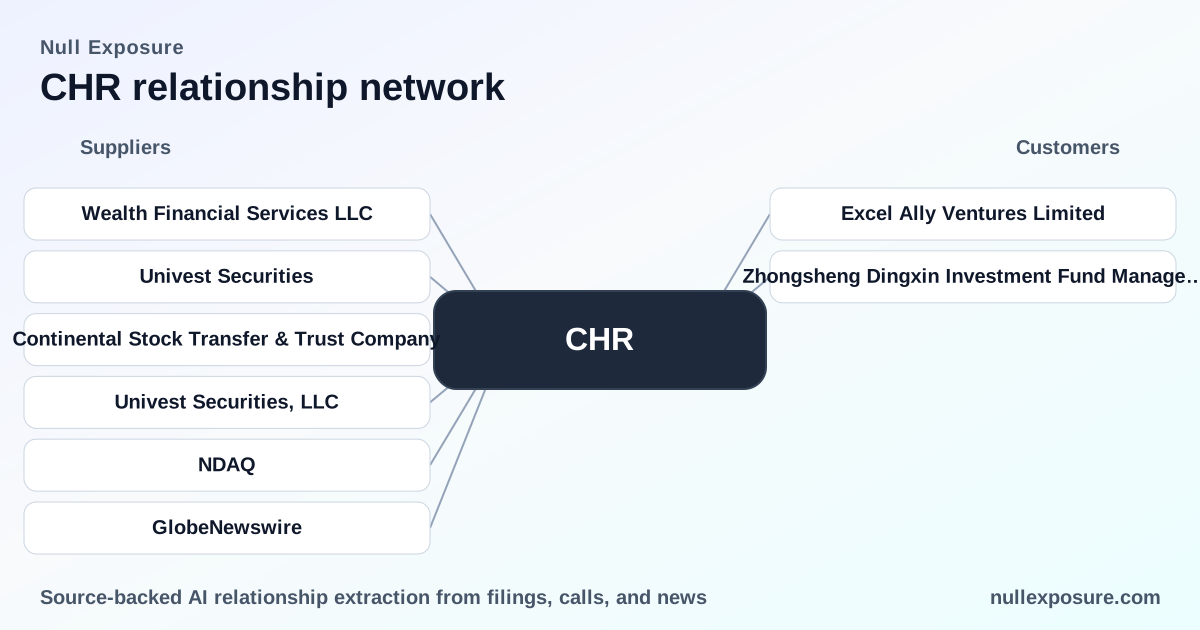
Excel Ally Ventures Limited — a cash offer at US$0.52 per Class A share
Excel Ally Ventures Limited reportedly proposed to acquire all outstanding Class A shares for US$0.52 in cash per share, representing a formal buyout bid aimed at taking control of the public float. The proposal was reported by ts2.tech on March 9, 2026. (Source: ts2.tech, March 9, 2026.)
Zhongsheng Dingxin Investment Fund Management (Beijing) Co., Ltd. — an incumbent shareholder offering US$0.56
Zhongsheng Dingxin Investment Fund Management (Beijing) Co., Ltd., identified as an existing shareholder, submitted a competing proposal to buy all outstanding Class A shares at US$0.56 in cash per share, signaling insider/affiliate willingness to consolidate ownership at a premium to the competing bid. This was reported in the same March 9, 2026 article. (Source: ts2.tech, March 9, 2026.)
Both reports come from the same market article and reflect active takeover interest, which materially changes governance dynamics given Cheer’s limited institutional base and small public float.
What the takeover activity means for customers, operators, and investors
- Strategic control vs. operational continuity: A successful buyout would centralize decision‑making and likely reprioritize investments in content or e‑commerce, but for advertisers the immediate effect is continuity risk: short‑term ad contracts give an acquirer latitude to reprice or reallocate sales resources quickly.
- Valuation and liquidity implications: Competing cash offers at US$0.52–US$0.56 put a near‑term valuation floor for shareholders and make the stock less a play on gradual cash flow growth and more a takeover arbitrage candidate while negotiations proceed.
- Counterparty certainty for merchants and broadcasters: Merchants on the e‑Mall and distribution partners should plan for potential operational changes under new ownership—even if content licensing rights remain intact, commission structures and platform priorities can shift.
Key investment takeaways and risks
- High operational leverage to ad spend cycles and client retention because advertising work is not locked by long‑term contracts; forecast models must assume higher churn and revenue variability.
- Geographic concentration in China creates both upside (large addressable market for short video and streaming) and policy/regulatory exposure that directly affects ad budgets.
- Reseller and commission revenue provide some diversification but the core earnings driver remains advertising and content monetization.
- Corporate liquidity and control are critical variables: the low shares outstanding, modest institutional ownership, and active acquisition proposals mean corporate actions will strongly influence equity outcomes.
- Active bidders change counterparty dynamics for customers and partners; an acquirer can reconfigure commercial terms more quickly than a large, diversified media company.
Bottom line
Cheer Holding is an asset‑light ad and content services operator with exposed revenue visibility due to short contract tenors and regional concentration. The March 2026 takeover proposals from Excel Ally Ventures Limited and Zhongsheng Dingxin Investment Fund Management crystallize strategic optionality and place a de facto valuation floor on Class A shares in the near term. Investors and operating partners should price the company as a small‑cap, control‑sensitive business where cash offers, governance shifts, and client renewal cycles drive outcomes more than incremental organic scale. For a concise overview of these relationship dynamics and further monitoring, visit NullExposure.