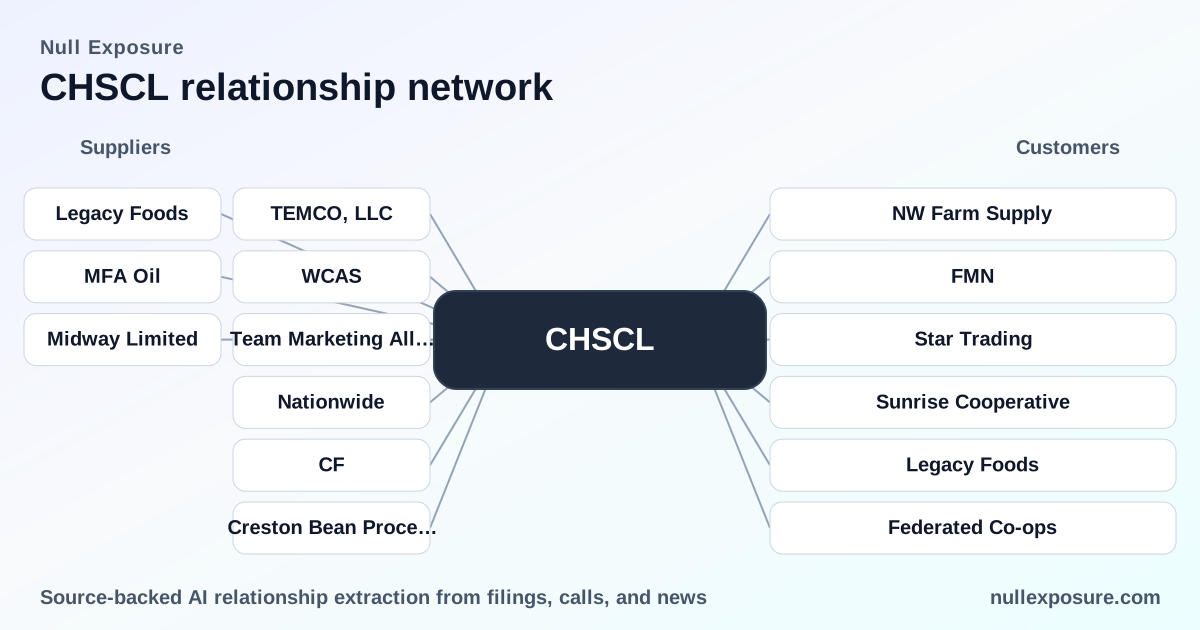
CHS Inc. (CHSCL) — Customer Relationships That Drive an Integrated Agribusiness
CHS operates as a vertically integrated agricultural cooperative that monetizes through grain merchandising, food and feed processing, agronomy inputs, and wholesale energy distribution. Revenue flows derive from fixed-price and spot commodity sales, long-term supply relationships with cooperatives and commercial buyers, and downstream sales of refined fuels and agronomy products; these channels together convert seasonal agricultural supply into recurring commercial cash flow. For a compact commercial intelligence briefing on counterparties and contract posture, visit https://nullexposure.com/.
Why customer relationships matter for CHSCL investors
CHS’s business model depends on scale, timing, and reliability of customer flows. Customer mix controls working capital, counterparty credit exposure, and margin capture — selling grain into global markets, supplying fuels to members, and providing agronomy inputs to cooperatives all create different cash-collection and risk profiles. Company disclosures make several company-level signals clear:
- CHS sells to both members and nonmembers and uses fixed-price sales contracts for creditworthy customers, establishing a commercial contracting posture that stabilizes margins and transfers price risk in defined windows.
- Customer base is global: the firm sources and sells commodities worldwide, which diversifies off-take but increases exposure to cross-border logistics and geopolitical trade disruptions.
- Counterparties include individual producers and local cooperatives, indicating a two-tiered exposure profile: many small counterparties on the production side and a smaller set of larger cooperative and commercial customers on the demand side.
- Business segments emphasize distribution (energy/fuels) and manufacturing (oilseed processing and renewable fuels), making CHS both a wholesale distributor and a processor — this dual role increases internal optionality but concentrates operational risk in logistics and processing assets.
These signals define CHS’s contracting posture: structured, credit-screened sales with significant member-channel concentration for fuels, and global commodity trading for grain and food products — a combination that favors steady cash generation but requires active working-capital management.
Relationship-by-relationship review: who CHS sells to and works with
NW Farm Supply — downstream retail distributor implicated in a CHS-related recall
An FDA recall notice (March 2026) documents that NW Farm Supply locations in Oregon and Washington further sold CHS-related medicated feed product to downstream customers, indicating a retail/distribution role in CHS’s feed channel. Source: FDA recall notice (Mar 2026) — https://www.fda.gov/safety/recalls-market-withdrawals-safety-alerts/chs-nutrition-recalls-champion-meat-goat-pellets-r20-medicated-feed-because-possible-rumensin
FMN — Flour Mill buyer identified in sizable wheat purchase
CHS supplied 850,000 bushels of hard red winter wheat in a June transaction executed for Flour Mills of Nigeria (FMN), demonstrating CHS’s role as a bulk-export grain supplier into West African commercial buyers. Source: CHS press release (Aug 2023) — https://www.chsinc.com/news-and-stories/2023/08/22/temco-grain-export-terminals
Flour Mills of Nigeria — end-customer for CHS export flows
Flour Mills of Nigeria is the end-buyer for the 850,000-bushel purchase noted above, illustrating CHS’s capacity to serve large, sovereign-market food processors and importers. Source: CHS press release (Aug 2023) — https://www.chsinc.com/news-and-stories/2023/08/22/temco-grain-export-terminals
Star Trading — commercial trader expanding purchases from CHS
Star Trading’s New York-based lead wheat trader cited CHS port access and multi-port logistics as reasons to increase wheat purchases from CHS, signaling CHS’s attractiveness to institutional commodity traders for supply diversity across Pacific Northwest and Gulf ports. Source: CHS press release (Aug 2023) — https://www.chsinc.com/news-and-stories/2023/08/22/temco-grain-export-terminals
Sunrise Cooperative — buyer and JV acquirer with ongoing supply commitments
CHS sold its Crestline Crop Nutrients joint venture to Sunrise Cooperative and continues to supply agronomy products under the transaction, reflecting a partner-level commercial relationship where CHS offloads an asset but retains supply ties; this relationship is documented across multiple communications (2019 and 2023). Sources: CHS press releases (Mar 2019; Nov 2023) — https://www.chsinc.com/news-and-stories/2019/03/05/chs-adds-crop-protection-distribution-with-acquisition-of-west-central and https://www.chsinc.com/news-and-stories/2023/11/28/fertilizer-efficiency
Legacy Foods — industrial buyer of soy flour with historical purchasing relationship
Legacy Foods had been a CHS customer, purchasing CHS soy flour over a multiyear period, illustrating CHS’s position as a supplier into food-industrial processors at the regional level. Source: Local reporting (Dec 2017) — https://www.cjonline.com/story/business/2017/12/03/hutchinson-s-chs-inc-plant-closes-laying-77/16518681007/
Federated Co-ops — services and equipment customer in energy channels
Federated Co-ops utilized CHS energy equipment to build a bulk oil and fluid management system that improved maintenance workflows, showing CHS’s role as a supplier of energy infrastructure and services to cooperative partners (FY2021 context). Source: CHS press release (Nov 2021) — https://www.chsinc.com/news-and-stories/2019/11/17/cooperative-ventures-chs-inc
Par Pacific Holdings Inc. — multi-year fuel supply agreement partner
As part of a strategic transaction, Par Pacific entered into a multi-year fuel supply agreement with CHS to exchange refined products across overlapping western operating regions, highlighting CHS’s role in wholesale refined-product logistics and reciprocal supply arrangements (FY2018 reporting). Source: Industry coverage (2018) — https://csnews.com/par-pacific-acquire-cenexs-zip-trip-chain
How these relationships shape CHS’s operating profile
The relationship map shows broad, multi-tiered commercial reach: CHS trades large bulk cargoes into industrial processors and importers, supplies local cooperatives and retailers with inputs and fuels, and signs multi-year reciprocal supply agreements with fellow refiners. That produces several structural characteristics:
- Contracting posture: Predominantly seller-side with fixed-price contracts for creditworthy buyers and long-term member commitments in fuels; this limits short-term price exposure but locks in working-capital timing.
- Concentration and counterparty mix: A dispersed base of individual producers on the supply side and a concentrated set of larger cooperative and industrial buyers on the demand side creates asymmetric credit risk — many small payers upstream versus fewer large commercial customers downstream.
- Criticality: CHS functions as both a distributor (energy, refined products) and a manufacturer/processor (oilseed, renewable fuels), making CHS a critical link in both agricultural input chains and refined-product supply networks.
- Maturity and stability: The longevity of partnerships (multi-year supply deals, JV sale-with-supply arrangements) signals mature commercial relationships that support predictable cash flows but require active logistics and counterparty credit monitoring.
Key investor takeaways and watchlist
- Customer diversity is a strength: global trading counterparties, cooperatives, and large industrial buyers reduce single-customer concentration risk.
- Working capital is the operational lever: fixed-price contracts and seasonal grain flows create inventory and receivables cycles that will dictate liquidity needs.
- Credit and logistics risk require active oversight: cross-border export deals (e.g., to FMN) and downstream retail distribution exposures (e.g., NW Farm Supply) create settlement and product-liability vectors investors must monitor.
- Watch for margin pressure in energy and processing segments, where input costs and commodity cycles transmit quickly to realized margins.
For ongoing monitoring of CHS’s counterparty network and to access curated relationship intelligence, visit https://nullexposure.com/.
Bold commercial relationships and disciplined contract terms underpin CHS’s cash generation profile; investors should track receivables, inventory turns, and the status of major supply agreements as the primary levers that will drive preferred-stock risk and return.