CHS Inc. (CHSCM) — Customer Relationships and What They Mean for Investors
CHS Inc. is an integrated agricultural cooperative that monetizes through commodity trading, agronomy and feed services, food distribution, energy marketing, and stake-managed equity investments. The company generates scale revenue—roughly $35.6 billion TTM with EBITDA north of $595 million—by buying and selling grain and inputs, operating service businesses with long operating footprints, and by structuring joint ventures and asset sales that lock in supply and margin capture. Investors in CHSCM preferred shares should evaluate counterparty concentration, contract terms, and the maturity of CHS’s customer channels because those factors determine cash stability and downside protection. Learn more at https://nullexposure.com/.
Big-picture operating signals investors need to internalize
CHS runs a global, two-way commercial model: it both buys commodities from producers and sells products and services to cooperatives, agribusinesses and retail customers. The company executes fixed-price sales contracts with assessed counterparty creditworthiness, and it actively manages equity investees and joint ventures to optimize capital allocation. These are not peripheral facts—these structural choices shape cashflow volatility, counterparty credit exposure, and the strategic rationale for asset-level disposals or supply agreements.
- Counterparty mix and reach: CHS explicitly transacts with individual agricultural producers, local cooperatives and commercial customers on a global basis, signaling a diversified but operationally intensive customer base. This is a company-level signal drawn from the firm’s filings.
- Contracting posture: CHS uses fixed-price sales contracts and internal credit evaluations, which translates to predictable margin capture when commodity markets are stable, and credit sensitivity during price stress.
- Relationship roles: CHS functions as both buyer and seller in its commodity flows—this dual role creates natural hedges but also concentrated operational exposure when large channels or investees change ownership.
The named customer relationships — a line-by-line review
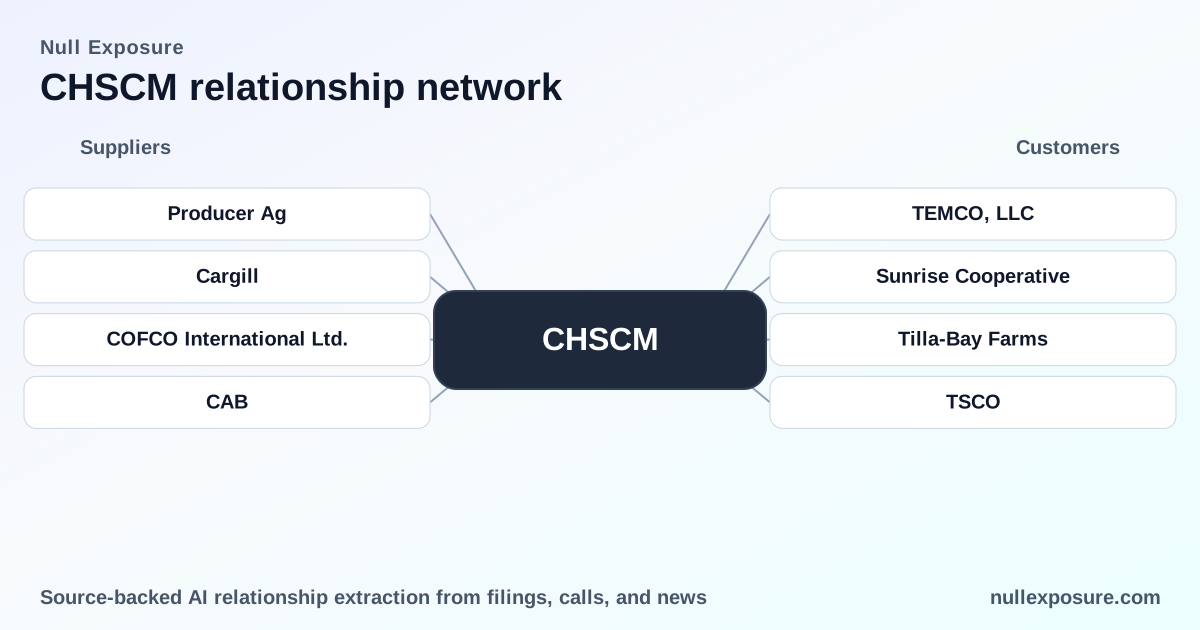
Below is a concise, source-linked summary of every relationship referenced in the records provided.
-
TEMCO, LLC — In FY2025 CHS reports it purchases and sells grain and other agricultural commodities with TEMCO as a listed equity investee, indicating an integrated trading relationship and capital stake that aligns commercial incentives. According to CHS’s FY2025 Form 10‑K, TEMCO is named among equity investees used for commodity flows (FY2025 filing).
-
Sunrise Cooperative — CHS sold the Crestline Crop Nutrients joint venture to Sunrise and retained a supply and agronomy-services role in multiple years; the transaction is described in CHS news coverage and recurring outreach (CHS news release, Nov 3, 2025). This sale-plus-supply pattern converts an ownership interest into an annuity-style commercial supply relationship.
-
Proteinas y Oleicos — CHS lists Proteinas y Oleicos as a key soybean customer that received marketing, buying and operational support to improve resilience, demonstrating CHS’s advisory and market-access capabilities in Latin America (CHS news, Mar 26, 2026).
-
Sunrise Cooperative (FY2022 reference) — Earlier CHS communications document the same Crestline JV disposition and subsequent supply commitments in FY2022 messaging, establishing that the Sunrise relationship is multi-period and strategic rather than one-off (CHS news, May 24, 2022).
-
Sunrise Cooperative (FY2024 reference) — CHS continued to reference the Sunrise transaction in FY2024 materials, reinforcing the multi-year commercial framing of the JV sale and ongoing supply arrangements (CHS news, Feb 27, 2024).
-
Tilla-Bay Farms — CHS provides feed consultancy and regular feed delivery to dairy operations such as Tilla-Bay Farms in Tillamook, Oregon, illustrating CHS’s downstream agronomy and feed services that support recurring revenue at the farm level (CHS news, Jan 12, 2023).
-
Sunrise Cooperative (FY2023 reference) — CHS mentioned the Crestline JV transition again in FY2023 commentary, confirming continuity in messaging and relationship execution across fiscal years (CHS news, Mar 7, 2023).
-
Tractor Supply Co. — News reporting from 2021 records that Tractor Supply Co. owns the Royal Wing brand, which was a former CHS brand, indicating CHS has divested some retail-facing brands and shows how CHS selectively pares consumer product exposure (WisFarmer, Feb 26, 2021).
-
TSCO (duplicate listing) — The same 2021 news entry is also captured under the TSCO ticker designation, reiterating that brand-level divestitures have moved certain consumer product lines into retail channels (WisFarmer, Feb 26, 2021).
(Each item above references the specific filings or company news posts cited in CHS materials and external reporting for the fiscal periods noted.)
For a broader collection of CHS relationship intelligence and analysis, visit https://nullexposure.com/ for consolidated views.
How these relationships shape CHS’s business risk and optionality
The customer evidence and company disclosures together produce a clear map of strategic levers and risks:
- Diversification with operational intensity: CHS’s global footprint and mix of individual producers, cooperatives and commercial customers dilute single-buyer concentration but increase execution complexity across logistics, credit and local regulation.
- Asset realization and recurring commerce: The Crestline JV sale to Sunrise demonstrates a deliberate approach to convert equity stakes into long-term commercial contracts—this reduces capital intensity while preserving revenue streams via supply agreements.
- Credit and commodity exposure: Fixed-price contracts and credit assessments reduce spot volatility at the transaction level, but aggregate exposure to commodity cycles and counterparty solvency remains material given the size of flows.
- Maturity spectrum of relationships: The portfolio spans early-stage advisory relationships (Proteinas y Oleicos), steady farm-level services (Tilla-Bay’s feed supply), equity investees used for trading (TEMCO), and completed divestitures that shift revenue recognition patterns (Royal Wing brand to Tractor Supply). That mix supports both near-term cash generation and strategic optionality.
Investment implications — what to watch next
- Monitor the earnings cadence for how JV sales and supply contracts flow through operating cash versus reported revenue; asset dispositions convert capital risk into counterparty/service risk.
- Watch counterparty credit performance in stressed commodity cycles—fixed-price contracts shift market risk but not counterparty risk.
- Track the Sunrise Cooperative supply agreement execution as a proxy for CHS’s ability to monetize JV exits without sacrificing recurring revenue.
Bottom line
CHS operates a high-touch, globally distributed commercial model that balances commodity trading, long-term service contracts, and selective asset monetization. The customer relationships documented here show a deliberate strategy: reduce capital exposure through JV sales while preserving revenue capture via supply and service agreements. For preferred-share investors, the key read is that CHS’s operating profile emphasizes steady commercial flows and credit management rather than retail brand ownership—a structural tilt that favors cash generation but requires active counterparty monitoring.
For a consolidated dashboard of this and similar commercial relationship intelligence, visit https://nullexposure.com/.