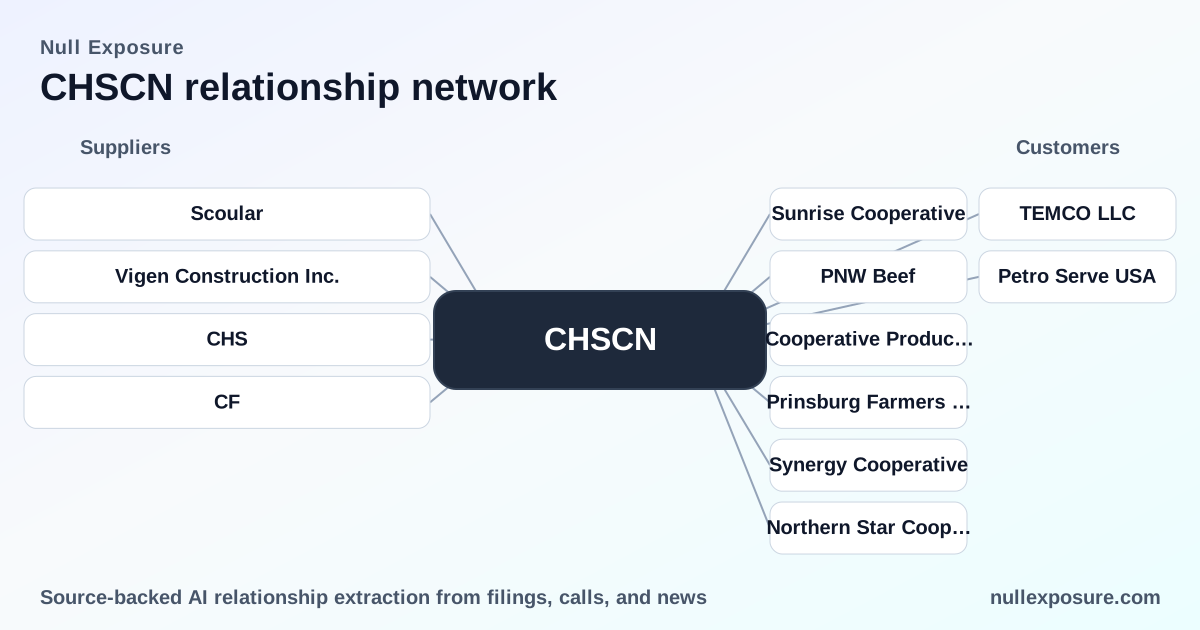
CHSCN Customer Relationships — Cooperative customers, asset sales and operational leverage
CHS Inc. operates as a vertically integrated agricultural cooperative that monetizes through grain merchandising, agronomy inputs, food ingredients and energy retailing, supplemented by asset-level services such as terminal operations and convenience-store financing. For investors in CHSCN, the company’s customer map is concentrated in cooperatives and regional operators, produces stable fee and product sales streams, and generates occasional balance-sheet activity through asset sales and lease/servicing arrangements. Learn more about upstream customer intelligence at https://nullexposure.com/.
How CHS turns crop inputs and terminals into cash flow
CHS’s go-to-market rests on three commercial levers: bulk commodity sales and merchandising, branded energy retail (Cenex®) and agronomy/product supply to cooperatives and individual producers. The firm reports roughly $35.6 billion in trailing revenue and operates globally — Europe, APAC and Latin America are active sourcing and marketing regions — which diversifies geographic price risk while keeping customer relationships concentrated in member cooperatives and farmer-producers. The company sells on fixed-price contracts to customers with internally evaluated credit and also acts as a servicer in certain conduit financing structures, exposing it to both trade and operational counterparty responsibilities.
The customer map — relationship-by-relationship (direct evidence)
Below are the named customer and counterparty relationships surfaced in CHS public materials and industry reporting, each with a concise plain-English summary and source.
Sunrise Cooperative
CHS sold its Crestline Crop Nutrients joint venture to Sunrise Cooperative and retained a supply relationship to continue providing agronomy products under the new ownership; that transaction and follow-up project announcements are documented in CHS press releases (Mar 3, 2025; Feb 11 & Feb 16, 2026). (CHS news releases — 2025/03/03; 2026/02/11; 2026/02/16)
PNW Beef
PNW Beef finished cattle using byproducts supplemented with CHS Payback® feeds, demonstrating CHS’s role as a feed ingredient and specialty input supplier in beef value chains. (CHS news — 2022/08/30)
Prinsburg Farmers Co‑op
Prinsburg Farmers Co‑op worked with CHS district management to convert a local fuel site into a convenience retail format, illustrating CHS’s involvement in retail conversions and store-level execution support. (CHS news — 2021/09/14)
Synergy Cooperative
Synergy Cooperative partnered with CHS on the LIFT program, which bundles lighting, image and facility upgrades for Cenex® stores and includes loan funding for in-store improvements — an example of CHS providing both product supply and project financing. (CHS news — 2021/09/14)
Cooperative Producers, Inc. (CPI)
CPI agreed to acquire CHS grain facilities in Roseland and Bladen, a divestiture that transfers asset ownership while CHS reallocates capital and operational focus. This sale was reported by BakingBusiness in connection with a planned close by Aug. 31 (publication covering FY2025 activity). (BakingBusiness — article on CHS facility acquisition/transfer)
Northern Star Cooperative Services
Northern Star took on debt in the 1990s to acquire a propane plant from CHS, highlighting historical asset transfers in the propane and energy lines of business that shape long-term cooperative ties. (CHS news — 2023/06/12)
COFCO International Ltd.
CHS will operate the Cahokia, Illinois grain terminal under a lease with COFCO, positioning CHS as an operator/lessee on third‑party-owned infrastructure and underscoring its operational services revenue potential. (Feedstuffs — 2026 reporting on Cahokia operations)
TEMCO LLC
A joint venture involving CHS and MKC loaded its first unit train destined for TEMCO LLC, showing CHS’s role in coordinated terminal logistics and export flows that feed downstream processors. (Grain Journal — coverage of MKC/CHS JV shipping to TEMCO, FY2025 context)
Petro Serve USA
Petro Serve USA acquired three CHS convenience stores in southeastern North Dakota, reflecting CHS’s occasional retail asset sales and downstream redistribution of convenience assets. (CSP Daily News — Petro Serve acquisition, FY2023)
Farmers Supply Cooperative
Farmers Supply Cooperative sources Cenex® energy products and operates convenience stores and aerial crop services, making it a multi-service customer that purchases both energy and agronomy products from CHS. (CHS news — 2023/10/16)
What the relationship set signals about CHS’s operating model
- Contracting posture is hybrid and formalized. CHS uses framework agreements and long-form contracts (evidence of a Master Framework Agreement and amendments) for financial and commodity transactions, indicating standardized legal relationships for institutional counterparties and lenders.
- Counterparty mix skews toward individual producers and cooperatives. Public commentary and filings explicitly describe purchases from individual agricultural producers and local cooperatives, positioning CHS as a principal supplier to member‑owners and non‑member customers alike.
- Global reach with regional execution. CHS maintains operations across EMEA, APAC and Latin America for sourcing and marketing, which supports global merchandising while leaving execution and retail relationships concentrated locally.
- Revenue model mixes product sales with services and asset operations. CHS acts as a seller of agronomy and energy products and also as a service provider/terminal operator and occasional lessor, increasing cash-flow diversity but also introducing operational counterparty exposure.
- Credit discipline is embedded. CHS uses fixed-price sales contracts with internal credit evaluation, indicating disciplined commercial underwriting but also exposure to trade receivables when market prices move against fixed positions.
These characteristics are drawn from CHS’s own filings and public releases and represent company-level signals rather than assertions tied to any single named customer.
Investor implications — concentration, counterparty and operational risk
- Concentration on cooperatives and producer channels is a structural advantage for stability but creates sectoral exposure to agricultural commodity cycles and weather-related volume swings.
- Asset sales and lease arrangements (e.g., CPI acquisition, COFCO terminal lease) show active balance-sheet management and a willingness to monetize or outsource physical infrastructure — a positive for capital redeployment but a monitorable factor for future fee income.
- Service-provider roles and financing programs (LIFT) increase cross-product dependence: when CHS funds store upgrades or services operations, it embeds credit risk alongside product revenue.
For a deeper view of counterparty footprints and event‑level relationships, visit https://nullexposure.com/.
Bottom line: what to watch next
- Track divestiture pace and lease/operating agreements as indicators of CHS’s shift between asset-heavy and fee-based revenue.
- Monitor agribusiness credit metrics and trade receivable trends given the fixed-price selling posture and cooperative counterparty base.
- Watch operational performance at leased/operated terminals (Cahokia) and the commercial success of Cenex® retail upgrade programs, which materially affect downstream energy margins.
Bold, cooperative-centric customer relationships drive CHS’s revenue engine; asset transactions and service agreements shape its margin profile. For investors focused on CHSCN, the company’s customer map signals stable product demand with episodic balance-sheet activity that will be decisive for preferred‑stock coverage and relative risk assessment.