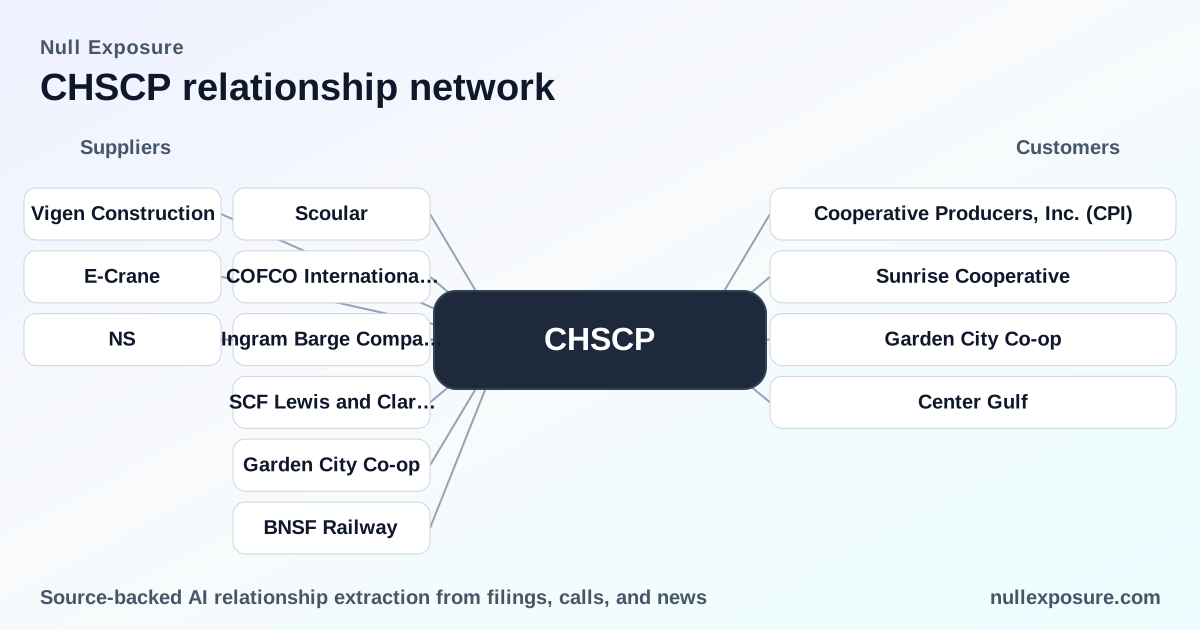
CHSCP Customer Relationships: Cooperative buyers, agronomy partners, and export channels that drive cash flows
CHS Inc. is an integrated agribusiness and energy operator that monetizes through commodity origination, wholesale agronomy distribution, refining and fuel retailing, and export terminal throughput. Its commercial model sells bulk grain and inputs to member cooperatives and independent retailers, wholesales refined fuels under the Cenex brand, and extracts margin via logistics and terminal services — a hybrid distribution-manufacturing business with meaningful working-capital intensity and counterparty credit exposure. For investors in CHSCP, the company’s customer relationships reflect cooperative-heavy demand, regional export linkages, and recurring commercial supply arrangements that underpin predictable cash flows. Learn more at https://nullexposure.com/.
How CHS sells value — a compact operating thesis
CHS runs two core economics engines: an Ag distribution network that sources grain and agronomy products from producers and sells through cooperatives and retail sites, and an Energy business that refines and distributes petroleum products through wholesale and roughly 1,200 Cenex-branded retail locations. Revenue is earned primarily through origination and margin on commodity flows, wholesale distribution spreads, and terminal/processing fees rather than high-fixed-margin proprietary products. Contracting is a mix of fixed-price sales to credit-approved customers and spot/market-priced origination; CHS also originates short-term financing through CHS Capital, which positions the firm as both seller and service provider in the ecosystem.
What the relationships tell you — the on-the-ground counterparties
Below I cover every customer relationship flagged in the public results, with concise, plain-English takeaways and source references.
Cooperative Producers, Inc. (CPI)
CHS sold its Roseland and Bladen, Nebraska grain facilities to Cooperative Producers, Inc., transferring physical origination capacity into a farmer-owned cooperative while reallocating CHS’s asset base. Source: CHS press release, August 14, 2025 (https://www.chsinc.com/news-and-stories/2025/08/14/chs-invests-in-holdrege-grain-facility).
Sunrise Cooperative
CHS divested its Crestline Crop Nutrients joint venture to Sunrise Cooperative and structured ongoing agronomy supply arrangements so CHS will continue to supply agronomy products under the new ownership, preserving a revenue stream while reducing JV capital needs. Source: CHS press material and crop protection releases (notably Jan 3, 2025 and earlier 2022 communications; see https://www.chsinc.com/news-and-stories/2025/01/03/chs-adds-st-louis-terminal).
Garden City Co-op
Garden City Co-op purchases corn from CHS and CHS’s member cooperatives for local resale, representing a classic midstream-to-local retail flow where CHS functions as an origination and aggregation partner to regional cooperatives. Source: CHS announcement, June 18, 2025 (https://www.chsinc.com/news-and-stories/2025/06/18/garden-city-co-op-chs-partnership-builds-grain-strength).
Center Gulf
CHS expanded its St. Louis footprint by leasing the Cahokia grain terminal to strengthen Center Gulf’s export supply chain, positioning CHS as the terminal operator/lessor and a throughput counterparty to export buyers. Source: CHS newsroom, May 6, 2025 (https://www.chsinc.com/news-and-stories/2025/05/06/myrtle-grove-terminal-upgrades).
Business-model constraints that shape commercial performance
Readers evaluating CHS through the customer lens should account for these company-level signals drawn from management disclosures and commercial actions:
- Counterparty mix is retail and cooperative heavy. CHS explicitly buys from individual producers and sells wholesale to member cooperatives and independent retailers; this structure reduces dependence on a small number of large industrial customers but increases exposure to aggregated agricultural cycles and local basis differentials.
- Geographic concentration in North America with global exposure. Management reports show the vast majority of revenues are North America–based, particularly the United States, while commodity and fuel margins are sensitive to global market movements that drive European, Latin American and global pricing effects.
- Dual-role contracting posture: seller and service provider. CHS operates as both a direct seller of commodities and inputs and a lender via CHS Capital; expect mixed credit dynamics where trade receivables, short-term finance, and inventory financing coexist on the balance sheet.
- Active, operating-stage relationships with recurring flows. The company’s retail sites and cooperative partners create ongoing, repeat business rather than one-off transactions; these active relationships support stable throughput volumes but tie working capital to commodity cycles.
- Segment mix blends distribution and manufacturing economics. Ag revenues derive from origination, agronomy sales and processing of soy products and renewable fuels; the Energy segment adds refining and retail margin, increasing operational complexity and capital intensity.
Taken together, these constraints describe a company with persistent operational scale in North American grain and fuel markets, recurring volume-based cash generation, and sensitivity to commodity cycles and counterparty credit.
Investment implications — where the relationships create optionality and risk
- Optionality from divestitures and supply contracts. Selling joint ventures like Crestline while retaining supply agreements preserves margin-generating commercial relationships while reducing capital employed — a positive for preferred‑stock claimholders seeking cash stability. The CPI and Sunrise transactions illustrate this playbook.
- Logistics and terminal exposure. Leasing and operating terminals (Cahokia for Center Gulf) increase fee-for-service revenue but also link cash flows to global export demand and port logistics; port disruptions or vessel rate swings would affect throughput economics.
- Credit and working capital sensitivity. With CHS functioning as seller and short‑term lender, economic stress in the farm sector or fuel markets amplifies receivable and inventory risk; investors should monitor trade credit performance and CHS Capital exposure.
- Concentration risk mitigated by cooperative network. The cooperative distribution model diffuses counterparty concentration but concentrates market exposure in regional agricultural conditions and U.S. policy/commodity cycles.
Key takeaway: CHS’s customer relationships are structured to preserve recurring distribution revenues while offloading asset intensity where appropriate, balancing margin capture with lower capital commitments; that trade-off supports stable cash flows for preferred securities but leaves the company exposed to commodity-price and working-capital volatility.
Final read for investors
For a capital markets audience, the relationships documented here demonstrate a deliberate strategy: retain commercial supply roles and recurring sales while selectively divesting physical assets to cooperatives and partners. That strategy reduces capital intensity and preserves revenue streams — a positive for CHSCP holders seeking income stability — yet keeps CHS leveraged to commodity cycles and trade-credit dynamics. Monitor CHS’s disclosures on receivables, terminal throughput, and agronomy supply agreements for the clearest forward signals.
If you want a consolidated view of CHS customer relationships and risk signals for portfolio due diligence, visit https://nullexposure.com/ for additional analysis and curated intelligence.