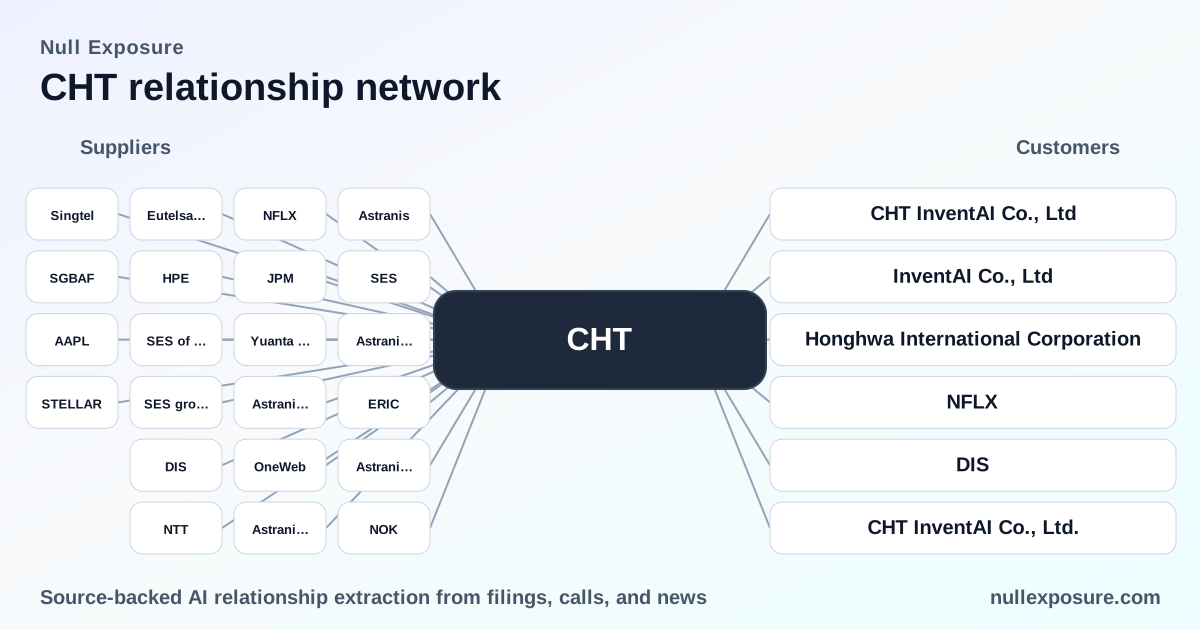
Chunghwa Telecom (CHT): Customer Relationships and Strategic Footprint
Chunghwa Telecom operates Taiwan’s largest integrated telecommunications network and monetizes through mobile and fixed-line subscriptions, broadband, enterprise ICT services, and content bundling partnerships that lift ARPU and reduce churn. Recent disclosures and call commentary show the company executing related‑party real‑estate transfers within its group while deepening content bundles with global streaming players—an operational mix that supports stable cash flow but elevates governance and concentration vectors investors must price. For deeper relationship analytics, visit https://nullexposure.com/.
Why these customer and partner signals matter to investors
Chunghwa’s business model is classic telecom: high fixed-cost infrastructure, recurring revenue from subscriptions, and strategic third‑party content to defend retail competitiveness. The relationship evidence in recent filings and the Q4 earnings call highlights four practical characteristics:
- Contracting posture: Active related‑party leasing and right‑of‑use asset transfers indicate internal reallocation of real estate and services rather than outright divestiture, signaling centralized control over operating locations.
- Concentration: Content partners (Netflix, Disney+) show a reliance on a small set of global media suppliers to retain consumer subscribers.
- Criticality: Office and infrastructure lease transfers inside the group are operationally material to subsidiary setups but not revenue‑generating; content partnerships are directly tied to consumer retention and upsell.
- Maturity: Subsidiaries taking on ROU assets and executing multi‑year leases reflect a maturing, internally integrated corporate structure rather than aggressive external expansion.
These are company‑level signals drawn from reported relationship activity.
Detailed relationship log — what the record shows
Below are the discrete relationship items captured in public notices and the earnings call; each entry is summarized in plain English with a source reference.
-
CHT InventAI Co., Ltd (MarketScreener, FY2026): CHT InventAI announced acquisition of a right‑of‑use asset from Chunghwa Telecom, indicating the parent transferred leasehold interests to a subsidiary as part of group infrastructure alignment. A MarketScreener note reported the move on Dec. 29, 2025.
-
InventAI Co., Ltd (MarketScreener, FY2025): A related MarketScreener item for FY2025 likewise records CHT InventAI’s acquisition of right‑of‑use assets from the parent, underscoring recurring intra‑group asset reallocations across reporting periods. MarketScreener published the notice tied to Dec. 29 disclosures.
-
NFLX (earnings call, 2025Q4): Chunghwa’s Q4 2025 earnings call references an ongoing partnership with Netflix as part of the consumer content mix, positioning the tie‑up as a retention and bundling lever for subscribers. The partnership was explicitly discussed in the 2025 Q4 earnings transcript.
-
Disney+ (earnings call, 2025Q4): Management announced the launch of a Disney+ bundle in January, presenting the streaming bundle as an immediate commercial initiative to increase take‑rate and customer stickiness. This was detailed in the same 2025 Q4 earnings call.
-
Netflix (duplicate listing, earnings call, 2025Q4): The earnings call entry appears again confirming the same ongoing collaboration with Netflix that the company highlights in its consumer content strategy, reinforcing the operational priority placed on global streaming partnerships. (CHT 2025 Q4 earnings call transcript.)
-
Honghwa International Corporation (The Globe and Mail press release, FY2025): On Nov. 18, 2025, Chunghwa’s subsidiary Honghwa International announced acquisition of right‑of‑use assets from the parent for office premises in Taichung and Taipei, indicating multiple subsidiaries are taking on leased office footprints from Chunghwa. The Globe and Mail summarized the press release in a FY2025 item.
-
CHT InventAI Co., Ltd. (The Globe and Mail press release, FY2025): A Dec. 24, 2025 related‑party lease was approved and executed between CHT InventAI and the parent for office premises across Taipei City, Taoyuan City, and Hsinchu County covering roughly 355–369 square meters for a two‑year term beginning Feb. 1, 2026. The Globe and Mail reported this as part of Q4 2025 results disclosures.
-
CHT InventAI Co., Ltd (MarketScreener, FY2026 — repeat): A separate MarketScreener FY2026 mention reiterates the Dec. 29 notice that CHT InventAI acquired a right‑of‑use asset from Chunghwa Telecom, reinforcing the group‑level pattern of intra‑company lease transfers. MarketScreener captured this on its FY2026 coverage.
What investors should take from these relationship entries
-
Related‑party property transfers are deliberate and material to the corporate structure. Multiple subsidiary entries show Chunghwa moving lease assets into operational arms rather than exiting properties; this reduces the parent’s direct lease liabilities but concentrates operational control in subsidiaries. That contracting posture signals centralized asset management rather than third‑party outsourcing.
-
Content partnerships are strategic revenue enhancers. The Netflix and Disney+ mentions in the Q4 call are not incidental marketing items — they are explicit commercial levers (bundles and ongoing partnerships) designed to protect ARPU in a saturated domestic market.
-
Governance and disclosure scrutiny rises with related‑party deals. Investors should monitor footnotes and ROIC impacts from these transfers; related‑party leases can create accounting and governance complexity even when they are operationally benign.
-
No explicit external constraints recorded in the relationship data. The relationship set contains no formal contractual constraints or third‑party supply limits flagged as restrictive; the absence of such constraints in the record is a neutral signal that the observed relationships are internal realignments and commercial partnerships rather than regulatory or supplier bottlenecks.
Bottom line and investor action
Chunghwa Telecom’s recent disclosures paint a company managing infrastructure and real‑estate footprint internally while relying on high‑value content partners to sustain consumer engagement. The combination supports stable cash flows but raises governance focus on related‑party transactions and commercial concentration on a few streaming vendors.
For investors assessing customer and partner risk, monitor forthcoming filings for lease accounting effects and any expanded content exclusivity terms that could materially shift ARPU or content spend. For a structured view of Chunghwa’s relationship map and comparable corporate partner analytics, see https://nullexposure.com/.
Key takeaway: CHT is optimizing internal asset allocation while leveraging global streaming suppliers to protect retail economics—operationally stable, strategically concentrated, and governance‑sensitive.