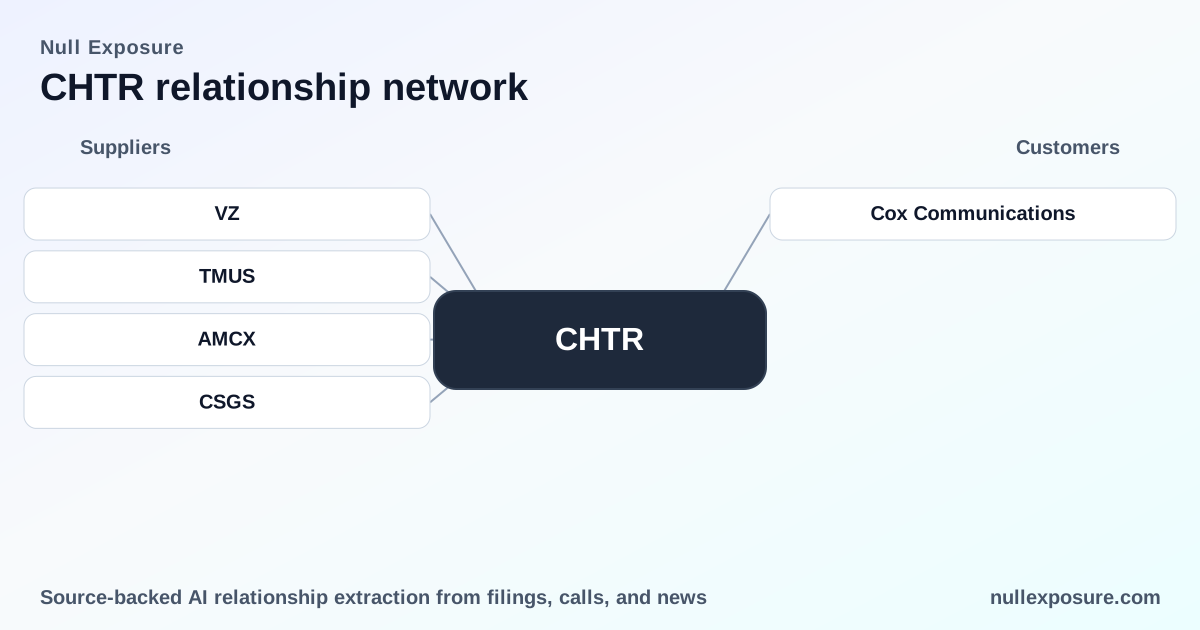
Charter Communications (CHTR) — Customer relationships drive predictable subscription cashflow and scale
Charter operates and monetizes as a national broadband and pay-television platform under the Spectrum brand, selling subscription-based Internet, mobile, video, voice and commercial services to households and businesses across the U.S. The business converts scale into high-margin recurring cashflow (TTM revenue $54.64bn; EBITDA $21.97bn) by layering bundled pricing, regional content rights and wholesale connectivity services. Approximately 89% of revenue is generated from monthly subscriptions, creating strong revenue visibility and high operational leverage for network and customer-care investments. Learn more at https://nullexposure.com/.
Why customers matter: a concise investor thesis
Charter’s customer base is its moat: high subscription stickiness, multi-year contracts, and diversified counterparty mix from individual consumers to large enterprises support durable free cash flow and a capital-intensive but defensible infrastructure business. For investors, the key levers are subscriber retention, ARPU migration to higher-speed tiers, and the company’s ability to integrate large footprint acquisitions while preserving margin. A mid-decade acquisition program expands addressable markets but requires careful monitoring of churn and integration cost. For institutional readers evaluating customer relationships, focus on contract tenor, counterparty concentration, and how wholesale or partnership arrangements translate into revenue and cost synergies.
How Charter structures customer relationships in practice
Charter’s operating model is characterized by subscription-dominant contracts, material contract duration, broad counterparty mix, and U.S.-centric geography:
- Contracting posture: Charter sells primarily monthly subscription services with about 89% of revenue from subscription fees, and a weighted-average contractual term around three years when long-term commitments exist, implying stable recurring revenue and predictable churn patterns (company filings, years ended Dec 31, 2025 and 2024).
- Counterparty concentration: Revenue comes from a mix of individual residential customers and business clients ranging from small business to large enterprise, and Charter also provides wholesale connectivity to carriers—reducing single-buyer concentration but increasing exposure to broadband competition.
- Relationship criticality and maturity: Broadband and video are critical services for customers and often embedded in consumer monthly budgets, which supports retention; many relationships are active and mature across established markets in 41 U.S. states.
- Geography and role: The company operates exclusively in North America and functions primarily as a service provider, owning the customer relationship while supplying connectivity and content.
These constraints imply a business that is capex-intensive but predictable, where customer lifecycle economics and integration of new customer pools (e.g., from acquisitions) determine near-term earnings trajectory.
Notable customer and partner mentions you should evaluate
Below are every relationship referenced in available coverage, summarized plainly with sourcing.
Liberty Broadband (LBDAV)
Charter has historically used equity subscriptions with Liberty Broadband to support transformational deals; in the Time Warner Cable transaction era Liberty agreed to purchase newly issued Charter shares totaling billions of dollars to support the combined company’s capitalization. Source: Patch.com coverage of the Charter–Time Warner Cable/Advance-Newhouse transaction (discussing FY2015 equity commitments), https://patch.com/connecticut/stamford/charter-communications-acquire-time-warner-cable-78-billion-0.
Comscore (SCOR)
Comscore disclosed lower data costs following an amendment to its data license agreement with Charter, indicating Charter’s role as a material data partner to measurement firms and the potential for commercial terms to shift economics for analytics vendors. Source: InsiderMonkey transcript of Comscore Q4 2025 earnings call (mentions a 2024 amendment to a data license agreement with Charter), https://www.insidermonkey.com/blog/comscore-inc-nasdaqscor-q4-2025-earnings-call-transcript-1720439/.
CARV (small-business lending initiative)
Charter provided a US$1.5 million loan to support a small-business credit initiative referenced by CARV, demonstrating Charter’s occasional role as a fintech backer for community or channel programs that extend commercial relationships beyond pure connectivity. Source: CEO Magazine executive interview (reporting a US$1.5m loan from Charter, FY2022 context), https://www.theceomagazine.com/executive-interviews/finance-banking/michael-t-pugh/.
Cox Communications
Recent coverage highlights a strategic acquisition of Cox’s footprint, which expands Charter’s customer base and gives the company new customers to convert to Spectrum’s pricing and product stack—an integration that materially affects near-term customer mix and revenue synergies. Source: SahmCapital article on Charter’s Cox transaction and operational outlook (March 2026), https://www.sahmcapital.com/news/content/charter-cox-deal-and-new-coo-reshape-growth-and-risk-outlook-2026-03-06.
What these relationships mean for investors and operators
- Capital partnership and equity support are precedent drivers of large deal financing. The Liberty Broadband example shows Charter uses shareholder-aligned capital commitments to underwrite major transactions that expand scale.
- Vendor and data-license relationships can be financially consequential. The Comscore amendment underscores that Charter’s data and distribution terms influence third-party cost structures.
- Strategic loans and community programs extend customer engagement. Targeted financing (e.g., the CARV example) can deepen commercial ties in local markets and support SMB acquisition or retention.
- Roll-up of regional operators materially changes customer composition. The Cox transaction creates immediate scale and upsell opportunities, but execution determines whether cost synergies and churn discipline materialize.
Risk and upside in plain terms
- Upside: High-margin subscription cashflow, scale benefits on network economics, and ARPU expansion from product bundling and migration to higher-speed tiers.
- Risk: Integration execution for large acquisitions, regulatory and competitive pressures in broadband, and any erosion in subscription retention would pressure margin and cash generation.
How to use this intelligence
For portfolio managers and operators, prioritize due diligence on contract tenors, post-acquisition churn rates, and the treatment of data-license and wholesale agreements that can shift margin for both Charter and its partners. If you want ongoing tracking and deeper relationship mapping for Charter, see additional coverage at https://nullexposure.com/ — the research platform consolidates disclosed partner agreements and public mentions into a single operational view.
Bold takeaway: Charter’s revenues are predominantly subscription-driven, its customer base spans consumers to large enterprises, and partner agreements (equity, data, acquisitions) materially shape near-term cashflow and strategic options.