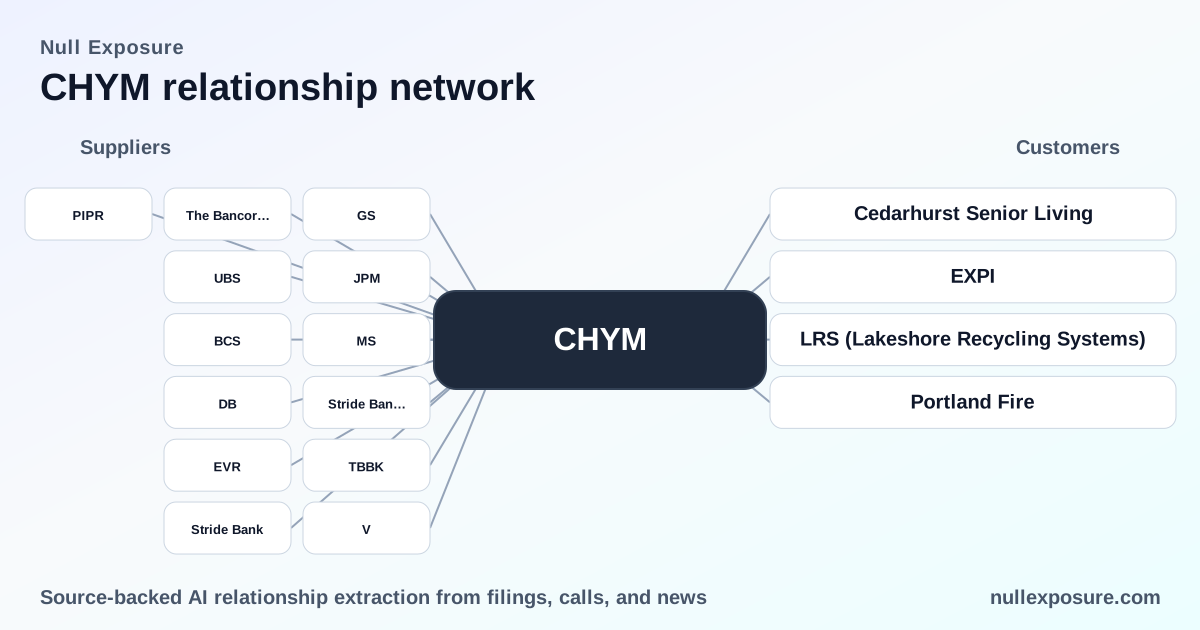
Chime Financial (CHYM): Customer relationships that broaden distribution and shorten the path to deposits
Chime Financial operates as a consumer-facing fintech platform offering digital banking and payment services and increasingly monetizes through interchange, interest and platform partnerships—both direct-to-consumer and white‑label/enterprise channels such as Chime Workplace. The company is scaling by converting enterprise and brand partnerships into fee-free deposit accounts and card spend, supported by a $2.19 billion revenue run‑rate and a market capitalization near $8.48 billion, even while EBITDA remains negative. Investors should view Chime’s customer relationships as distribution and engagement tools that trade near-term profitability for faster deposit growth and higher lifetime interchange. For additional background on how we track partner signals, visit https://nullexposure.com/.
Operationally, Chime combines a consumer app with B2B enterprise offerings and marketing/sponsorship deals. This mix creates multiple monetization vectors—transaction revenue from consumer card use, interest spread, and enterprise subscription or integration fees—while also concentrating risk in the company’s ability to convert partnerships into active deposit relationships.
What the customer list signals about Chime’s go-to-market
Chime’s recent relationship set shows a deliberate strategy: enterprise workplace rollouts (frontline and distributed workforces), brand and sports sponsorships for audience reach, and education/CSR partnerships for long-term behavioral adoption. These relationships are neither accidental nor experimental; they map directly to Chime’s core objective of adding low‑friction deposit and spend customers via third‑party distribution.
- Contracting posture: Chime is executing flexible, multi‑year commercial agreements (workplace integrations and league sponsorships) rather than one-off co-marketing, which signals an orientation toward durable distribution contracts.
- Concentration: The current roster is diversified across industries—healthcare/housing, real estate brokers, waste services, professional sports, and education—reducing single‑partner concentration risk.
- Criticality: Partnerships range from strategic (MLS multi-year retail banking partnership) to tactical (single-employer workplace deployments); the strategic deals provide national reach and branding leverage, while employer rollouts add predictable customer acquisition flows.
- Maturity: Several relationships are new additions in FY2026, indicating an early-growth phase for Chime’s enterprise channel where scale is still being proven.
Relationship coverage — what’s in the FY2026 feed
Below are plain-English summaries of each relationship item surfaced in the FY2026 results, with source context.
-
Cedarhurst Senior Living — Cedarhurst has adopted Chime Workplace to deliver financial wellness benefits to its frontline caregiving and operations teams, targeting stability and reliability in employee pay and benefits. According to a Sahm Capital news release dated February 23, 2026, the move is positioned as part of Cedarhurst’s broader workforce investment strategy (SahmCapital, 2026-02-23: https://www.sahmcapital.com/news/content/chime-enterprise-adds-new-employer-partners-as-demand-grows-for-comprehensive-financial-wellness-2026-02-23).
-
EXPI (eXp Realty) — eXp Realty selected Chime Workplace to provide scalable, fee‑free financial tools that fit its flexible, cloud‑based operating model, potentially giving Chime access to a distributed salesforce and recurring employee deposit flows. This selection was also reported in the Sahm Capital release on February 23, 2026 (SahmCapital, 2026-02-23: https://www.sahmcapital.com/news/content/chime-enterprise-adds-new-employer-partners-as-demand-grows-for-comprehensive-financial-wellness-2026-02-23).
-
eXp Realty (duplicate entry) — The same eXp Realty announcement appears a second time in the results feed, reinforcing that Chime is targeting high‑volume, distributed professional networks as a scale channel. The duplicate is recorded in the same Sahm Capital piece (SahmCapital, 2026-02-23: https://www.sahmcapital.com/news/content/chime-enterprise-adds-new-employer-partners-as-demand-grows-for-comprehensive-financial-wellness-2026-02-23).
-
LRS (Lakeshore Recycling Systems) — LRS adopted Chime Workplace to support financial health across frontline and field operations, with the stated goal of reducing financial stress that can affect safety and performance; this is a classic play to monetize employee spend and payroll-related flows. Sahm Capital covered the adoption on February 23, 2026 (SahmCapital, 2026-02-23: https://www.sahmcapital.com/news/content/chime-enterprise-adds-new-employer-partners-as-demand-grows-for-comprehensive-financial-wellness-2026-02-23).
-
Major League Soccer (MLS) — Chime entered a multi‑year partnership with MLS as the league’s Official Retail Banking, Credit Card, and Debit Card Partner, an arrangement expected to expand Chime’s national brand reach and direct consumer acquisition through fans and sponsorship activations. This deal was reported in Sahm Capital’s March 1, 2026 coverage focused on Chime’s expanded workplace platform and MLS agreement (SahmCapital, 2026-03-01: https://www.sahmcapital.com/news/content/chime-financial-expands-workplace-platform-and-mls-deal-to-tackle-losses-2026-03-01).
-
Portland Fire — Chime was named the Official Banking and Credit Partner of the Portland Fire, including jersey placement and local fan engagement, which supports regional brand building and targeted customer acquisition in a WNBA market. Sahm Capital reported the Portland Fire partnership on January 27 and January 29, 2026 in two related items announcing the deal and its fan/valuation implications (SahmCapital, 2026-01-27 and 2026-01-29: https://www.sahmcapital.com/news/content/portland-fire-names-chime-as-official-banking-and-credit-partner-chime-to-be-featured-on-fire-jerseys-2026-01-27 and https://www.sahmcapital.com/news/content/chime-financial-portland-fire-deal-puts-fan-growth-and-valuation-in-focus-2026-01-29).
-
Knowlej — Knowlej launched a Financial Futures campaign “powered by Chime,” a financial literacy initiative targeted at middle and high school students that positions Chime as the technology partner behind educational challenges designed to drive early adoption and long-term customer relationships. The announcement was published by Sahm Capital on April 18, 2026 (SahmCapital, 2026-04-18: https://www.sahmcapital.com/news/content/knowlej-and-chime-launch-financial-futures-campaign-to-help-students-build-financial-confidence-and-strengthen-engagement-in-school-2026-04-18).
Why these relationships matter for investors
- Distribution scale without incremental CAC on advertising: Employer rollouts and league sponsorships shift acquisition toward partner-driven onboarding, which lowers direct marketing spend and leverages partners’ payroll or fan engagement mechanics to activate accounts.
- Diverse acquisition vectors: Chime is not reliant on one channel; workplace integrations, sports partnerships, and educational programs target different lifetime value cohorts.
- Branding and retention lift: High‑visibility deals (MLS, Portland Fire) are designed for sustained brand salience, which supports card spend and interchange—core revenue drivers.
Key risks and watch items
- Conversion efficiency: These partnerships generate signups, but the investment thesis depends on converting those users into depositors and card spenders at scale. Monitor customer activation and average account economics.
- Profitability timing: Chime reported negative EBITDA even as revenue scales; partnerships often frontload acquisition costs before margin accretion.
- Contract terms and exclusivity: Multi‑year relationships are beneficial if Chime retains exclusive retail/credit rights; investor diligence should prioritize contract scope and termination clauses (company filings and press releases will be decisive).
Bottom line and next steps
Chime’s FY2026 customer relationships show an intentional mix of enterprise workplace rollouts for predictable deposit flow, and sports/education partnerships for brand and cohort development. These align with a growth-first model that leverages third‑party distribution to accelerate card spend and deposits while the company repairs margins. For a deeper view of partner signals and how they drive customer economics, explore our tracking and research at https://nullexposure.com/.
Bold takeaway: partnerships are the lever that converts marketing into lasting deposit and interchange revenue for Chime — the question for investors is whether conversion and unit economics will close the path from signups to sustainable profitability.