Cigna (CI) customer relationships: where revenue concentration, government contracts and strategic partners shape risk and opportunity
Cigna operates as a global managed-care and health services platform that monetizes through employer- and group-based insurance premiums, pharmacy benefit management and related health services delivered across its Cigna Healthcare and Evernorth segments. The company’s revenue mix combines recurring, contract-driven cashflows from large national accounts and governments with fee-for-service and pass-through pharmacy arrangements where a single pharmacy benefit client represented roughly 16% of consolidated revenues in 2024. For a consolidated view of Cigna’s customer signals and how investors should think about counterparty risk, see NullExposure’s overview at https://nullexposure.com/.
The business model in plain language: pricing power, contract structure and concentration
Cigna sells health benefit products primarily to employers and other groups, and it runs a substantial health-services business through Evernorth Health Services, which includes pharmacy benefit management (PBM) and specialty care capabilities. This structure produces two distinct monetization streams: underwritten, premium-based revenue from employer and government accounts and services and fee-based revenue from PBM and care management. According to company filings for the year ended December 31, 2024, U.S. federal government agencies accounted for approximately 11% of consolidated revenues, underscoring the material role of public-sector contracts in the revenue base.
The operating model combines long-term, negotiated contracts for large national accounts and government programs with high-volume pass-through pharmacy arrangements where Cigna often acts as the principal in dispensing and billing. Company disclosures show a material concentration signal—revenues from a single pharmacy benefit client were approximately 16% of consolidated revenues in 2024—which drives both leverage and single-counterparty risk for the enterprise.
Primary customer relationships identified in recent reporting
Huize (HUIZ): product co-development in global critical-illness insurance
Cigna has a co-development relationship with Huize on a children’s critical-illness product called Xiaotao T Global, which was created alongside CMB Life Insurance to provide overseas client settlement and overseas medical support as part of Huize’s global expansion strategy. This partnership reflects Cigna’s role in enabling cross-border insurance and medical assistance services, particularly in China-facing products. The detail was disclosed in a Huize earnings call transcript published March 10, 2026 by The Motley Fool, referencing Huize’s FY2025 strategy.
Health Care Services Corporation (HCSC): divestitures reduced medical customers
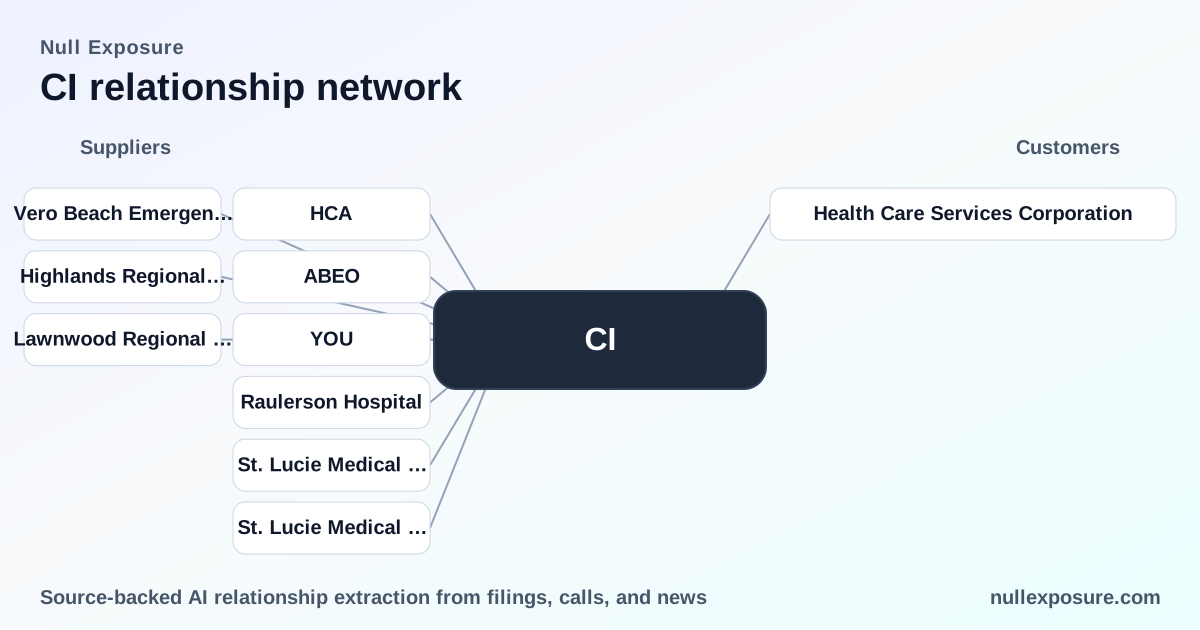
A March 9, 2026 report referencing Zacks noted that a decline in Cigna’s medical customers was driven in part by divestitures to Health Care Services Corporation, which has reduced Cigna’s customer counts and contributed to an elevated expense profile in certain periods. This is an investor-relevant operational dynamic because customer count shifts tied to strategic divestitures can materially affect near-term revenue trends and margin timing.
What the relationship signals collectively tell investors about Cigna’s contracting posture
- Counterparty diversity spans the spectrum: Filings and segment descriptions identify customers from small employers (2–50 employees) through mid-market (500–2,999 employees), very large national accounts (3,000+ employees), and government agencies. This breadth gives Cigna scale but creates a multi-modal contracting posture: long negotiated deals with national accounts and governments sit alongside standardized offerings to small groups.
- Global reach with localized partners: The company brands itself as a global health platform; partnerships like the Huize co-development emphasize local-market collaboration to extend services internationally, which is a deliberate go-to-market approach where Cigna supplies capabilities and distribution partners localize products.
- High service criticality in PBM and Evernorth: Evernorth is framed as a core services pillar—PBM and specialty care services are mission-critical to clients’ benefit delivery. Company disclosures indicate PBM revenues are derived from providing pharmacy benefit management services, and Cigna often acts as the principal in pharmacy arrangements, reinforcing operational centrality and settlement risk.
- Concentration and single-client risk: The presence of a single pharmacy client representing approximately 16% of consolidated revenues in 2024 is a structural concentration that elevates counterparty risk and potential volatility in the event of contract renegotiation or loss. Investors should treat this as a top-line and cashflow sensitivity.
(Company filing references: revenues from U.S. Federal Government agencies and the single pharmacy benefit client figures are reported in Cigna’s annual disclosures for the year ended December 31, 2024.)
Investment implications: catalysts, risks and what to monitor
Cigna’s profile presents asymmetric outcomes: scale, high recurring premium income and an integrated PBM business provide durable cashflow and margin expansion potential, while concentration and portfolio changes introduce runway risk. Key items for investment monitoring:
- Contract renewals and pricing with the large pharmacy client—any change materially affects revenue and working capital.
- Government contract exposure—federal programs represented roughly 11% of consolidated revenues in 2024, and shifts in government sourcing or regulation will influence utilization and reimbursement.
- Divestiture activity and customer migration—observations such as the report on divestitures to HCSC that reduced medical customers should be tracked for revenue trend implications and restructuring costs.
- International partnerships and distribution—co-developed products like the Huize collaboration demonstrate growth through local partnerships, particularly in Asian markets; monitor rollout cadence and revenue contribution.
Actionable checklist for due diligence:
- Confirm the status and renewal timeline of the top PBM client contract.
- Review recent filings for the impact of divestitures and the associated customer flows to HCSC.
- Track Evernorth margin trends to understand whether service revenues scale profitably.
- Evaluate regulatory developments affecting government reimbursements and PBM contracting.
For a concise investor-facing dashboard that consolidates customer-level signals and concentration metrics, see NullExposure’s analysis hub: https://nullexposure.com/.
Final read: balance size with concentrated exposures
Cigna’s strength is its diversified product set and scale across employer, government and services channels, anchored by Evernorth’s PBM capabilities. The countervailing risk is concentration—both a single large pharmacy client and the economic implications of divestitures that shift customer counts to peers such as HCSC. Investors should weigh Cigna’s resilient premium base and global distribution against these asymmetric counterparty risks when assessing valuation and downside scenarios.